Should you study
vocabulary before bed?
Yes — and the lever is the gap, not the hour. Gais, Lucas and Born (2006) had students learn vocabulary at 3 p.m. or 9 p.m. and found the benefit tracked how little waking time sat between learning and sleep, not the time on the clock. Across 271 samples the sleep benefit for this kind of memory is moderate and reliable (g = 0.44, Berres & Erdfelder, 2021), and its largest measured component is protection: word pairs slept on survived later interference at 76% against 32% awake (Ellenbogen et al., 2006).
Every figure on this page is referenced at the end
What the sleep studies actually measured
Sleep is the only stretch of the day in which your memory for something gets measurably better while you do nothing at all. That is a strange enough claim to be worth checking against the experiments rather than the summaries of them. The design is nearly always the same: two groups learn identical material, one retention interval contains sleep and the other does not, and both are tested after the same number of hours.
Read the third column as effect sizes rather than promises. These are word lists and paired associates, tested over days rather than years, on people who mostly slept normally.
| Study | What it compared | What it found |
|---|---|---|
| Gais, Lucas & Born (2006) | School students learning English vocabulary at 3 p.m. or at 9 p.m., then sleeping or being kept awake | Retention improved when sleep followed learning within a few hours, independent of the time of day, and the advantage was still there at 48 hours |
| Ellenbogen et al. (2006) | Word pairs recalled after 12 hours of sleep or of waking, with and without competing pairs learned just before the test | With interference, 76% recalled after sleep against 32% after waking; without it, 94% against 82% — most of what sleep bought was protection |
| Mazza et al. (2016) | Sixteen French–Swahili pairs practised twice, 12 hours apart, with the gap being either a night or a day | Sleeping between the sessions halved the practice needed to relearn; a week later that group recalled about 15 pairs against 11, and an advantage remained at six months |
| Berres & Erdfelder (2021) | Meta-analysis of 823 effect sizes from 271 independent samples, published between 1967 and 2019 | A moderate and robust overall sleep benefit for episodic memory, g = 0.44 — worth having, and not a transformation |
| Lahl et al. (2008) | A 30-word list recalled after an hour spent awake, napping, or napping only very briefly | Napping beat staying awake, and a nap averaging about six minutes was already enough to produce a benefit |
None of these is a study of language learning as a whole. They measure retention of verbal material over hours and days, which is the part of language learning most exposed to forgetting, and the effect sizes are moderate. Sleep multiplies the review that happened; it does not stand in for one.
Three different claims travel under “study before bed”
They have wildly different evidence behind them, which is why the advice manages to sound obvious and suspicious at the same time. Only the first one is well supported.
- The supported one: sleep soon after learning. What Gais and colleagues varied was the length of waking time between the session and sleep, not the hour it happened. A review at ten followed by sleep at eleven is the condition that helped; a review at ten followed by four hours awake is not.
- The overstated one: a magic hour. Time-of-day effects on learning exist, but they are small and person-specific, and in the vocabulary experiment the afternoon and evening groups did not differ once the interval to sleep was matched. Your evening slot is good because sleep follows it.
- The false one: learning new words while asleep. Playing a word list to a sleeping person does not teach it to them. What laboratories can do is cue words already studied before bed and measure a small improvement (Schreiner & Rasch, 2015) — reactivation of an existing memory, in a sleep lab, on material learned awake. It is not a shortcut, and it is not something an app should claim.
Sleep is one interval among several. What happens to a word across all the others is on why you forget vocabulary.
What the evidence supports doing
Six requirements, each taken from one of the studies above, and each cheap enough to satisfy tonight. Notice how few of them are about studying harder: five are about placement, and one is about deliberately doing less.
| What to do | What the evidence says | What that looks like |
|---|---|---|
| Put the last review near sleep | Gais et al. (2006): the shorter the waking interval between learning and sleep, the larger the retention benefit | What matters is the last review before you sleep, not one at a fixed hour — on a late night move it later rather than dropping it |
| Keep it small enough to cost no sleep | Yoo et al. (2007): a night without sleep reduced hippocampal activity during encoding, so lost sleep is paid for again the next day | Spending an hour of sleep to gain an hour of study loses in both directions; a few minutes is the size that fits |
| Retrieve, don't reread | Roediger & Karpicke (2006): being tested on material produced better long-term retention than restudying it | Try to produce the word before you see the answer — a card you read through is worth much less than one you attempted |
| Take the second pass in the morning | Mazza et al. (2016): the session that came after a night of sleep needed about half the practice and retained far better | The morning pass is the cheap one — the same words cost less to bring back and stay longer once slept on |
| Don't stack competing material after it | Ellenbogen et al. (2006): interference imposed before the test cut waking recall to 32% while slept-on recall held at 76% | Sleeping soon after the review is what protects it from the next thing you learn; a second unrelated list right afterwards gives part of that back |
| Count a nap | Lahl et al. (2008): a nap averaging about six minutes already improved recall of a 30-word list compared with staying awake | You do not need the whole night for the effect to begin — a short daytime sleep after a review is a real, smaller version of it |
Only the second row asks you to do less. The rest are about where the review sits relative to sleep, which is what makes this one of the few levers in language learning that costs no extra minutes at all.
The trade the folklore gets backwards
The popular version of this advice ends up recommending late-night study, which is close to the opposite of what the experiments support. Sleep is not the empty time between two study sessions. In the standard account it is where consolidation happens — hippocampal traces replayed and gradually redistributed to cortical storage, largely during slow-wave sleep (Diekelmann & Born, 2010; Rasch & Born, 2013). Shortening the night to add study time removes the process the study time was supposed to feed.
It also costs the next day. Yoo, Hu, Gujar, Jolesz and Walker (2007) scanned people encoding new material after a night without sleep and found reduced hippocampal activity during encoding, with worse retention afterwards. Sleep before learning and sleep after learning are two separate jobs, and a short night damages both. That is the practical reason the pre-sleep review has to stay small: it is competing directly with the thing that makes it work.
The ceiling deserves stating too. A meta-analytic g of 0.44 (Berres & Erdfelder, 2021) is a moderate effect, not a method. Sleep will not consolidate a word you never met, and the oldest result in this literature — Jenkins and Dallenbach's 1924 comparison of retention across sleep and waking — is a century old precisely because the effect is modest, reliable and easy to reproduce rather than because it is dramatic. Treat it as a multiplier on whatever review actually happened, and the question stops being what time to study and becomes whether the last review happens at all.
What a night apart from the review costs
Sleep advice gets moralised, and moralised advice is easy to wave away. Measured costs are harder to dismiss. Each row below is something an experiment put a number on, and together they explain why the last few minutes before sleep are worth more than the same minutes anywhere else in the day.
Three of these are losses. The fourth is the one that is paid forward rather than backward, and it is the reason a late study session is a worse deal than it looks.
| What is lost | Evidence | Measured size |
|---|---|---|
| Protection from interference | Ellenbogen et al. (2006), word pairs with competing pairs learned before the test | 76% against 32% — the largest single gap in this table, and it is entirely about what happened after learning |
| The cheap second pass | Mazza et al. (2016), two practice sessions 12 hours apart | Roughly half the practice to relearn, and about 15 pairs against 11 recalled a week later |
| The spacing advantage | Cepeda et al. (2006), synthesising 254 studies of distributed practice | About 47% spaced against 37% massed — and a night is the cheapest gap you will ever insert |
| Tomorrow's encoding | Yoo et al. (2007), learning new material after a night of sleep deprivation | Reduced hippocampal activity while encoding and worse retention afterwards — this one is charged to the following day |
None of this argues for perfection. Gais and colleagues found the benefit stable across 48 hours, and Mazza's group still measured an advantage six months later, so a slept-on word is durable rather than fragile. What a broken night costs you is that night's words, not the vocabulary you already have.
The two unlocks that bracket a night
If the last review before sleep is the one that counts, the hard part is not knowing that. It is being tired at eleven at night and willing to open a study app anyway. LearnScreen removes that step by putting the review inside something already happening at exactly that hour.
The last unlock already happens
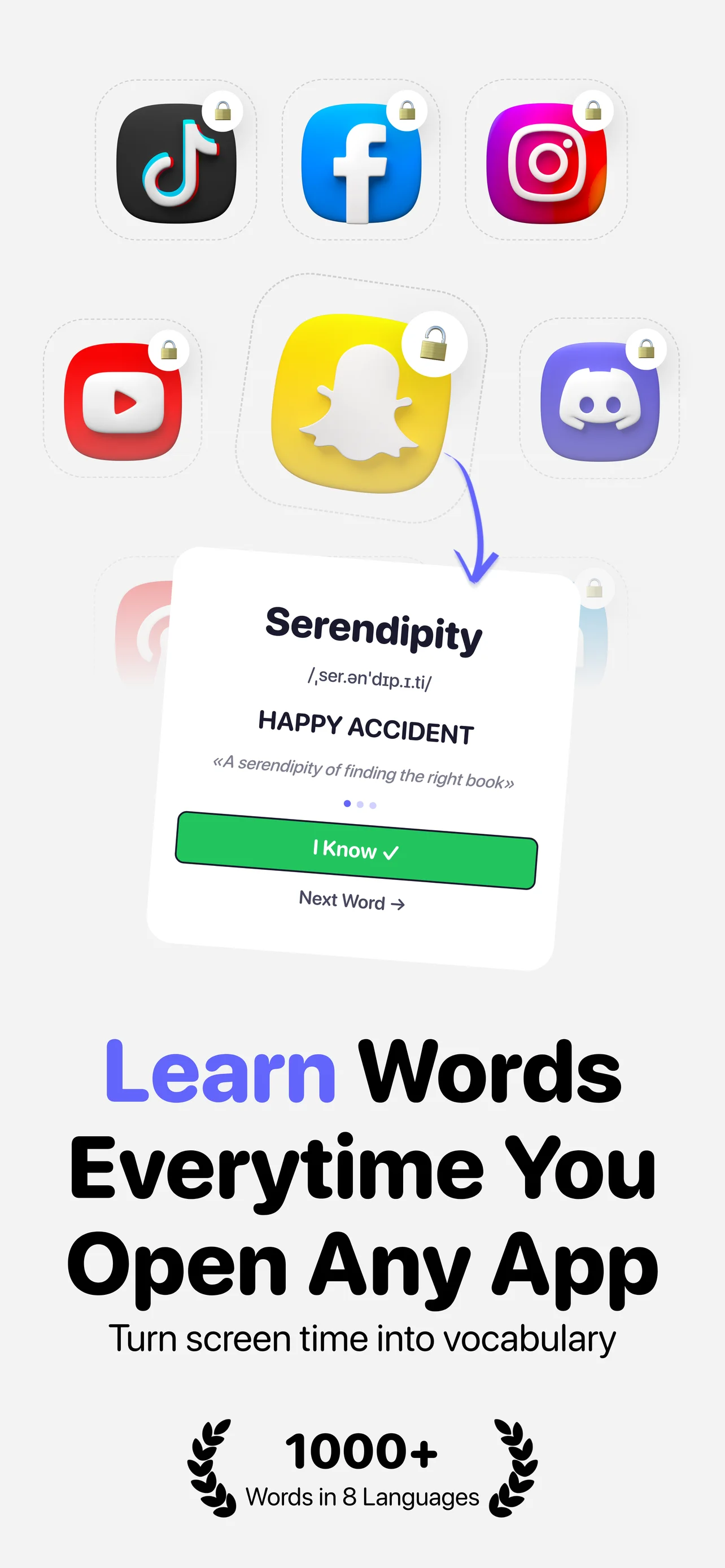
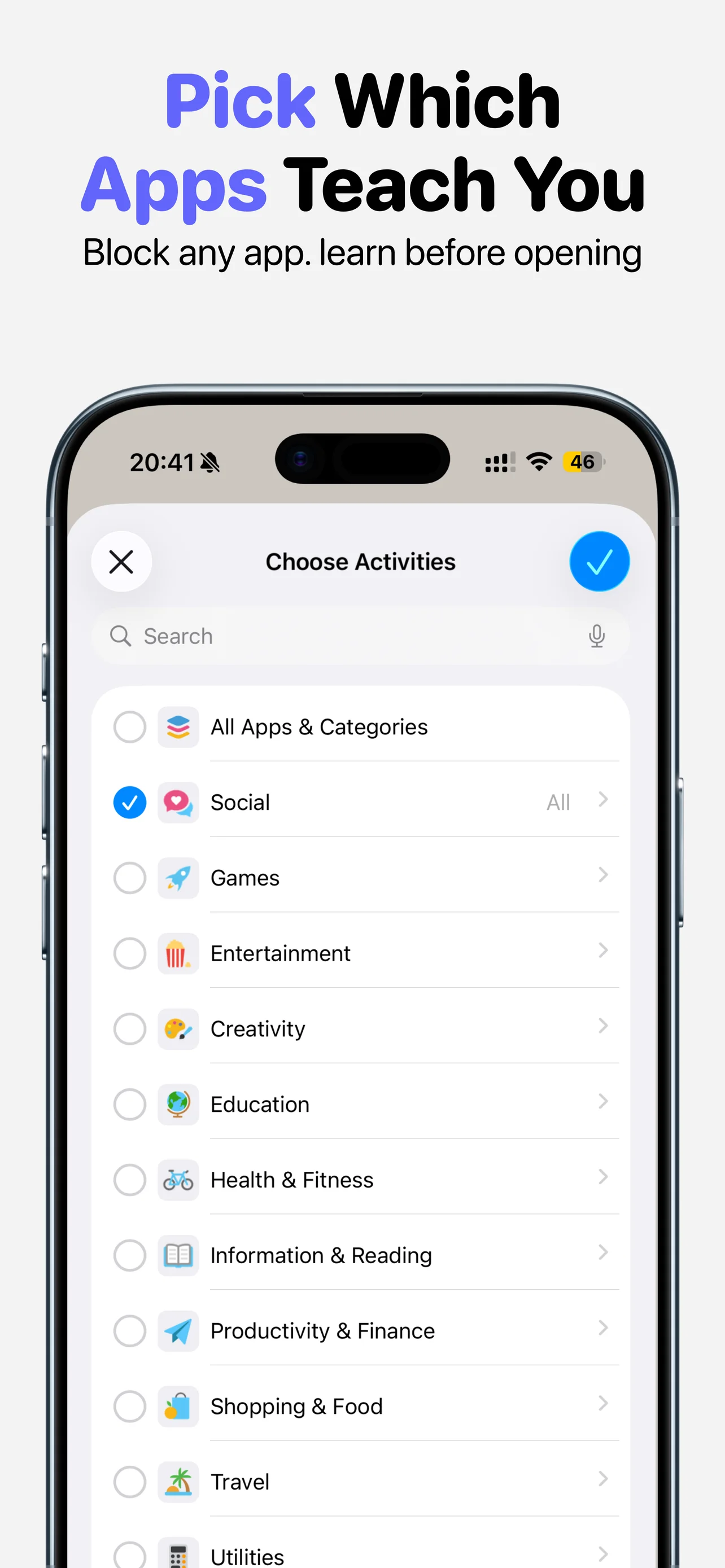
Phones get checked about 186 times a day, roughly 11.6 times per waking hour (Reviews.org, 2026), and the late-evening scroll is one of them. Apple's Screen Time API lets LearnScreen shield the apps you choose and put a word card where the feed would have been, so the pre-sleep review is the thing you were going to do anyway.
The morning unlock is the cheap test
Mazza and colleagues found the session after a night of sleep needed about half the practice of the same session after a day awake. The first reach for the phone in the morning is that session: the same words, attempted again, at the point the research says they cost the least.
Nothing runs while you sleep
No audio, no overnight notifications, nothing scheduled to fire in the dark. Cards appear only once you have unlocked the phone and opened a shielded app. That is deliberate: there is no evidence for learning new material during sleep, and a notification that wakes you would cost more than the review is worth.
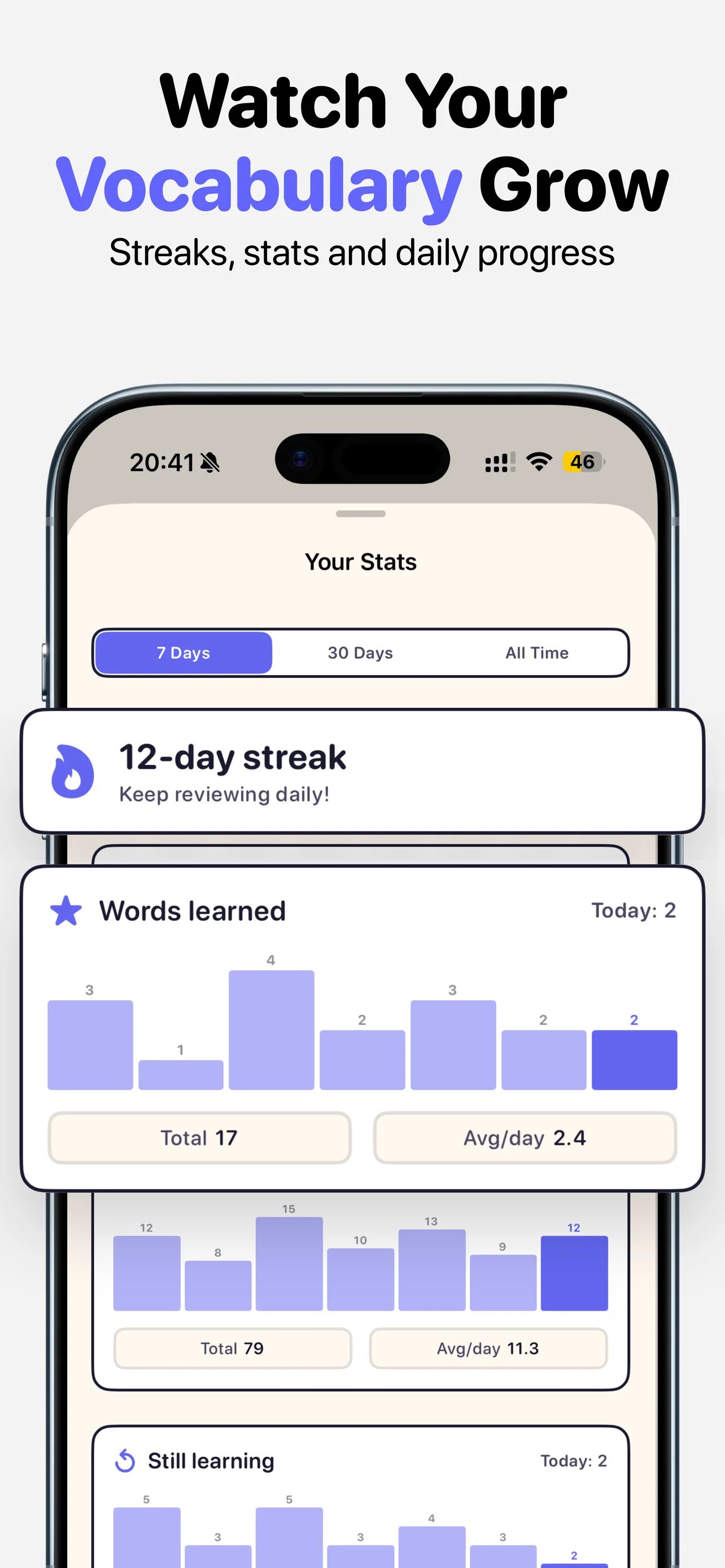
- You set the dose. Words per session adjust from 3 to 20, as does how often the shield returns — the defaults come to roughly 25 recall attempts a day, about two and a half minutes spread across it, which is small enough to sit in the last hour without taking anything from sleep.
- The answer stays hidden until you tap. Each card is a recall attempt rather than a reading, which is the direction that transfers: active versus passive vocabulary.
- A Leitner schedule decides what comes back. Words you got wrong return sooner and words you got right back off geometrically, so the evening cards are the ones actually due rather than a fixed list you work through.
- It works offline, with no account. Cards and shields run without a network once installed; iCloud backup writes to your own private database rather than our servers, and there is nothing to sign up for.
Related reading
- Why do I forget vocabulary I've learned? — what happens to a word between encounters, awake as well as asleep.
- How often should you review vocabulary? — the intervals that follow the first night.
- How many minutes a day do you need? — the budget the evening review has to fit inside.
- How do you stop quitting a language? — whether the last review happens at all.
- Does passive learning actually work? — what exposure alone delivers, and where it stops.
Frequently asked questions
Sources
- Gais, S., Lucas, B., & Born, J. (2006). Sleep after learning aids memory recall. Learning & Memory, 13(3), 259–262.
- Ellenbogen, J. M., Hulbert, J. C., Stickgold, R., Dinges, D. F., & Thompson-Schill, S. L. (2006). Interfering with theories of sleep and memory: Sleep, declarative memory, and associative interference. Current Biology, 16(13), 1290–1294.
- Mazza, S., Gerbier, E., Gustin, M.-P., Kasikci, Z., Koenig, O., Toppino, T. C., & Magnin, M. (2016). Relearn faster and retain longer: Along with practice, sleep makes perfect. Psychological Science, 27(10), 1321–1330.
- Berres, S., & Erdfelder, E. (2021). The sleep benefit in episodic memory: An integrative review and a meta-analysis. Psychological Bulletin, 147(12), 1309–1353.
- Lahl, O., Wispel, C., Willigens, B., & Pietrowsky, R. (2008). An ultra short episode of sleep is sufficient to promote declarative memory performance. Journal of Sleep Research, 17(1), 3–10.
- Diekelmann, S., & Born, J. (2010). The memory function of sleep. Nature Reviews Neuroscience, 11(2), 114–126.
- Rasch, B., & Born, J. (2013). About sleep’s role in memory. Physiological Reviews, 93(2), 681–766.
- Schreiner, T., & Rasch, B. (2015). Boosting vocabulary learning by verbal cueing during sleep. Cerebral Cortex, 25(11), 4169–4179.
- Yoo, S.-S., Hu, P. T., Gujar, N., Jolesz, F. A., & Walker, M. P. (2007). A deficit in the ability to form new human memories without sleep. Nature Neuroscience, 10(3), 385–392.
- Jenkins, J. G., & Dallenbach, K. M. (1924). Obliviscence during sleep and waking. American Journal of Psychology, 35(4), 605–612.
- Cepeda, N. J., Pashler, H., Vul, E., Wixted, J. T., & Rohrer, D. (2006). Distributed practice in verbal recall tasks: A review and quantitative synthesis. Psychological Bulletin, 132(3), 354–380.
- Roediger, H. L., & Karpicke, J. D. (2006). Test-enhanced learning: Taking memory tests improves long-term retention. Psychological Science, 17(3), 249–255.
- Murre, J. M. J., & Dros, J. (2015). Replication and analysis of Ebbinghaus’ forgetting curve. PLOS ONE, 10(7), e0120644.
- Reviews.org (2026). Cell Phone Usage Stats. Survey of ~1,000 US adults, fielded Q4 2025. Report
These are laboratory studies of verbal memory, run mostly on young adults with ordinary sleep and tested over hours to days rather than years, so the specific percentages belong to the materials each study used and the overall effect is moderate rather than large. Sleep timing interacts with age, shift work, medication and sleep disorders in ways none of this addresses, and nothing here is medical advice about sleep. Card counts and daily totals are arithmetic from a roughly twenty-second recall attempt, not measured app data.
Put the last review where it already fits
LearnScreen turns the phone you check before bed, and again on waking, into the two encounters the sleep research values most — without adding a session, a notification, or a minute of lost sleep.
Download on the App Store