How many minutes a day
to learn a language?
Fifteen minutes a day is 91 hours a year. Set against the 600–750 hours the US Foreign Service Institute budgets for an English speaker to reach professional proficiency in Spanish or French — and 2,200 for Japanese, Chinese or Korean — that is years, not months. Which is why the honest answer is not a number of minutes but a shape: the same total retains far better distributed than massed (Cepeda et al., 2006), so many short recall attempts beat one protected block. The minutes that survive a busy week are the ones attached to something you already do.
Every figure below is sourced at the end of the page
What each daily time budget adds up to
A daily minute count is a promise about a year. Multiply by 365 and divide by 60 and you have the annual hours — the only number that can be compared with the published estimates of how long a language takes. Ten minutes a day is 61 hours a year. Half an hour is 183. An hour a day, every day without exception, is 365.
The two right-hand columns measure those hours against the Foreign Service Institute's training estimates: about 600–750 hours to professional proficiency in Spanish, French, Italian or Portuguese, and about 2,200 for Japanese, Chinese or Korean.
| Minutes/day | Hours/year | To 600 h (Spanish, French) | To 2,200 h (Japanese, Korean) |
|---|---|---|---|
| 5 | ~30 h | ~20 years | ~72 years |
| 15 | ~91 h | ~6 ½ years | ~24 years |
| 30 | ~183 h | ~3 ¼ years | ~12 years |
| 60 | ~365 h | ~1 ½ years | ~6 years |
| 90 | ~548 h | ~1 year | ~4 years |
These rows assume you never miss a day, which nobody does — a realistic five-days-a-week habit stretches every figure by about 40%. The FSI hours describe intensive small-group instruction with a teacher plus homework, aimed at a professional standard most learners never target, so treat them as a ceiling on the scale of the task rather than a personal deadline.
Why the total is the wrong number to optimise
Those year-columns look discouraging because they treat an hour as an hour. Memory does not. The same sixty minutes can produce a handful of durable words or almost none, depending entirely on how it is cut up and what you do inside it.
- Hours are not interchangeable. Cepeda and colleagues (2006) synthesised 254 studies of distributed practice and found the same total study time retains substantially better spread out than massed, so a long session is not a short one scaled up.
- The FSI hours buy a different target. They lead to professional working proficiency with a teacher; the first 1,000 word families already cover about 80% of everyday speech (Nation, 2006), and that is reachable in months at a few minutes a day.
- Scheduled minutes are the first to be cancelled. A daily block competes with everything else in your day, and a skipped day is not neutral — forgetting keeps running while the review queue waits.
How that translates into a daily word count rather than a daily clock: how many words a day should you learn.
Where the minutes already are
Most people looking for study time are looking in the wrong place: for a contiguous block, in a day that has none. The minutes exist, but they are scattered in twenty-second pieces. Reviews.org's 2026 survey of about 1,000 US adults found phones get checked around 186 times a day — roughly 11.6 times per waking hour. Attaching a recall attempt to a fifth of those moments produces this:
| Moment | Times a day | Seconds each | Minutes/day |
|---|---|---|---|
| Opening a social app out of habit | ~20 | ~20 s | ~7 min |
| Waiting — queue, lift, kettle | ~6 | ~20 s | ~2 min |
| Commuting as a passenger | ~2 | ~90 s | ~3 min |
| Switching between tasks | ~8 | ~15 s | ~2 min |
| First and last unlock of the day | ~2 | ~60 s | ~2 min |
| Total | ~38 moments | — | ~16 min |
The 186 checks/day figure is from Reviews.org (2026); the rows are illustrative arithmetic on top of it, not measured behaviour — 38 moments is about a fifth of that daily total. The point is the order of magnitude: a quarter-hour a day already exists, in pieces, in a day with no free block in it.
Does splitting the minutes really work better?
It is one of the most reliably replicated findings in learning research. Cepeda and colleagues (2008) had people learn material and then tested them after gaps ranging from days to a year, and found an optimal spacing gap of roughly 10–20% of the interval you want to remember for. If you want a word next month, the ideal second look is days later, not seconds later — which is precisely what a single daily block cannot produce and a scattered day can.
Kornell (2009) tested the same idea in the format most learners actually use: flashcards. Spacing a deck out beat cramming it in every experiment — and, tellingly, most participants believed the opposite about their own performance. The intuition that a concentrated session feels more productive is exactly the intuition that costs retention.
What happens inside those minutes matters as much as their spacing. Roediger and Karpicke (2006) showed that being tested on material beats re-reading it, even when re-reading takes longer. So the best-spent minute is not a minute of exposure; it is a few seconds of trying to recall, repeated. Bahrick and Phelps (1987) tested Spanish vocabulary eight years after learning and found retention tracked how widely the original sessions had been spaced — not how hard any one of them was.
How the answer changes by language
Not every language costs the same number of minutes. The Foreign Service Institute has been training US diplomats for decades and publishes expected times to General Professional Proficiency (ILR 3/3) by language category — the closest thing the field has to a controlled measurement, since the students, the method and the target are held constant and only the language changes.
The last two columns convert those hours into daily habits. They are sobering on purpose: the useful conclusion is to move the target, not the alarm clock.
| FSI category | Hours to professional proficiency | At 20 min/day | At 60 min/day |
|---|---|---|---|
| I — Spanish, French, Italian, Portuguese | 600–750 h (24–30 weeks) | ~5–6 years | ~1 ½–2 years |
| II — German | 900 h (36 weeks) | ~7 ½ years | ~2 ½ years |
| III — Russian, Polish | 1,100 h (44 weeks) | ~9 years | ~3 years |
| IV — Japanese, Chinese, Korean | 2,200 h (88 weeks) | ~18 years | ~6 years |
Professional proficiency is a high bar — roughly the ability to work in the language. Conversational coverage needs 2,000–3,000 word families, about 95% of everyday speech (Nation, 2006), and is a fraction of these totals: how many words you need to speak a language.
Filling the minutes without scheduling them
A quarter-hour scattered through the day is worth more than a quarter-hour in one block — but only if something makes it happen without a decision each time.
The trigger already repeats
Phones get checked about 186 times a day, roughly 11.6 times per waking hour (Reviews.org, 2026). A daily minutes target does not need a new slot in the calendar; it needs to attach to a moment that already repeats on its own.
Twenty seconds, spent on recall
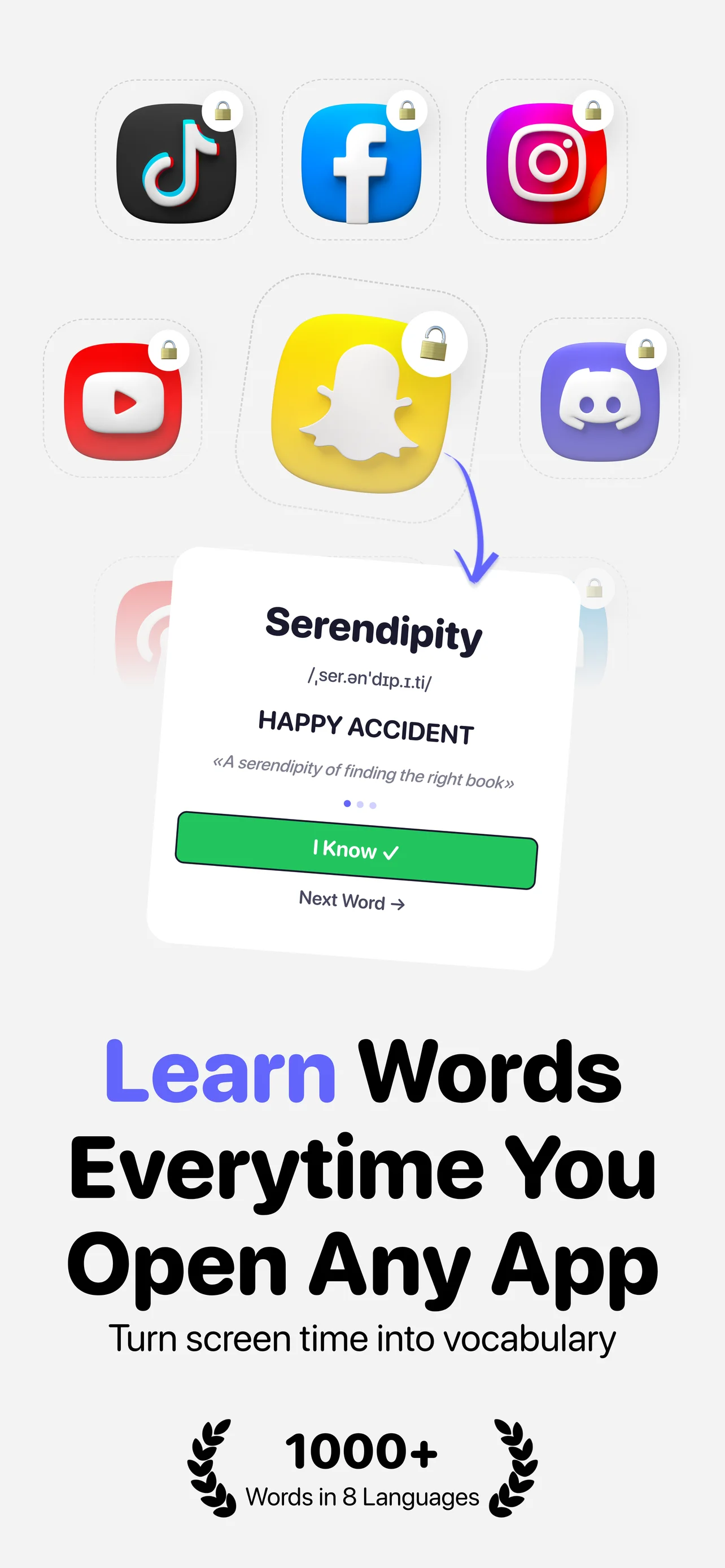
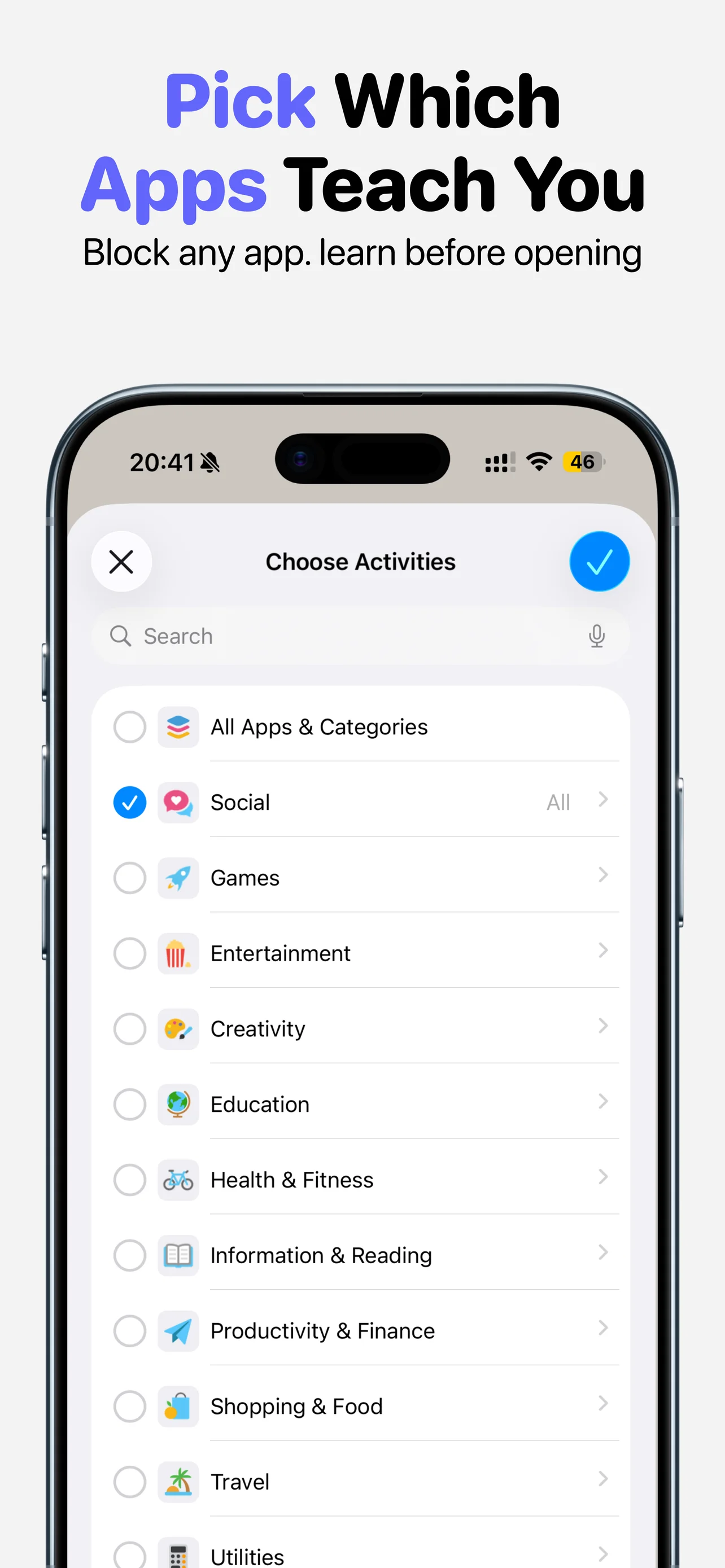
LearnScreen uses Apple's Screen Time API to shield the apps you pick. Opening one shows a vocabulary card instead of the feed; answer it and the app unlocks for a set window. The seconds go into a retrieval attempt, which is the kind that counts (Roediger & Karpicke, 2006).
The spacing is not your job
A Leitner schedule decides which word appears: one you just missed comes back quickly, one you knew backs off geometrically. You never pick what to review, so the gaps land closer to the 10–20% ridgeline Cepeda et al. (2008) describe than a fixed daily list would.
- You set how many minutes it costs. Words per session is adjustable from 3 to 20, and so is how many times a day the shield returns — the defaults come to roughly 25 recall attempts a day, about two and a half minutes spread across it.
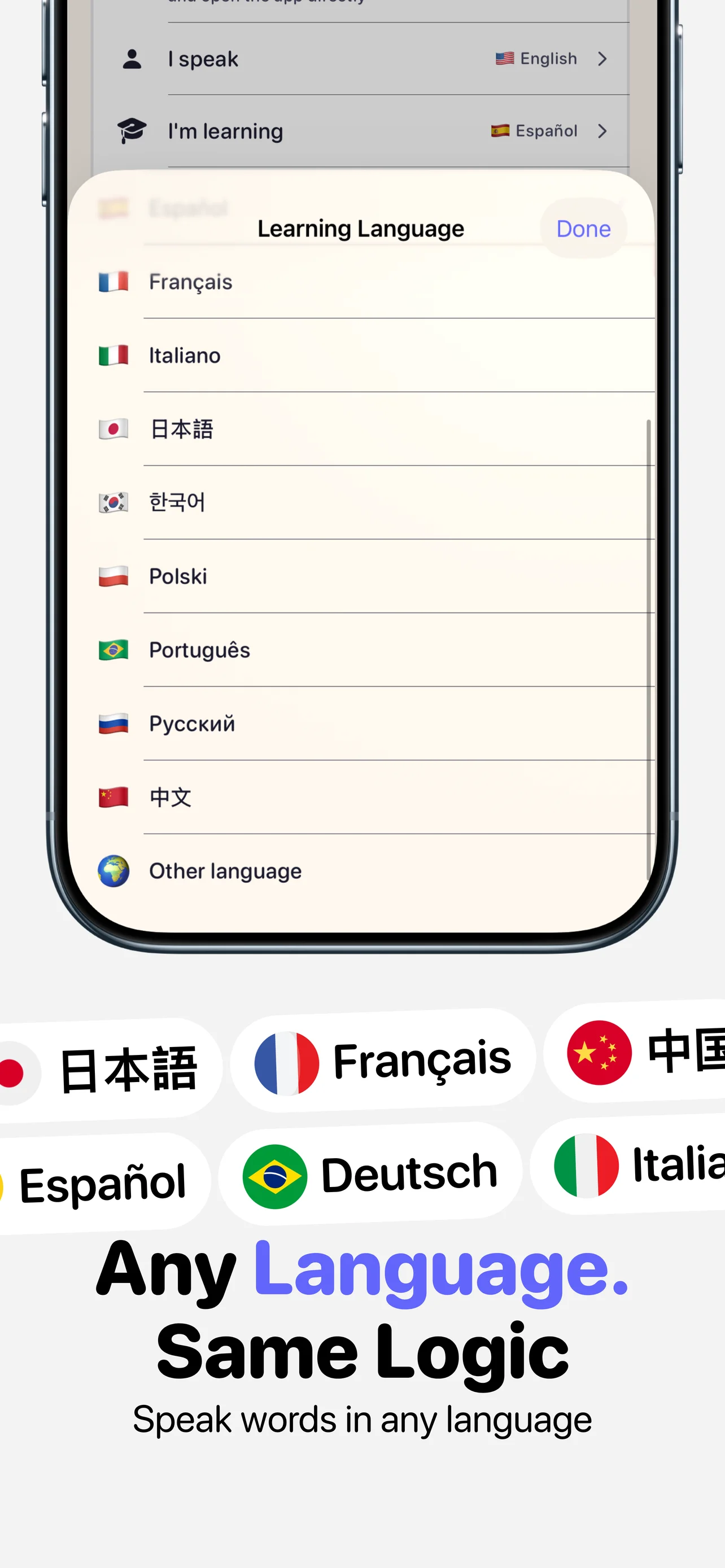
- 1,080+ curated words across 18 topics. Eleven languages are supported as learning targets, and you can add unlimited custom words with translation, transcription and an example sentence.
- It works offline. Cards and shields run with no network once installed; iCloud backup is opportunistic and writes to your own private database rather than our servers.
- No account and no streak to break. Nothing to sign up for, and no chain that punishes a light day — the queue simply carries the word forward to the next time you reach for a shielded app.
Related reading
- How many words a day should you learn? — the same question measured in words instead of minutes.
- How many words do you need to speak a language? — the size of the target, by coverage and CEFR band.
- How many times do you need to see a word? — where the 8–12 encounters figure comes from.
- Microlearning for languages — why seconds-long bursts beat scheduled sessions.
- Does passive learning actually work? — the evidence on how much pure exposure really returns per hour.
- Passive language learning — accumulating vocabulary without a study block.
- Can you learn while doing something else? — which of those minutes can be shared with another activity, and which cannot.
- Why do you forget vocabulary you have learned? — why the first 24 hours decide more than any amount of extra study time.
- How do you stay consistent? — why the plan is rarely what fails, and what a routine needs to survive.
- Should you study vocabulary before bed? — where in the day those minutes are worth the most, and why the last ones before sleep win.
Frequently asked questions
Sources
- Foreign Service Institute, U.S. Department of State. Foreign Language Training: expected weeks and hours of instruction to General Professional Proficiency (ILR 3/3), by language category. Reference
- Cepeda, N. J., Pashler, H., Vul, E., Wixted, J. T., & Rohrer, D. (2006). Distributed practice in verbal recall tasks: A review and quantitative synthesis. Psychological Bulletin, 132(3), 354–380.
- Cepeda, N. J., Vul, E., Rohrer, D., Wixted, J. T., & Pashler, H. (2008). Spacing effects in learning: A temporal ridgeline of optimal retention. Psychological Science, 19(11), 1095–1102.
- Kornell, N. (2009). Optimising learning using flashcards: Spacing is more effective than cramming. Applied Cognitive Psychology, 23(9), 1297–1317.
- Roediger, H. L., & Karpicke, J. D. (2006). Test-enhanced learning: Taking memory tests improves long-term retention. Psychological Science, 17(3), 249–255.
- Murre, J. M. J., & Dros, J. (2015). Replication and analysis of Ebbinghaus' forgetting curve. PLOS ONE, 10(7), e0120644.
- Bahrick, H. P., & Phelps, E. (1987). Retention of Spanish vocabulary over 8 years. Journal of Experimental Psychology: Learning, Memory, and Cognition, 13(2), 344–349.
- Nation, I. S. P. (2006). How large a vocabulary is needed for reading and listening? Canadian Modern Language Review, 63(1), 59–82.
- Reviews.org (2026). Cell Phone Usage Stats. Survey of ~1,000 US adults, fielded Q4 2025. Report
Training hours, spacing effects and coverage percentages come from the published sources above. The arithmetic in the tables is ours: 365 days a year, no missed days, and the moment counts in the second table are illustrative estimates built on the Reviews.org check figure rather than measured data.
Use the minutes you already spend
LearnScreen puts a recall attempt in front of the apps you open anyway, so the daily minutes do not have to come out of the calendar.
Download on the App Store