How many words do you
need to speak a language?
About 2,000–3,000 word families covers roughly 95% of everyday conversation — enough to hold one. Comfortable, unassisted understanding is higher: 6,000–7,000 families for speech and 8,000–9,000 for novels and newspapers (Nation, 2006). Native speakers know several times that, which is exactly why the useful question isn’t “how many words are there” but which few thousand, and how fast you can actually add them.
Sources cited in full at the foot of the page
The number that matters is coverage, not vocabulary size
Vocabulary research doesn’t ask how many words you know in the abstract. It asks what percentage of the words in a given text or conversation you already know — the lexical coverage. That framing is what makes the numbers useful, because word frequency is extraordinarily lopsided: a small set of very common words does most of the work in any language.
Nation (2006) puts the most frequent 1,000 word families at around 80% of spoken text. The next few thousand buy progressively less. That’s the good news and the bad news at once: the first 2,000 families are the highest-value thing you will ever learn, and the climb from 95% to 98% coverage costs several thousand more.
| Word families known | Approx. coverage | What that feels like |
|---|---|---|
| 1,000 | ~80% of speech | Gist of simple conversation; one unknown word in five |
| 2,000–3,000 | ~95% of speech | You can hold a conversation; gaps are guessable from context |
| 6,000–7,000 | ~98% of speech | Films, podcasts and fast native speech without constant effort |
| 8,000–9,000 | ~98% of writing | Novels and newspapers with no dictionary |
| ~17,000 base words | Native range | Educated adult native speaker (Goulden, Nation & Read, 1990) |
Coverage figures from Nation (2006) and Adolphs & Schmitt (2003); native estimate from Goulden, Nation & Read (1990). Measured on English — the shape holds across languages, the exact counts don’t.
What counts as “one word”?
Every figure above is in word families, not word forms. A word family is a base word plus its inflections and regular derivations: help, helps, helped, helping, helper, helpful, unhelpful is one family, not seven. Research counts this way because once you know the base and the affix, the rest are largely predictable.
Two consequences worth keeping in mind:
- A 3,000-family vocabulary is far more than 3,000 words. Depending on the language, it can be two to four times as many distinct forms. Advertised “learn 5,000 words” counts and research counts are rarely the same unit.
- Highly inflected languages inflate the raw count. Russian, Polish, Finnish and Korean spread one family across many surface forms; the family count needed for a given coverage stays broadly comparable, but the forms you meet do not.
- Receptive and productive vocabulary differ. The CEFR and coverage figures below measure what you recognise. The set you can produce in speech is consistently smaller.
Related: the cost of adding one family to that count — how many times you need to see a word to remember it.
How many words per CEFR level?
The CEFR itself describes what you can do, not how many words you know — there is no official vocabulary count per level. What exists is measurement: Milton (2010) tested learners of English at each level and reported the vocabulary sizes that actually accompany them. Treat these as observed averages with wide spread, not entry requirements.
| CEFR level | Word families (observed) | What it typically supports |
|---|---|---|
| A1 | under ~1,500 | Set phrases, introductions, immediate needs |
| A2 | ~1,500–2,500 | Routine exchanges: shops, directions, small talk |
| B1 | ~2,750–3,250 | Conversation on familiar topics; travel without help |
| B2 | ~3,250–3,750 | Discussion and argument; most media with effort |
| C1 | ~3,750–4,500 | Academic and professional use; implicit meaning |
| C2 | ~4,500–5,000+ | Near-complete comprehension; nuance and register |
Milton (2010), receptive vocabulary of learners of English as a foreign language. The instrument samples up to the 5,000-word band, so C1 and C2 are compressed at the top — a C2 speaker’s real vocabulary is larger than the table can show.
Why the bar for “understanding” is 98%, not 95%
95% coverage sounds close to complete. It isn’t: it means one unknown word in every twenty — roughly one per line of a novel. Hu and Nation (2000) tested this directly by manipulating the density of unknown words in a fiction text. At 80% coverage essentially no one reached adequate unassisted comprehension; at 95% only a minority did; 98% was where most learners got there without help.
Schmitt, Jiang and Grabe (2011) then tested 661 learners across academic texts and found the relationship between coverage and comprehension is essentially linear — no cliff, no magic threshold. Every additional percentage point of coverage buys a proportional amount of comprehension. So 98% is a practical planning figure, not a switch that flips.
The practical reading: 2,000–3,000 families makes you conversational, and every thousand after that makes the language quieter — fewer gaps, less guessing, less fatigue.
How long does 3,000 words take?
Once you have a target, the timeline is a division problem — and the answer is governed entirely by the rate, which is the part most plans get wrong. A word met while reading takes roughly 8–12 encounters before it sticks, and those encounters have to be spaced across days to survive.
So “words per day” is not how many you meet — it’s how many finish their repetition schedule. Here is the arithmetic at four honest rates:
| New words per day | Per year | To +1,250 (A2→B1) | To 3,000 from zero |
|---|---|---|---|
| 1 | 365 | ~3 yr 5 mo | ~8 yr 3 mo |
| 2 | 730 | ~1 yr 8 mo | ~4 yr 1 mo |
| 3 | 1,095 | ~1 yr 2 mo | ~2 yr 9 mo |
| 5 | 1,825 | ~8 months | ~1 yr 8 mo |
Straight division, assuming no days off and no backsliding — which is the assumption that actually breaks. Three words a day for three years is not a hard day; it is 1,095 consecutive days of remembering to do something.
Where a few words a day
can actually come from
The constraint is never the target. It’s consistency — and consistency is easier to buy from an existing habit than from willpower. Reviews.org’s 2026 survey of ~1,000 US adults found people check their phone 186 times a day. That is the largest supply of repeated moments most people have.
Attach the review to a habit
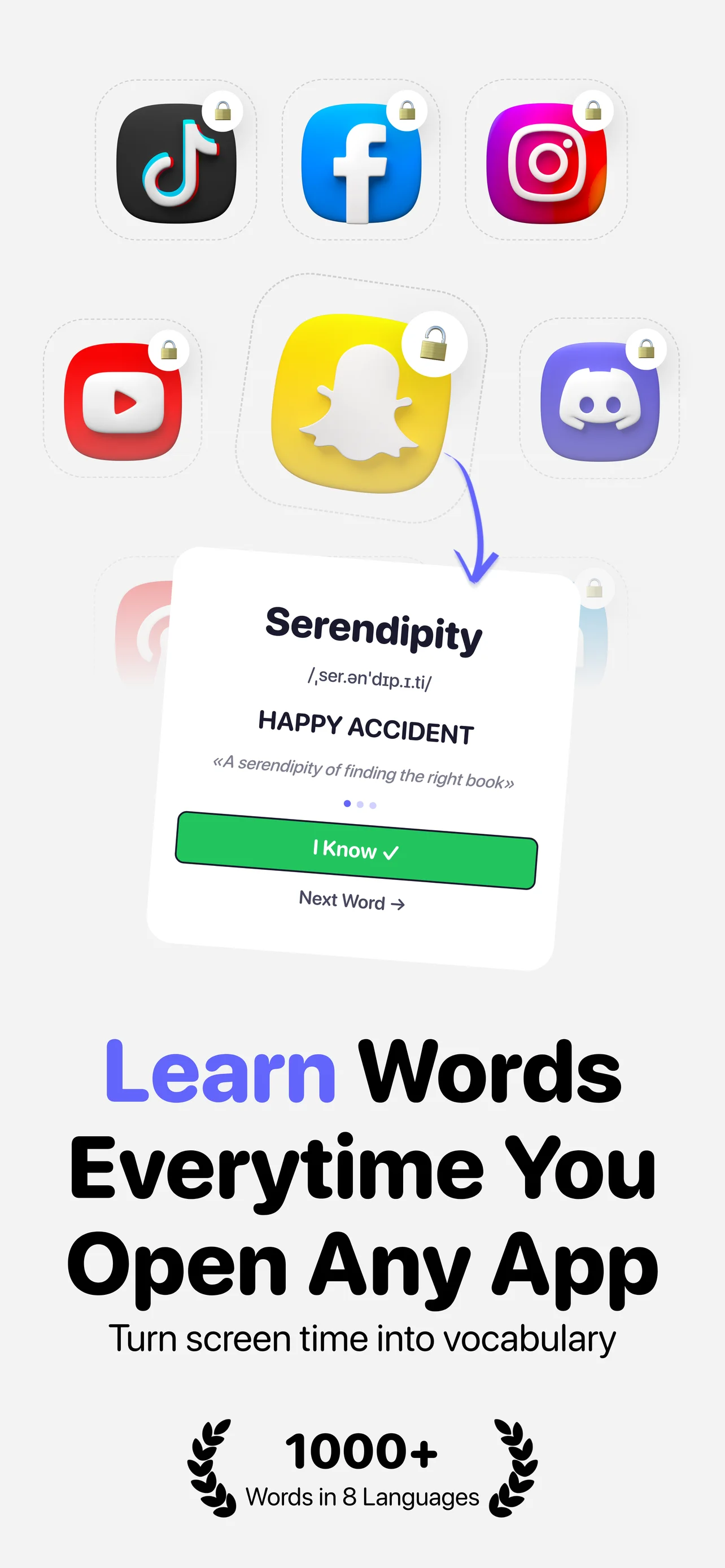
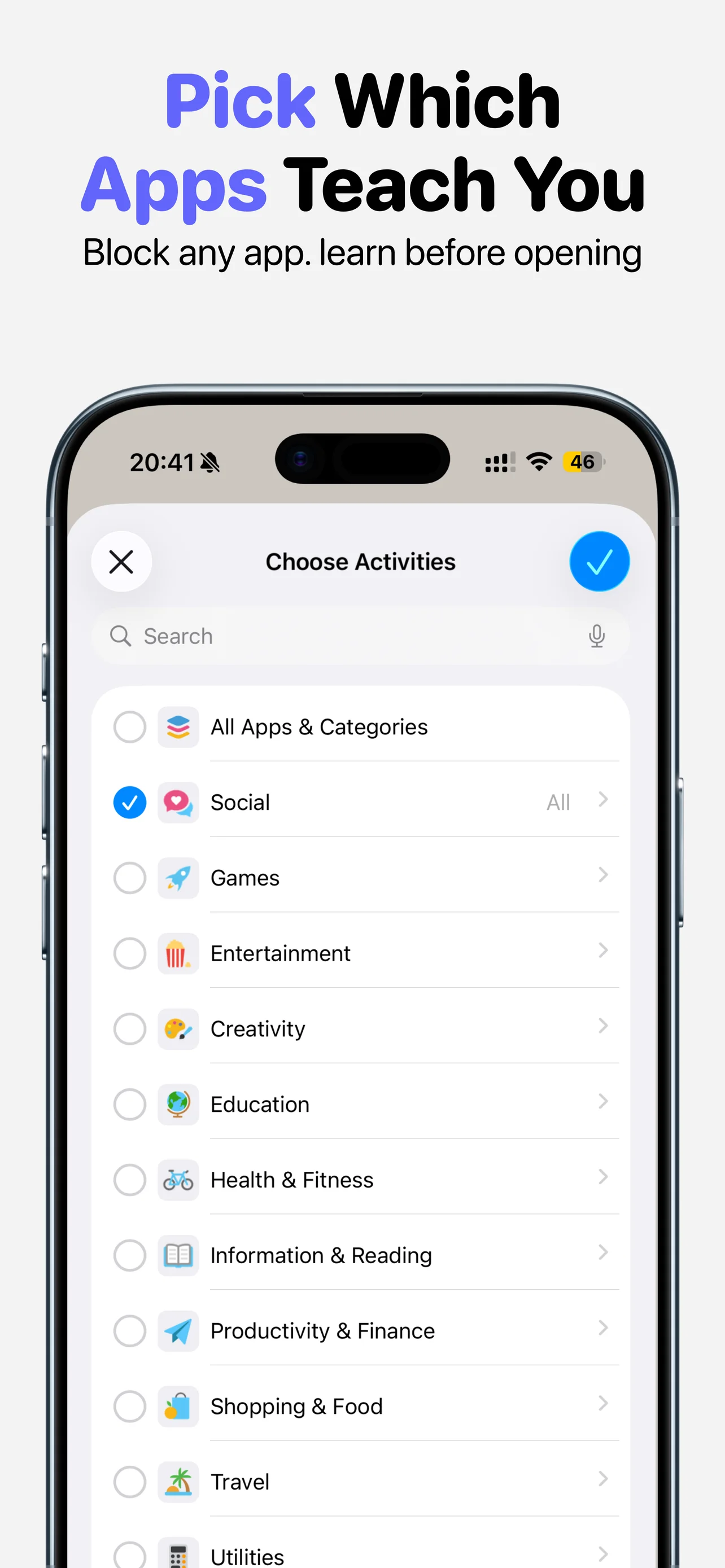
LearnScreen shields the apps you pick — Instagram, TikTok, X, games — through Apple’s Screen Time API. The block runs at the OS level, so there’s no VPN or DNS trick around it.
Make each open a recall attempt
A vocabulary card appears in place of the app. Answer it and the app unlocks for a set window. That’s active recall — the encounter type that survives a delay — not a word list you skim.
Let the schedule pick the word
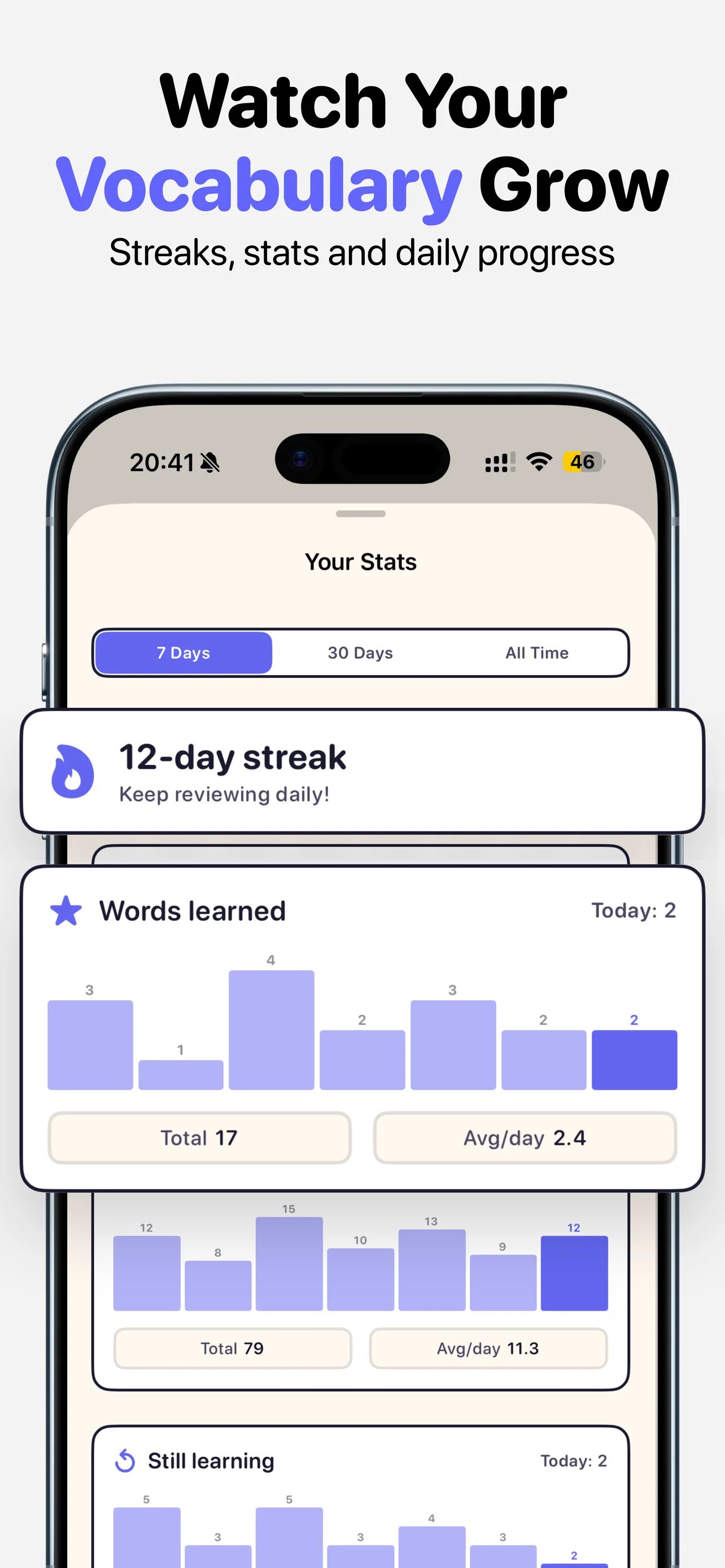
A Leitner spaced-repetition schedule decides what you see. Missed words come back quickly; known words back off. The spacing that the research demands happens without you tracking it.
- 1,080+ curated words across 18 topics — Basics, Daily Life, Travel, Food, Work, Numbers and more, which is roughly the frequency band that does the heavy lifting in the coverage table above.
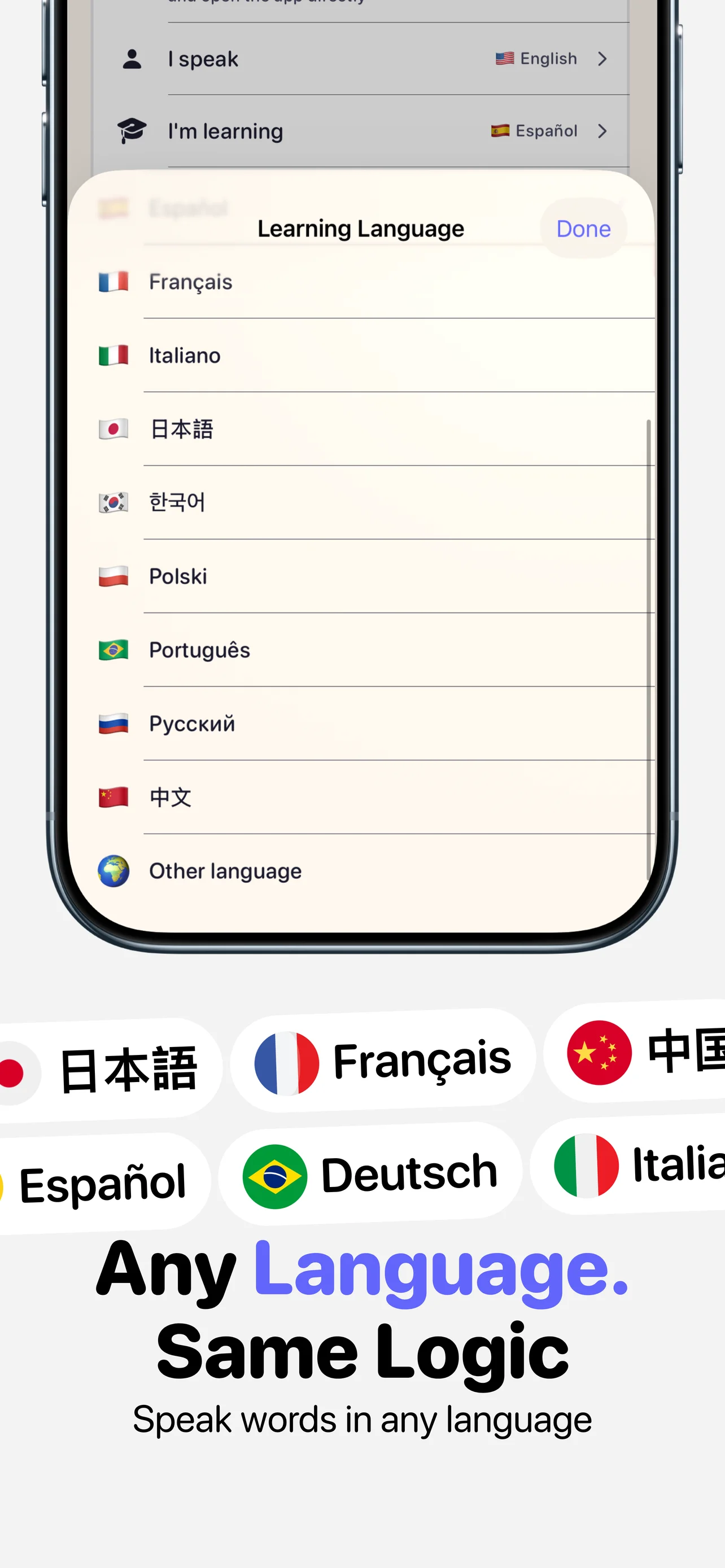
- 11 target languages — English, German, Spanish, French, Italian, Japanese, Korean, Polish, Brazilian Portuguese, Russian and Mandarin Chinese.
- Your own words too — add any word with translation, transcription and an example sentence; it joins the same rotation.
- Offline, no account. Cards and shields work with no network once installed. No signup, no email, no password; iCloud backup uses your own private database.
Related reading
- Which words should you learn first? — how the target breaks down by frequency band, and which thousand is worth the most.
- How many times to learn a word — the repetition cost of each entry in the count above.
- How many words a day should you learn? — the pace that turns this target into a schedule, and what it costs per day.
- Does passive learning actually work? — how much of that target pure exposure can realistically deliver.
- Passive learning — how vocabulary practice can run without a decision to study.
- Microlearning — why seconds-long bursts beat one long session for retention.
- Anki alternative — spaced repetition without building or opening a deck.
- Lock-screen language learning — where the review actually appears on iPhone.
- Productive screen time — turning 186 daily pickups into something that compounds.
- Why do you forget vocabulary you have learned? — why a target you once hit still shrinks, and what holds it in place.
Vocabulary size FAQ
Sources
- Nation, I. S. P. (2006). How large a vocabulary is needed for reading and listening? Canadian Modern Language Review, 63(1), 59–82. Author page
- Adolphs, S., & Schmitt, N. (2003). Lexical coverage of spoken discourse. Applied Linguistics, 24(4), 425–438.
- Hu, M., & Nation, P. (2000). Unknown vocabulary density and reading comprehension. Reading in a Foreign Language, 13(1), 403–430. Journal archive
- Schmitt, N., Jiang, X., & Grabe, W. (2011). The percentage of words known in a text and reading comprehension. Modern Language Journal, 95(1), 26–43.
- Goulden, R., Nation, P., & Read, J. (1990). How large can a receptive vocabulary be? Applied Linguistics, 11(4), 341–363.
- Milton, J. (2010). The development of vocabulary breadth across the CEFR levels. In Communicative Proficiency and Linguistic Development, EuroSLA Monographs 1, 211–232.
- Reviews.org (2026). Cell Phone Usage Stats: Americans Check Their Phones 186 Times a Day. Survey of ~1,000 US adults, fielded Q4 2025. Report
Last reviewed 28 July 2026.
Start on the first
two thousand
No account. Works offline. The next time you reach for a shielded app, that’s one word closer.
Download for iOS