Why do I forget
vocabulary I've learned?
Because nothing came back for the word in time. Forgetting is the default for any memory that goes unused — not evidence that you learned it wrong. In Ebbinghaus's savings data, replicated by Murre and Dros (2015), roughly 58% of freshly learned material survived 20 minutes and about 34% survived a single day with no review at all, after which the curve flattens for years. That shape is the whole story: the first 24 hours decide almost everything, so one well-timed recall attempt is worth more than any amount of extra effort at the moment you first met the word.
Every figure below is sourced at the end of the page
How fast does a new word actually fade?
Hermann Ebbinghaus spent the early 1880s memorising lists of nonsense syllables and then testing himself at fixed delays — not to be difficult, but because meaningless material strips out the head start that a familiar word gets from everything you already know. He measured what was left as savings: how much less effort it took to relearn the list than to learn it cold. In 2015 Murre and Dros repeated the whole procedure under modern conditions and found the curve held.
What the numbers describe is not a slow leak. It is a cliff followed by a plateau. More is lost in the first hour than in the following month, which means the interval that matters most is the one nobody schedules.
| Time since learning | Retained (savings) | What it means in practice |
|---|---|---|
| About 20 minutes | ~58% | The decline has already started before you have put the phone down |
| About 1 hour | ~44% | More than half gone within the hour, with nothing going wrong |
| 1 day | ~34% | The steep stretch is essentially over — this is the day that decides the word |
| 6 days | ~25% | Five more days cost less than the first sixty minutes did |
| 31 days | ~21% | The curve has flattened; what survived a month largely keeps surviving |
Read these as a shape, not as constants for your own vocabulary. They come from nonsense syllables, self-tested, by one person in the 1880s — Murre and Dros (2015) replicated the procedure and found values close to the originals, which is remarkable but does not make them universal. Real words decay more slowly, because meaning, cognates and example sentences all give the trace something to hang on. What transfers is the geometry: a steep first day, then a long flat tail.
Three different things get called “forgetting”
The word covers at least three failures with different causes and different fixes. Sorting out which one you are experiencing is worth more than any study technique, because two of the three are not really memory problems at all.
- It never got in. A word you glanced at while half-listening was never encoded deeply enough to be retrieved later. Craik and Lockhart (1972) framed this as levels of processing: what determines durability is not how long material was in front of you but how meaningfully it was handled. Scrolling past a translation is the shallowest possible handling.
- It is in there, but you cannot reach it. Tulving and Pearlstone (1966) separated availability from accessibility: the same words that people failed to produce freely came back when a category cue was supplied. That is the tip-of-the-tongue experience, and it means “I forgot it” often describes a missing cue rather than a missing memory.
- Something else took its place. Underwood (1957) showed that most of what looked like spontaneous decay in list-learning studies was interference from earlier lists — recall a day later fell from roughly 80% for people with no prior lists to around 20% for people who had learned many. Two similar words in a new language interfere with each other the same way.
The timing question — when a review should land to catch a word before it is lost: how often should you review vocabulary.
Which kind of forgetting is yours?
Each row below is a complaint learners actually make, matched to what is going on underneath it. The last column is deliberately narrow: one change, not a study system. Note how many of the rows are fixed by the same thing arriving at a different time rather than by working harder.
| What it feels like | What is actually happening | What changes it |
|---|---|---|
| “I recognise it, I just can't produce it” | Exposure trained recognition; recall is a separate skill (Tulving & Pearlstone, 1966) | Attempt the word before revealing it — testing beat re-reading in Roediger and Karpicke (2006) |
| “I knew it last night and it's gone by morning” | Ordinary first-day decay, the steepest part of the curve | One retrieval inside the first 24 hours, which is where the loss is concentrated |
| “I keep mixing up two similar words” | Interference, not decay — the dominant cause in Underwood's (1957) analysis | Separate the pair in time, and practise them against each other rather than alone |
| “I only know it inside the app” | The memory is cue-dependent: available, but not accessible without its usual context | Meet the word in varied places and orders so it stops relying on one cue |
| “I did 200 cards in one evening, then nothing for weeks” | Massed practice, which reads as fluency during the session and fades after it | Spread the same minutes out — about 47% recalled spaced against 37% massed (Cepeda et al., 2006) |
| “I just never get round to reviewing” | Not a memory failure at all — the schedule failed, and the curve simply ran | Attach the review to a moment that already happens instead of one you must remember |
The last row is the one that describes most people, and it is the only row where nothing is wrong with the learning at all. A schedule you have to remember to follow competes with everything else in a day; the forgetting curve does not compete with anything, and it never skips an evening.
A forgotten word is not back to zero
The most encouraging finding in this literature is hidden in Ebbinghaus's method rather than his results. He could not measure what he remembered, because after a month there was often nothing he could consciously produce — so he measured how much faster relearning went instead. Savings exist because a trace you cannot retrieve is still there, doing work. The second pass at a word is always cheaper than the first, and often dramatically so.
Bahrick (1984) took this to its limit. He tested nearly 800 people on Spanish they had studied at school, some of them fifty years earlier, and found the expected decline — but only for the first three to six years. After that, retention stopped falling. What was left sat almost unchanged for the next twenty-five years, whether or not anyone had touched Spanish since. He called that surviving layer permastore, and the people who had more of it were, unsurprisingly, the ones whose original study had been spread over more terms.
This reframes the whole problem. You are not fighting to prevent an inevitable slide to zero; you are trying to get words across a threshold, after which they stop needing you. Bahrick and Phelps (1987) showed how much the spacing of the original learning decides that: word pairs relearned at 30-day intervals were retained far better eight years later than the same pairs relearned on the same day. So the words you feel guilty about — the ones you learned once and lost — are not wasted. They are half-built, and they are waiting for encounters that never came.
What actually decides whether a word survives
Four variables explain most of the difference between vocabulary that lasts years and vocabulary that lasts a weekend. Three of them are well-studied and produce large effects. The fourth has no research literature to speak of, because it is not a memory question — and it is the one that decides the outcome for most learners.
Read the right-hand column as the size of the prize. These are not marginal percentage points; the gap between retrieving and re-reading is roughly the gap between remembering most of a list and remembering a third of it.
| What decides survival | The evidence | How big the effect is |
|---|---|---|
| Whether you retrieved or re-read | Karpicke & Roediger (2008), with total study time held constant | Recall a week later fell from about 80% to about 35% when repeated retrieval was dropped |
| How wide the gaps were | Cepeda et al. (2006), 254 studies; Bahrick et al. (1993) over nine years | About 47% against 37% for the same time massed; 56-day gaps beat 14-day gaps at every long delay |
| How many encounters it got | Nation & Wang (1999); Webb (2007) | Roughly 8–12 spaced encounters to stick; knowledge was still incomplete after ten |
| Whether the review happened at all | No study needed — a skipped review has no effect size | Decisive. The other three rows are worth nothing on the days the app stays closed |
Cepeda and colleagues (2008) add the detail that makes the second row actionable: the best gap is roughly 10–20% of how long you want to remember something. To hold a word for a month, review it around three to six days after learning it — a schedule almost nobody arrives at by intuition, because it feels far too late.
Reviews that don't depend on remembering to review
If the decisive row is the fourth one, the useful thing to automate is not the studying but the showing up. That is the shape LearnScreen is built in: the curve gets answered by something already in your day rather than by a plan you have to keep.
The review comes to you
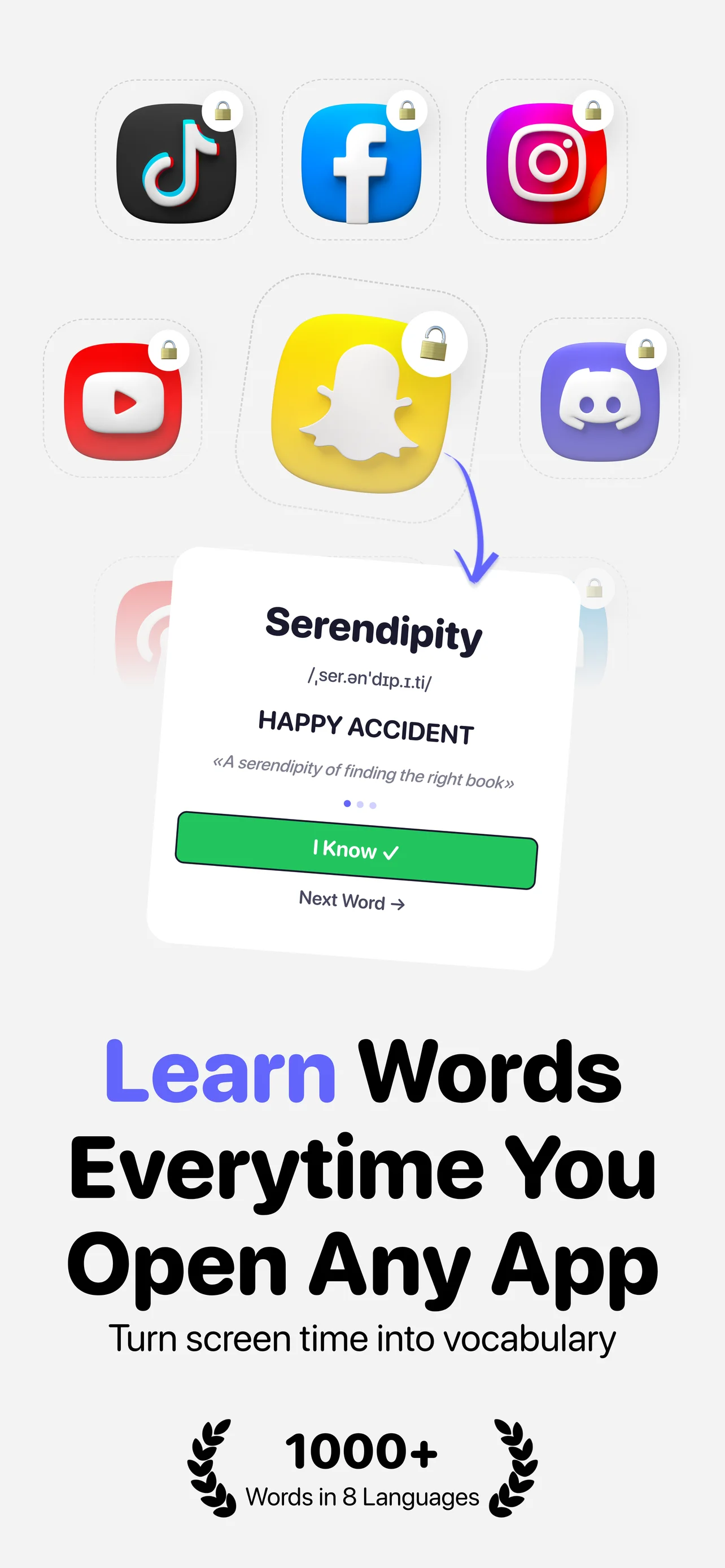
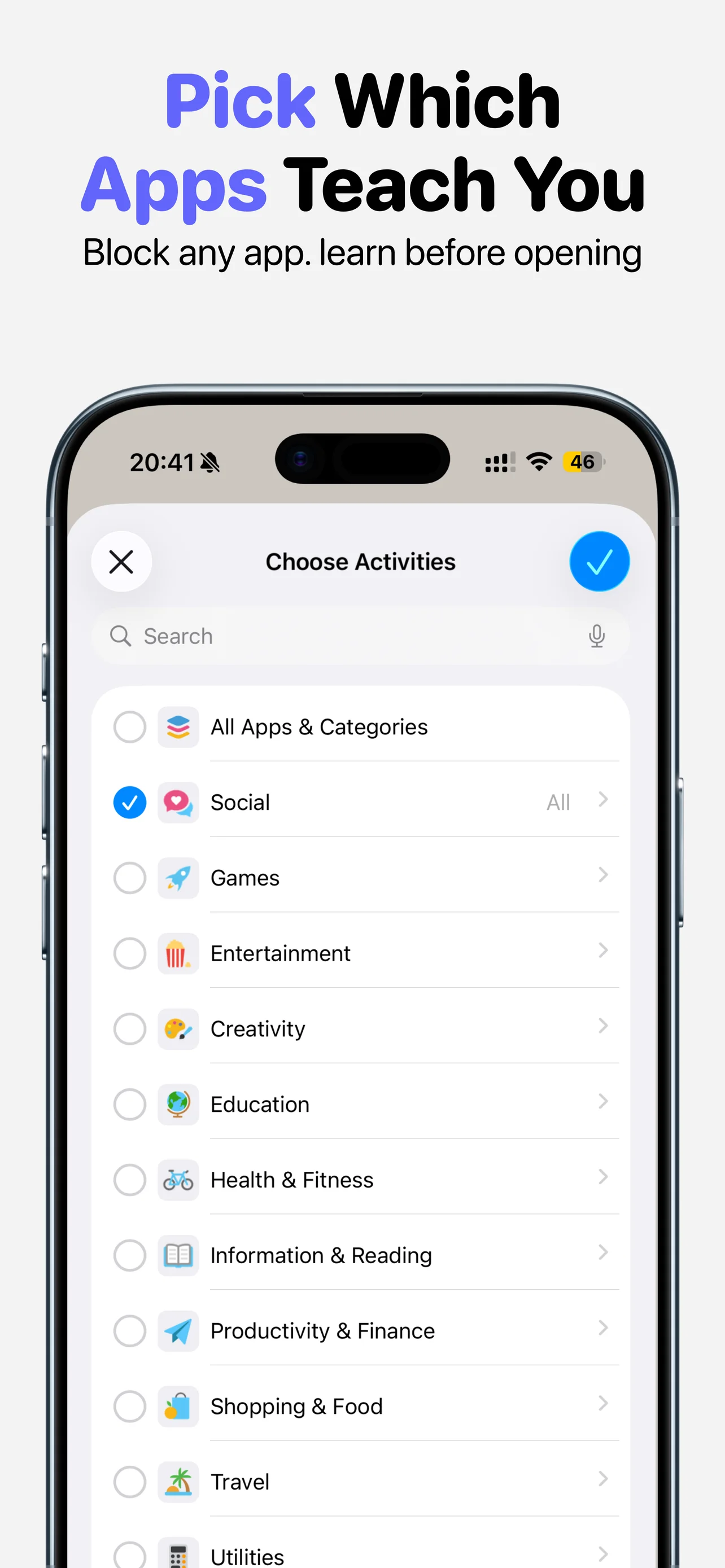
Phones get checked about 186 times a day, roughly 11.6 times per waking hour (Reviews.org, 2026). Using Apple's Screen Time API, LearnScreen shields the apps you pick and shows a word instead — so the encounter lands inside the first day, on a reach you were making anyway, with nothing to open and nothing to remember.
It asks you to recall, not to read
The card shows the word and waits before revealing the meaning. That attempt is the difference between the ~80% and the ~35% in Karpicke and Roediger (2008) — and it is the part that cannot be automated away, which is why it is the only part left for you to do. It costs about twenty seconds.
The gaps widen on their own
A Leitner schedule promotes a word you knew and returns one you missed, so the interval stretches as the memory strengthens — toward the 10–20% ridgeline Cepeda et al. (2008) describe, without you deciding anything. Words on their way out come back first, which is exactly where a review is worth most.
- You set the dose. Words per session adjust from 3 to 20, as does how often the shield returns — the defaults come to roughly 25 recall attempts a day, about two and a half minutes spread across it.
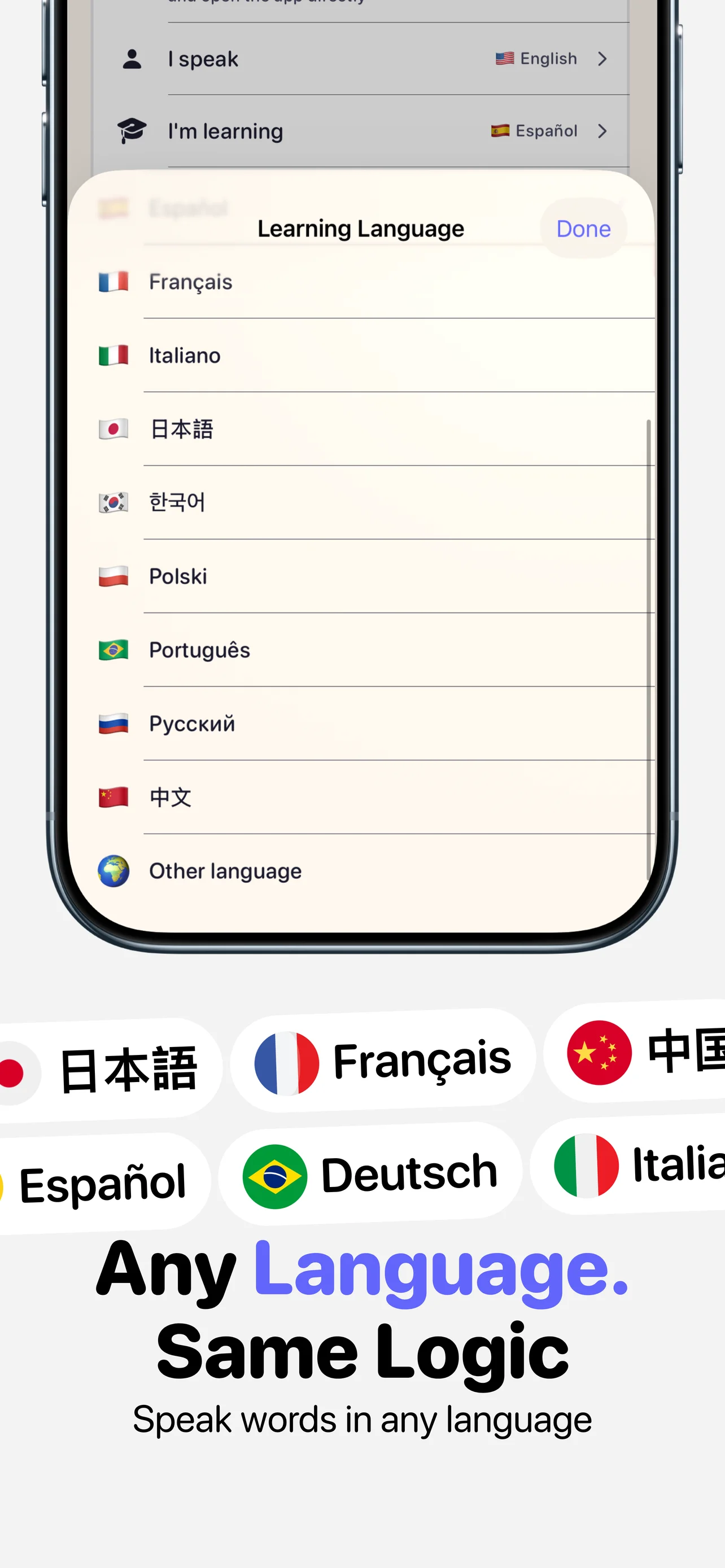
- 1,080+ curated words across 18 topics. Eleven languages are supported as learning targets, and you can add unlimited custom words with translation, transcription and an example sentence to give a new word something to hang on.
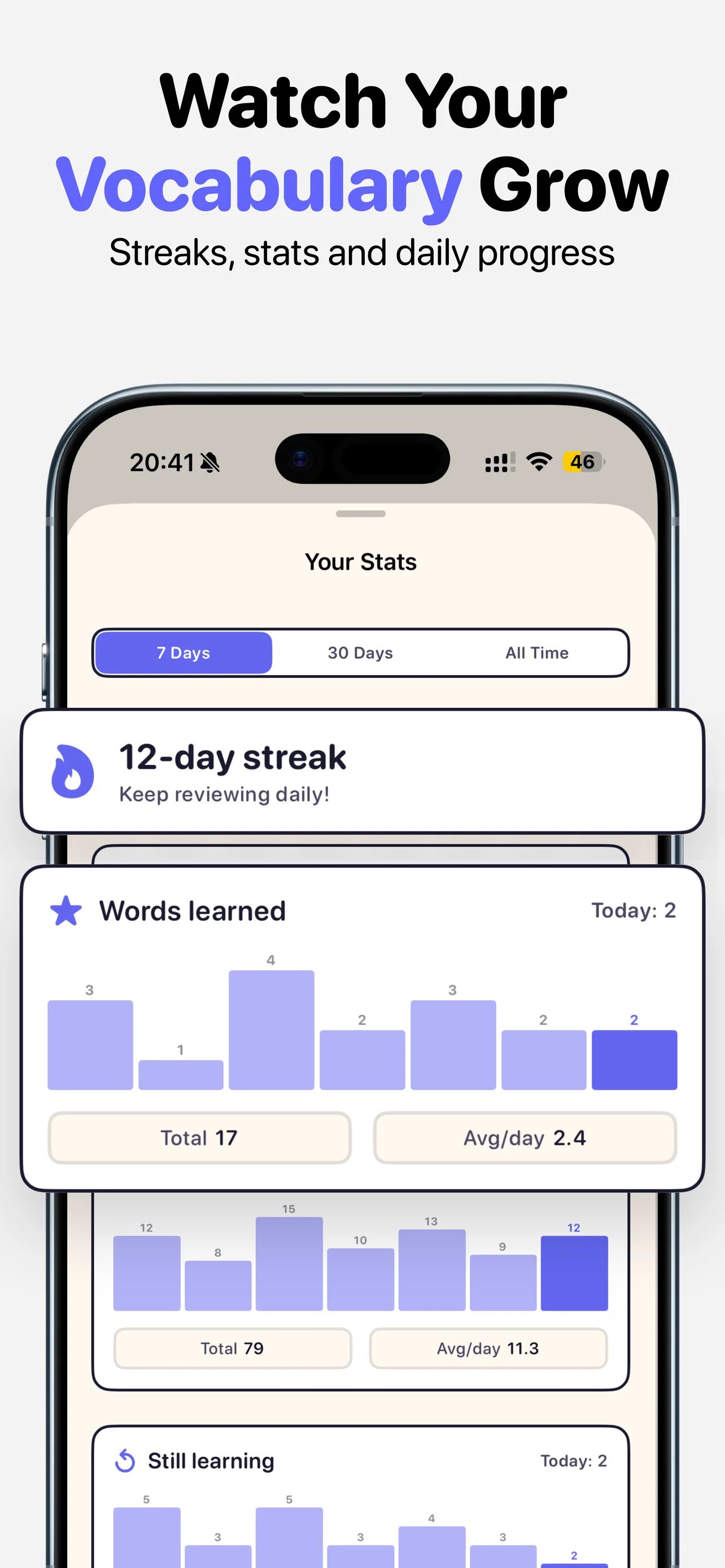
- Nothing is lost when you fall behind. There is no streak to break and no penalty for a quiet week — the words you missed are still in the queue, and the permastore evidence says they are cheaper to recover than they were to learn.
- It works offline, with no account. Cards and shields run without a network once installed; iCloud backup writes to your own private database rather than our servers, and there is nothing to sign up for.
Related reading
- Which words should you learn first? — why the words that slip are mostly mid-frequency, and how the order you learn them in changes that.
- How often should you review vocabulary? — the intervals that catch a word before the curve takes it.
- How many times do you need to see a word? — where the 8–12 encounters figure comes from.
- Does passive learning actually work? — what exposure alone produces, and where it stops.
- How many words a day should you learn? — why the ceiling is set by review load, not by intake.
- Can you learn while doing something else? — which moments can carry a review, and which cannot.
- A passive Anki alternative — spaced repetition that does not wait for you to open it.
- Active vs passive vocabulary — the direction of retrieval, and why one way is far harder.
- Should you learn words in context or alone? — which format supplies which part of a word.
- How do you stay consistent? — why the plan is rarely what fails, and what a routine needs to survive.
- Should you study vocabulary before bed? — the one interval where a word gets stronger instead of decaying, and what it costs to miss it.
Frequently asked questions
Sources
- Ebbinghaus, H. (1885). Über das Gedächtnis: Untersuchungen zur experimentellen Psychologie. Duncker & Humblot.
- Murre, J. M. J., & Dros, J. (2015). Replication and analysis of Ebbinghaus’ forgetting curve. PLOS ONE, 10(7), e0120644.
- Bahrick, H. P. (1984). Semantic memory content in permastore: Fifty years of memory for Spanish learned in school. Journal of Experimental Psychology: General, 113(1), 1–29.
- Bahrick, H. P., & Phelps, E. (1987). Retention of Spanish vocabulary over 8 years. Journal of Experimental Psychology: Learning, Memory, and Cognition, 13(2), 344–349.
- Bahrick, H. P., Bahrick, L. E., Bahrick, A. S., & Bahrick, P. E. (1993). Maintenance of foreign language vocabulary and the spacing effect. Psychological Science, 4(5), 316–321.
- Cepeda, N. J., Pashler, H., Vul, E., Wixted, J. T., & Rohrer, D. (2006). Distributed practice in verbal recall tasks: A review and quantitative synthesis. Psychological Bulletin, 132(3), 354–380.
- Cepeda, N. J., Vul, E., Rohrer, D., Wixted, J. T., & Pashler, H. (2008). Spacing effects in learning: A temporal ridgeline of optimal retention. Psychological Science, 19(11), 1095–1102.
- Karpicke, J. D., & Roediger, H. L. (2008). The critical importance of retrieval for learning. Science, 319(5865), 966–968.
- Roediger, H. L., & Karpicke, J. D. (2006). Test-enhanced learning: Taking memory tests improves long-term retention. Psychological Science, 17(3), 249–255.
- Tulving, E., & Pearlstone, Z. (1966). Availability versus accessibility of information in memory for words. Journal of Verbal Learning and Verbal Behavior, 5(4), 381–391.
- Underwood, B. J. (1957). Interference and forgetting. Psychological Review, 64(1), 49–60.
- Craik, F. I. M., & Lockhart, R. S. (1972). Levels of processing: A framework for memory research. Journal of Verbal Learning and Verbal Behavior, 11(6), 671–684.
- Nation, I. S. P., & Wang, K. (1999). Graded readers and vocabulary. Reading in a Foreign Language, 12(2), 355–380.
- Webb, S. (2007). The effects of repetition on vocabulary knowledge. Applied Linguistics, 28(1), 46–65.
- Reviews.org (2026). Cell Phone Usage Stats. Survey of ~1,000 US adults, fielded Q4 2025. Report
The savings percentages are Ebbinghaus's own, as tabulated and replicated by Murre and Dros (2015); they describe nonsense syllables studied by a single subject and are reported here as the shape of decay rather than as rates for real vocabulary. Retention and spacing effects come from the published studies named in each row. Card counts and daily totals are arithmetic from a roughly twenty-second recall attempt, not measured app data.
Answer the curve without scheduling anything
LearnScreen brings the word back while it is still recoverable — on a phone check you were making anyway. All it asks of you is the twenty seconds of recall that actually stop the decay.
Download on the App Store