Should you learn words
in context or alone?
Both, because they build different parts of the same word. Isolated pairs get the word in fastest: Laufer and Shmueli (1997) found words met in a short glossed sentence were retained better than the same words met inside a full text. Context supplies what a pair cannot — which words it goes with, how formal it is, how it behaves — but it is slow, yielding about 22% of the unknown words in a whole book (Horst et al., 1998). Pairs to get the word in; context to finish it.
Every figure below is sourced at the end of the page
What the studies actually compared
“Learn words in context” is repeated so often that it sounds like a settled result. It is not one. The experiments that put the two formats side by side mostly found the opposite of the folk advice on the measure they used — and the reason is not that context is useless, but that the tests were measuring how well the word had been learned, not how well it could be used.
Each row below is a study that made a direct comparison, with what it found. Read the third column carefully: several of these results are narrower than the headline anyone would write from them.
| Study | What it compared | What it found |
|---|---|---|
| Laufer & Shmueli (1997) | Words alone, in a short sentence, in a text, and in an elaborated text — glossed in L1 or explained in L2 | The shorter, less contextualised presentations were retained better, and L1 glosses beat L2 explanations |
| Prince (1996) | Learning from translations against learning from context, across proficiency levels | Translation produced more words recalled — but those words transferred to use in context less well, especially for weaker learners |
| Webb (2008) | Informative contexts against uninformative ones, holding encounters constant | Context is not one thing: informative contexts produced clearly larger gains, uninformative ones very little |
| Horst, Cobb & Meara (1998) | What a whole simplified novel teaches, with no deliberate study at all | About 22% of the unknown words in the book — real learning, at a rate that cannot carry a vocabulary on its own |
| Elgort (2011) | Whether words learned deliberately from pairs become genuine lexical entries | They do: deliberately learned words showed the priming behaviour of real vocabulary, not of memorised trivia |
These are small studies with different learners, languages and tests, and none of them settles the question by itself. What they agree on is narrower and more useful than a winner: the isolated format is measurably efficient at getting a word into memory, and the tests it wins are tests of exactly that. Where context wins is on questions those tests never asked — and Prince (1996) is the study that shows the seam, because the translation group knew more words and could do less with them.
Three different things get called “in context”
Most disagreements about this question are people defending three different practices with one word. They have different costs, different evidence and different failure modes, and lumping them together is what makes the advice contradictory.
- A whole text you read for the story. The word appears once or twice, surrounded by material that has nothing to do with it. This is where the low yields come from — about 22% of the unknown words in a whole book (Horst et al., 1998) — and Webb (2008) explains the variance: most sentences do not constrain what an unfamiliar word could mean, so most encounters teach almost nothing.
- One example sentence attached to the word. A short sentence chosen because it makes the meaning obvious, sitting next to a translation. This is the format Laufer and Shmueli (1997) found retained best, and Bolger et al. (2008) found that varying it across encounters, alongside a definition, produced better meaning knowledge than any single context. It is closer to a word pair than to reading.
- Real use, with someone, under pressure. No study format captures this, and it is the only one that tests whether the word is genuinely available. It is also the one you cannot practise with words you do not yet have — you route around them silently, which is why it completes vocabulary rather than building it.
The direction question — whether your practice asks you to recognise the word or produce it: active vs passive vocabulary.
Which part of a word does each format teach?
Nation (2001) treats knowing a word as a bundle rather than a fact: its form, its meaning, the grammar it takes, the words it keeps company with, and the situations it belongs in. Once you split the bundle, the argument dissolves — the two formats are not competing for the same job. Each row is one component, and the last column is the honest verdict on which format supplies it.
| Component of the word | What a pair gives you | What context gives you |
|---|---|---|
| The form — how it sounds and is spelled | Directly and immediately, with nothing competing for attention | The same, buried in a sentence you are also parsing |
| The core meaning | An unambiguous L1 gloss — the fastest route there is (Laufer & Shmueli, 1997) | An inference, reliable only when the context is informative (Webb, 2008) |
| Its grammar — the case, the preposition, the pattern | Nothing, unless the card carries a sentence | This is context's job, and no pair substitutes for it |
| Collocation — the words it goes with | Nothing at all | Only available here, and only after many varied encounters (Webb, 2007) |
| Register — how formal, how rude, who says it | Nothing, and a bare gloss can actively mislead | Only available here, and mostly from real use rather than study material |
| Speed — having it arrive when you need it | Retrieval practice builds it, if the card withholds the answer | Volume builds it, given far more hours than most learners have |
Two rows of this table are the whole practical answer. A pair is unbeatable at the top two and useless at the middle two; context is the reverse. Which is why the format with the best evidence behind it is neither — it is a pair that carries one good sentence, so the fast route to the meaning and the only route to the grammar arrive on the same card.
Deliberate learning is not the shallow option
The suspicion behind “learn words in context” is that a translation produces a fragile, artificial kind of knowledge — something you can pass a test with but never really own. Elgort (2011) tested that directly. Learners studied words from pairs, deliberately, and were then measured with priming tasks that reveal how a word is stored rather than what a learner can report about it. The deliberately learned words behaved like established lexical entries. Whatever the intuition says, the knowledge produced was the real kind.
Schmitt (2008) draws the conclusion the whole literature points at: explicit learning and incidental exposure are complementary rather than rival. Explicit study is dramatically more efficient per word — a handful of minutes can move a word that a novel would have taken twenty thousand words to half-teach — while exposure supplies the volume, the repetition and the depth that no deck contains. Nation (2001) turns this into a budget with his four strands: meaning-focused input, meaning-focused output, deliberate language-focused learning, and fluency development, at roughly equal weight. About a quarter of the time on explicit word study, and no more.
Which makes the practical failure clear. Almost nobody is short of input; shows, feeds, songs and articles arrive by themselves. The strand that goes missing is the deliberate quarter, because it is the only one that has to be scheduled, and a strand that has to be scheduled is a strand that competes with everything else in a day. The gap between the two formats measured in any of these studies is small next to the gap between doing the deliberate strand and skipping it.
What decides the outcome, whichever format you pick
Four things determine whether a word survives, and the choice between context and pairs is not among them. Three are well-measured and produce effects large enough to see without statistics. The fourth has no literature, because it is not a memory question — and it is the one that settles the result for most people.
Read the right-hand column as the size of the prize. The distance between the top and bottom of this table is much larger than the distance between any two presentation formats.
| What decides it | The evidence | How big the effect is |
|---|---|---|
| Whether you had to retrieve, or were simply shown | Karpicke & Roediger (2008); Craik & Lockhart (1972) on depth | Recall a week later fell from about 80% to about 35% when repeated retrieval was removed |
| Whether the encounters were spread out | Cepeda et al. (2006), across 254 studies | About 47% recalled spaced against 37% massed — same material, same total time |
| Whether there were enough of them | Nation & Wang (1999); Webb (2007) | Roughly 8–12 spaced encounters, and several components still incomplete after ten |
| Whether the encounter happened at all | No study needed — a session that never started has no effect size | Decisive. The three rows above are worth nothing on the days nothing is opened |
This is why the context-versus-pairs argument is worth less attention than it gets. Spending it on choosing the perfect format, and then studying on four days out of thirty, loses to almost any format used on most days. The only question with a large answer is the last row.
A pair and its sentence, arriving on their own
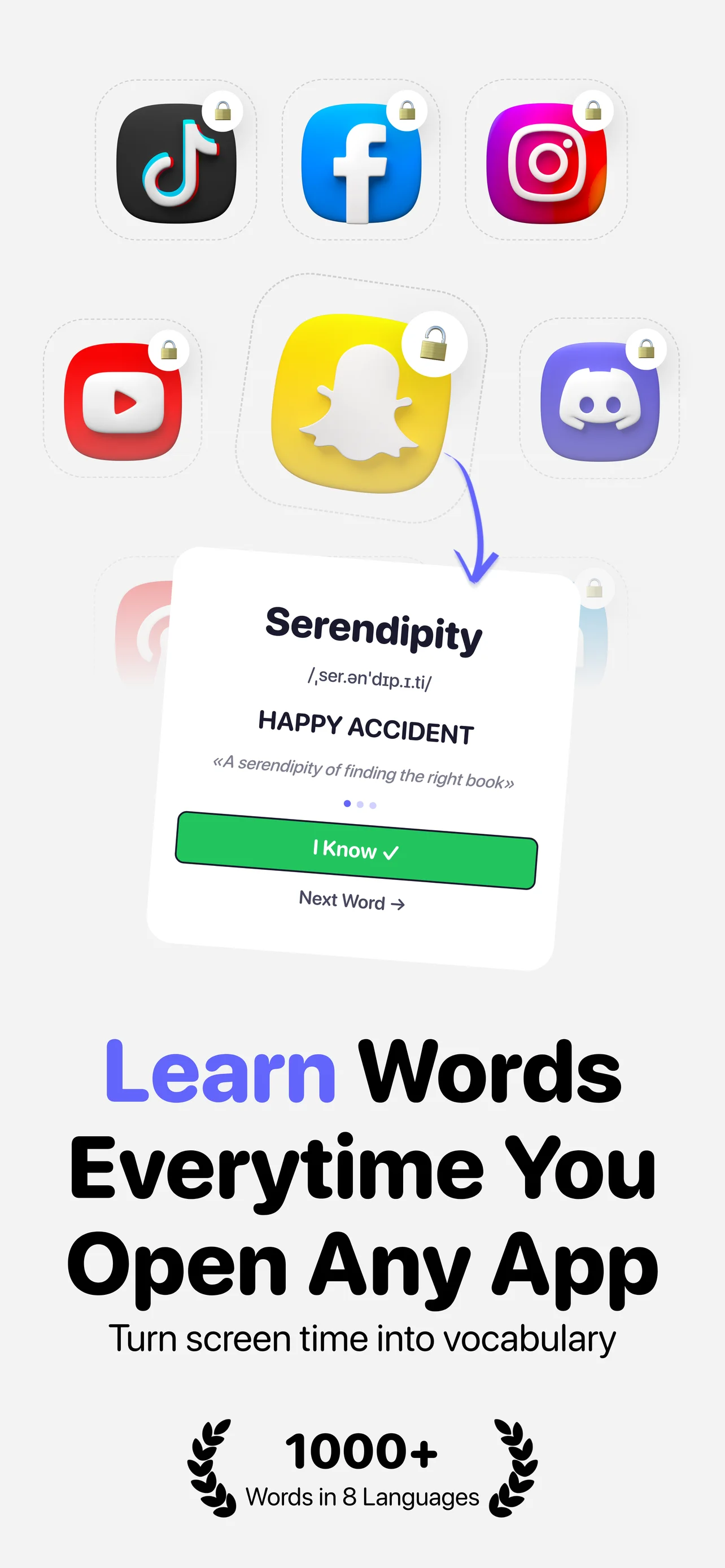
If the decisive row is the last one, the thing worth automating is not the choice of format but the arrival of the card. That is the shape LearnScreen is built in — and the card it delivers is the format the evidence favours: the pair, with a sentence under it.
The card comes to you
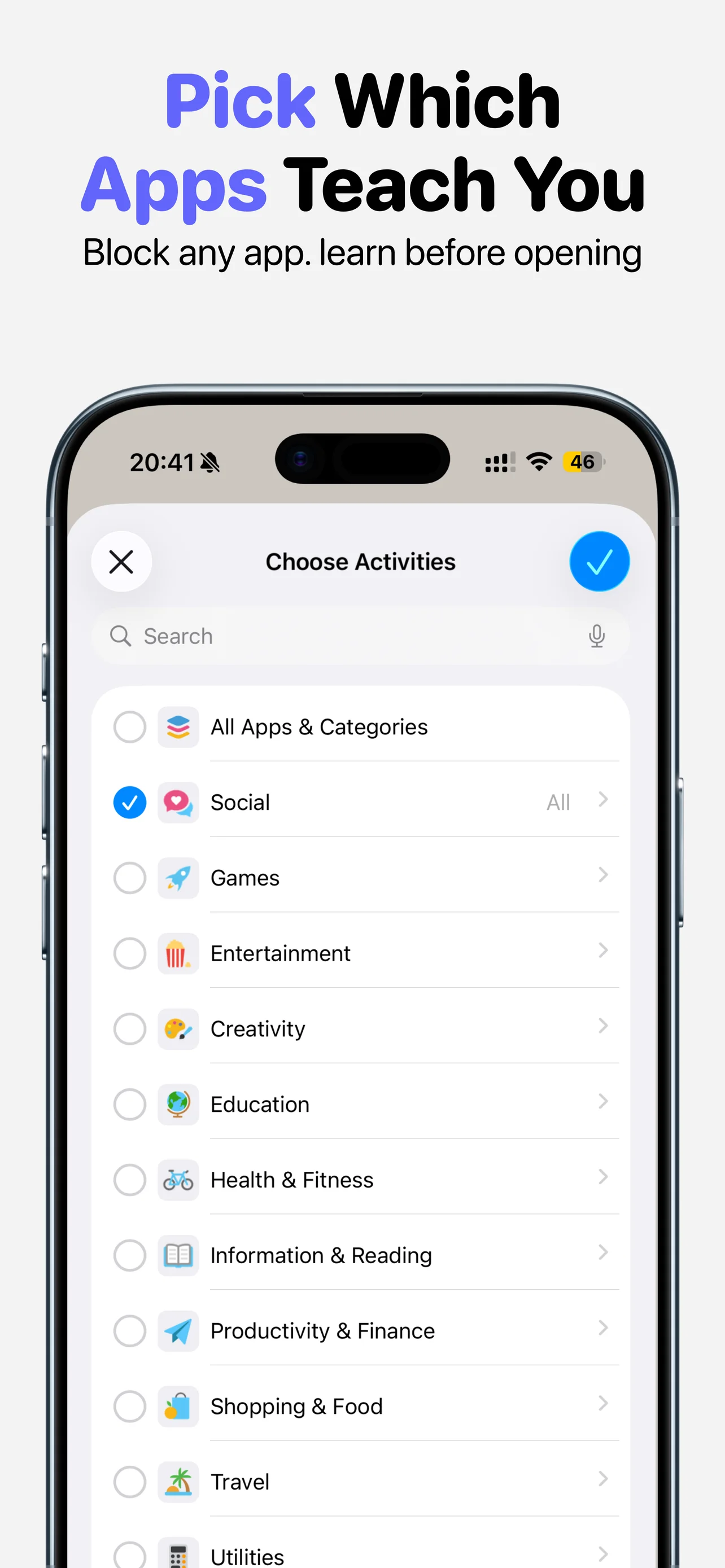
Phones get checked about 186 times a day, roughly 11.6 times per waking hour (Reviews.org, 2026). Using Apple's Screen Time API, LearnScreen shields the apps you choose and puts a word there instead — so the deliberate strand lands on a reach you were already making, with nothing to schedule.
It carries both halves
Every word holds a translation, a transcription and an example sentence, so the unambiguous gloss and the one good context sit on the same card. That is the presentation Laufer and Shmueli (1997) found retained best, rather than a bare pair or a paragraph of prose.
It waits before answering
The answer stays hidden until you tap, so the encounter is a retrieval rather than a reading. A Leitner schedule then stretches the gap as the word firms up and brings back the ones you missed — rows one to three of the table above, without you managing any of it.
- You set the dose. Words per session adjust from 3 to 20, as does how often the shield returns — the defaults come to roughly 25 recall attempts a day, about two and a half minutes spread across it.
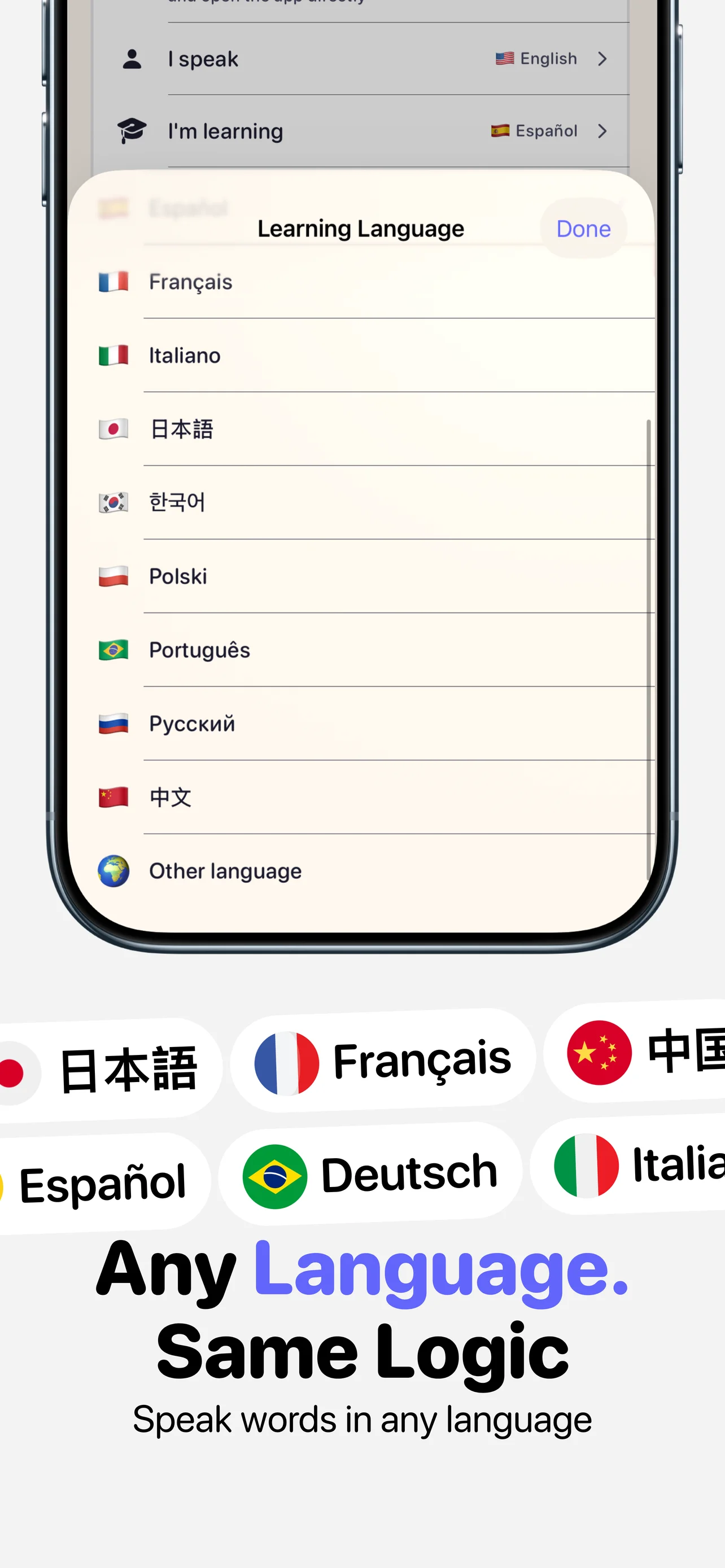
- 1,080+ curated words across 18 topics. Eleven languages are supported as learning targets, and unlimited custom words can be added with their own translation, transcription and example sentence — so a word you keep failing gets a context of your choosing.
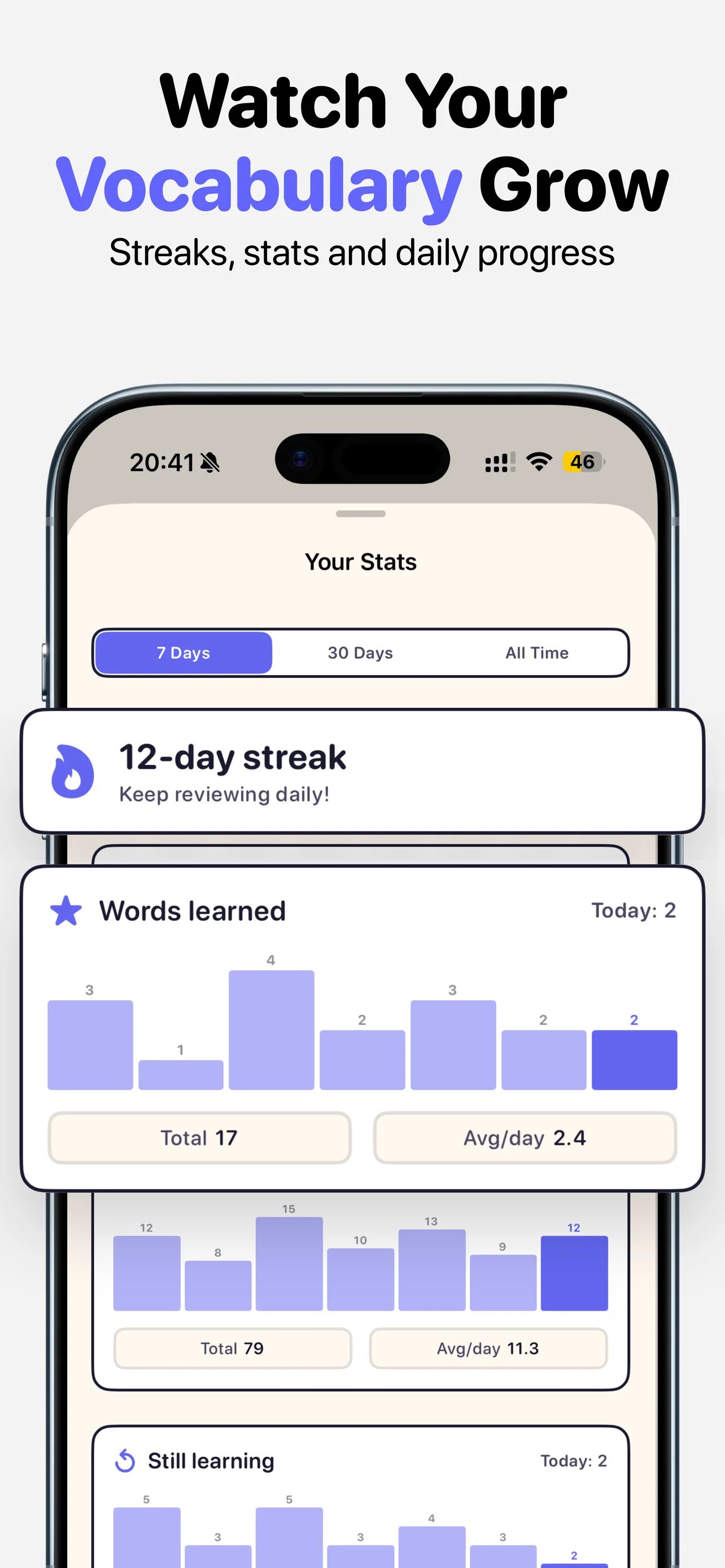
- Nothing is lost when you fall behind. There is no streak to break and no penalty for a quiet week; missed words stay in the queue, and a half-known word is cheaper to finish than a new one is to start.
- It works offline, with no account. Cards and shields run without a network once installed; iCloud backup writes to your own private database rather than our servers, and there is nothing to sign up for.
Related reading
- Which words should you learn first? — which word earns a card in the first place, before the question of what goes on it.
- Does passive learning actually work? — what exposure alone produces, and the four conditions it needs.
- Active vs passive vocabulary — why you understand words you can't say, and what changes it.
- How many times do you need to see a word? — where the 8–12 encounters figure comes from.
- Why do I forget vocabulary I've learned? — what happens to a word between encounters.
- How often should you review vocabulary? — the intervals that catch a word before it slips.
- A passive Anki alternative — spaced repetition that does not wait for you to open it.
- How do you stay consistent? — why the plan is rarely what fails, and what a routine needs to survive.
Frequently asked questions
Sources
- Laufer, B., & Shmueli, K. (1997). Memorizing new words: Does teaching have anything to do with it? RELC Journal, 28(1), 89–108.
- Prince, P. (1996). Second language vocabulary learning: The role of context versus translations as a function of proficiency. Modern Language Journal, 80(4), 478–493.
- Webb, S. (2008). The effects of context on incidental vocabulary learning. Reading in a Foreign Language, 20(2), 232–245.
- Webb, S. (2007). The effects of repetition on vocabulary knowledge. Applied Linguistics, 28(1), 46–65.
- Horst, M., Cobb, T., & Meara, P. (1998). Beyond A Clockwork Orange: Acquiring second language vocabulary through reading. Reading in a Foreign Language, 11(2), 207–223.
- Elgort, I. (2011). Deliberate learning and vocabulary acquisition in a second language. Language Learning, 61(2), 367–413.
- Nation, I. S. P. (2001). Learning Vocabulary in Another Language. Cambridge University Press.
- Schmitt, N. (2008). Instructed second language vocabulary learning. Language Teaching Research, 12(3), 329–363.
- Bolger, D. J., Balass, M., Landen, E., & Perfetti, C. A. (2008). Context variation and definitions in learning the meanings of words. Discourse Processes, 45(2), 122–159.
- Hulstijn, J. H., Hollander, M., & Greidanus, T. (1996). Incidental vocabulary learning by advanced foreign language students: The influence of marginal glosses, dictionary use, and reoccurrence of unknown words. Modern Language Journal, 80(3), 327–339.
- Nation, I. S. P., & Wang, K. (1999). Graded readers and vocabulary. Reading in a Foreign Language, 12(2), 355–380.
- Cepeda, N. J., Pashler, H., Vul, E., Wixted, J. T., & Rohrer, D. (2006). Distributed practice in verbal recall tasks: A review and quantitative synthesis. Psychological Bulletin, 132(3), 354–380.
- Karpicke, J. D., & Roediger, H. L. (2008). The critical importance of retrieval for learning. Science, 319(5865), 966–968.
- Craik, F. I. M., & Lockhart, R. S. (1972). Levels of processing: A framework for memory research. Journal of Verbal Learning and Verbal Behavior, 11(6), 671–684.
- Reviews.org (2026). Cell Phone Usage Stats. Survey of ~1,000 US adults, fielded Q4 2025. Report
The context-versus-translation studies used classroom learners of English and Hebrew on written measures, with small samples and differing designs; they establish the direction of the difference, not a general ratio. Retention and spacing effects come from the studies named in each row. Card counts and daily totals are arithmetic from a roughly twenty-second recall attempt, not measured app data.
Get the word and its sentence, without opening anything
LearnScreen puts the deliberate quarter of the work — a pair, a sentence, and a pause before the answer — into phone checks you were making anyway. It asks for about twenty seconds, and nothing else in your day has to move.
Download on the App Store