How many times do you
need to see a word?
Roughly 8–12 encounters for a word you meet while reading — individual studies report anywhere from 6 to more than 20. The count falls when each encounter is a recall attempt rather than a glance, and falls further when the encounters are spread across days instead of stacked in one sitting. The hard part was never the number; it’s getting that many spaced repetitions into an ordinary week.
Sources cited in full at the foot of the page
The short answer: 8–12 encounters
There is no magic number, but the research clusters tightly enough to plan around. Four findings do most of the work:
- About 10 encounters is the usual threshold. Nation and Wang (1999) found words were substantially more likely to be learned after around ten meetings in context, though even then acquisition wasn’t guaranteed. Pigada and Schmitt (2006) reported the same shape: a marked jump in learning at roughly ten or more exposures.
- The published range is 6 to 20+. Different studies land on 6, 8, 10, 12 or more than 20, depending on the word, the learner and how learning was measured. Treat 8–12 as the planning figure, not a guarantee.
- Repetition is a medium-sized effect, not a magic one. A meta-analysis of 45 effect sizes from 26 studies (N = 1,918) put the correlation between number of encounters and incidental vocabulary learning at r = .34 (Uchihara, Webb & Yanagisawa, 2019). Frequency matters — it just isn’t the only thing that does.
- Spacing was one of the moderators. The same meta-analysis found the size of the repetition effect varied with, among other things, whether the encounters were spaced. When you meet the word again changes how much that meeting is worth.
So the honest one-line answer: plan for about ten good encounters per word, and care as much about their spacing and quality as their count.
Not all encounters are worth the same
“Seeing” a word and “being asked for” a word are different events in memory. Roediger and Karpicke (2006) had learners either re-read material or take recall tests on it the same number of times. Re-reading won when the final test came five minutes later — and lost badly when it came two days or a week later. Retrieval, not exposure, is what survives the delay.
That’s why a flashcard you have to answer buys more progress per encounter than a word list you skim, and why the 8–12 figure — measured on incidental reading — is an upper bound rather than a target when you’re actively recalling.
| Kind of encounter | What it does to memory | Encounters needed |
|---|---|---|
| Meeting it while reading | Meaning inferred from context; recognition builds slowly | ~8–12, sometimes 20+ |
| Re-reading a word list | Familiarity without recall — feels easy, fades fast | Many, and low value each |
| Answering a flashcard | Active retrieval — the effortful attempt is the learning | Fewer, and each one counts |
| Answering on a spaced schedule | Retrieval timed near the edge of forgetting | Fewest — retrieval plus spacing compound |
Prefer the classic deck-based version of the bottom row? See how a passive scheduler compares as an Anki alternative.
When the repetitions happen matters as much as how many
Hermann Ebbinghaus mapped the forgetting curve in 1885: new material drops away sharply in the first days unless it’s revisited. Every repetition schedule since has been an attempt to place encounters where that curve is steepest.
The modern synthesis is unambiguous. Cepeda, Pashler, Vul, Wixted and Rohrer (2006) reviewed 839 assessments of distributed practice across 317 experiments in 184 articles and found spaced study reliably outperforms massed study — and that the optimal gap between encounters grows as the delay before the test grows. Ten encounters in one evening and ten encounters over three weeks are not the same ten encounters.
In practice that means an expanding schedule. A Leitner system — the box method spaced-repetition apps are built on — produces one automatically: get a word right and it moves to a slower box; get it wrong and it drops back to a fast one.
| Leitner box | Gap before the next attempt | Where you are with the word |
|---|---|---|
| Box 1 | Same day | Brand new, or just got it wrong |
| Box 2 | ~1 day | Recognised once; still fragile |
| Box 3 | ~3 days | Recalled without the context clue |
| Box 4 | ~1 week | Surviving a real delay |
| Box 5 | ~2–4 weeks | Effectively known; occasional check-ins |
Illustrative intervals in the Leitner tradition; exact gaps vary by implementation. LearnScreen uses a Leitner schedule of this shape.
Where ten encounters per word actually come from
Here’s the practical problem. Ten spaced retrievals per word, across a 20-word rotation, is 200 recall attempts — and a study session you have to remember to start is the least reliable way to produce them. The most reliable source of repeated moments in a modern day is the phone itself.
Reviews.org’s 2026 cell-phone usage survey (fielded Q4 2025, ~1,000 US adults) found people check their phone 186 times a day — about 11.6 times an hour. That is an enormous, already-existing budget of repetitions, currently spent on feeds.
| Step | Figure | Where it comes from |
|---|---|---|
| Phone checks per day | 186 | Reviews.org 2026 survey, US adults |
| Share landing on a shielded app | 15% | Assumption — the apps you chose to block |
| Recall attempts per day | ~28 | One flashcard per shielded open |
| Words in the active rotation | 20 | A typical working set |
| Days to ~10 encounters each | ~7 | 28 ÷ 20 ≈ 1.4 per word per day |
Arithmetic, not a promise. Your pickup count and blocked-app share will differ, and a spaced scheduler deliberately doesn’t spread encounters evenly — it front-loads the words you keep missing and backs off the ones you know.
Getting the encounters
without scheduling them
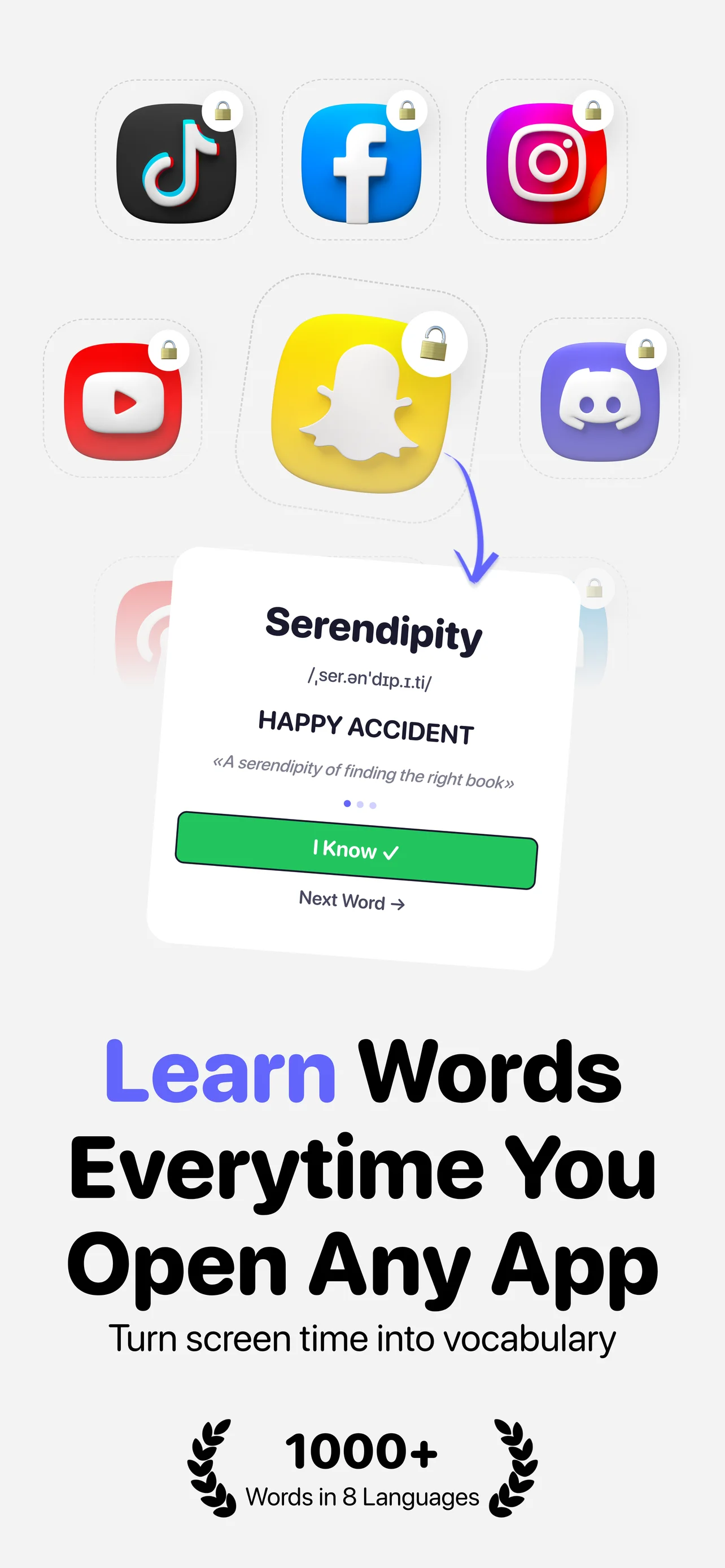
The repetitions have to happen. They don’t have to be planned by you. LearnScreen attaches each one to a habit you already repeat dozens of times a day.
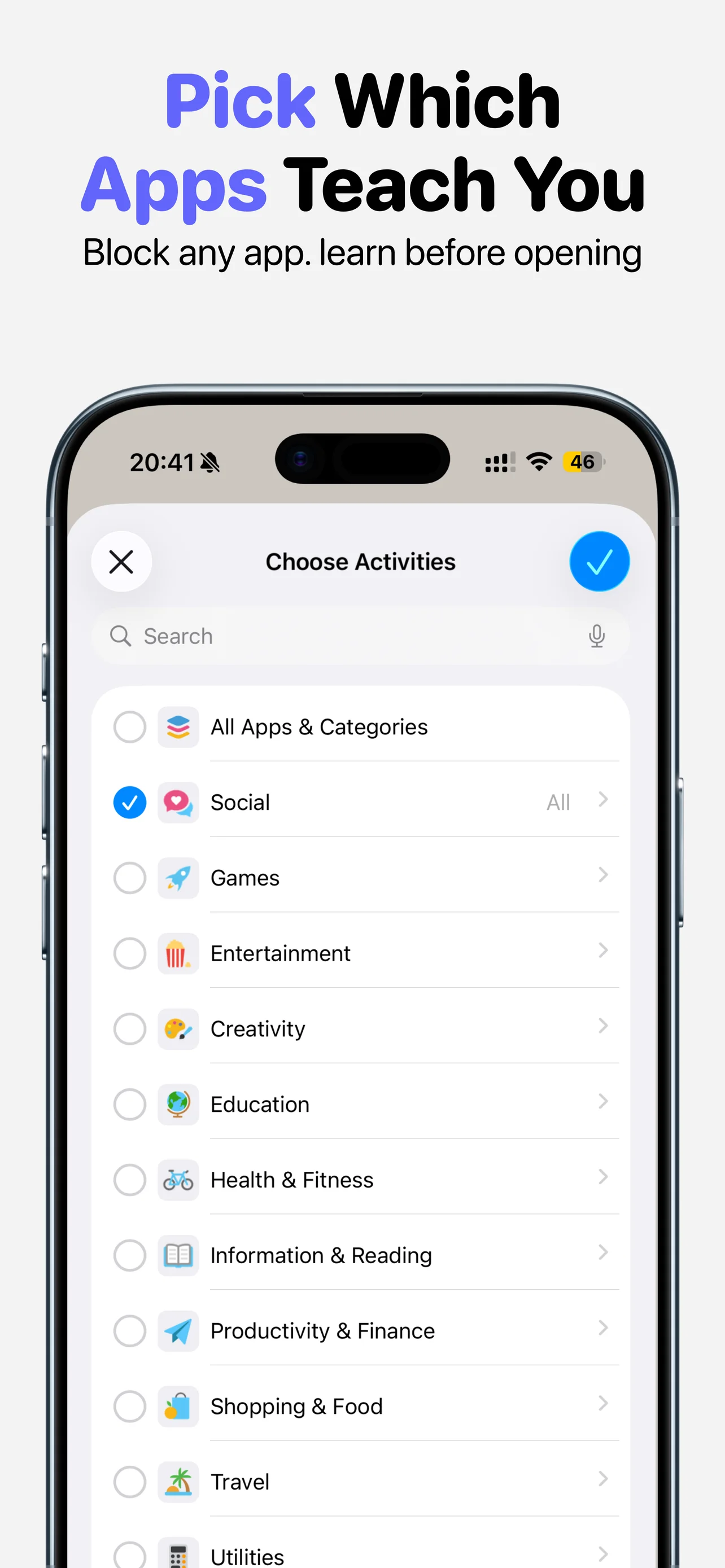
Choose the trigger apps
Pick the apps that pull you in — Instagram, TikTok, X, games. They’re shielded at the OS level through Apple’s Screen Time API, so there’s no VPN or DNS trick to route around it.
Each open becomes a retrieval
A vocabulary card appears before the app does. You answer it — a real recall attempt, the kind of encounter that survives a delay — and the app unlocks for a set window.
The schedule picks the word
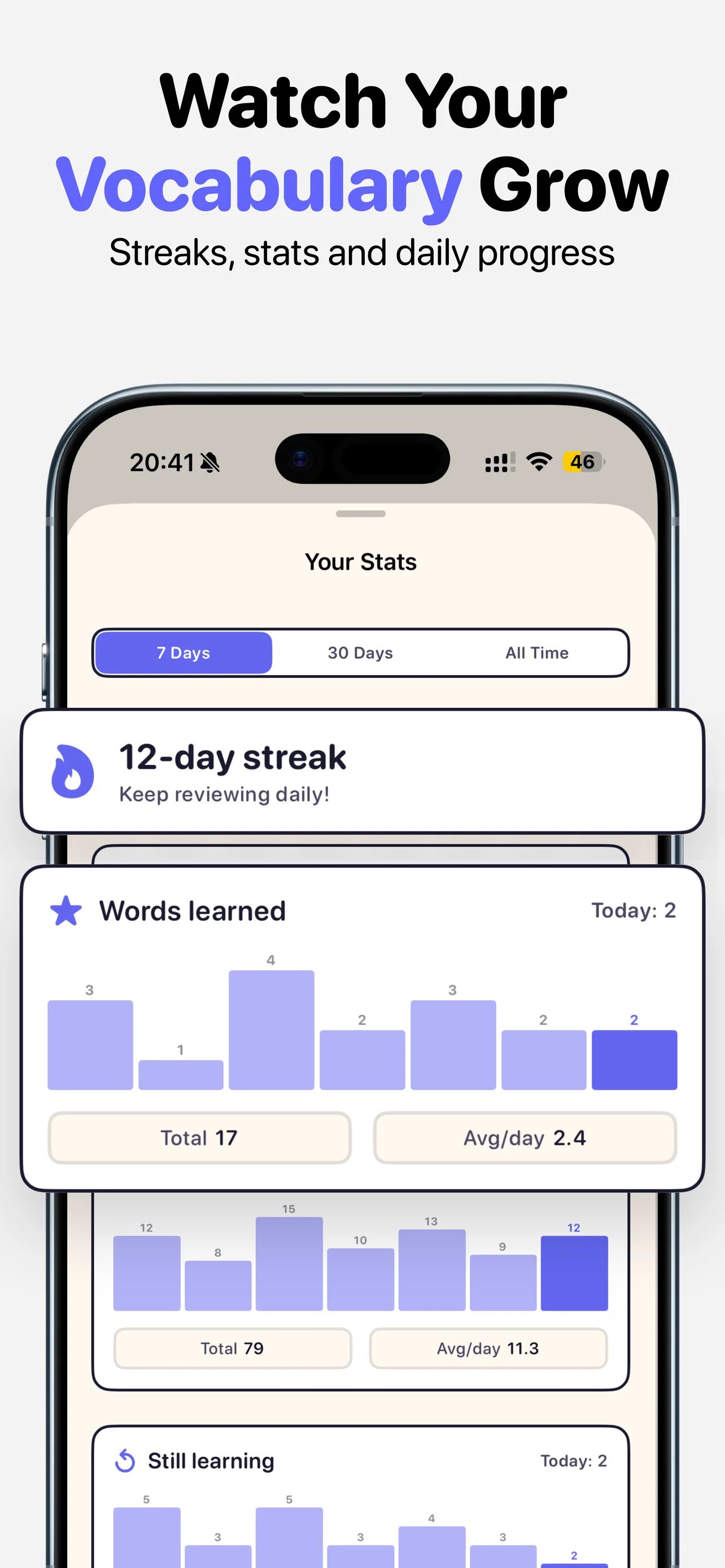
A Leitner spaced-repetition schedule chooses which word you see. Words you missed come back fast; words you know back off. The spacing is handled without you tracking anything.
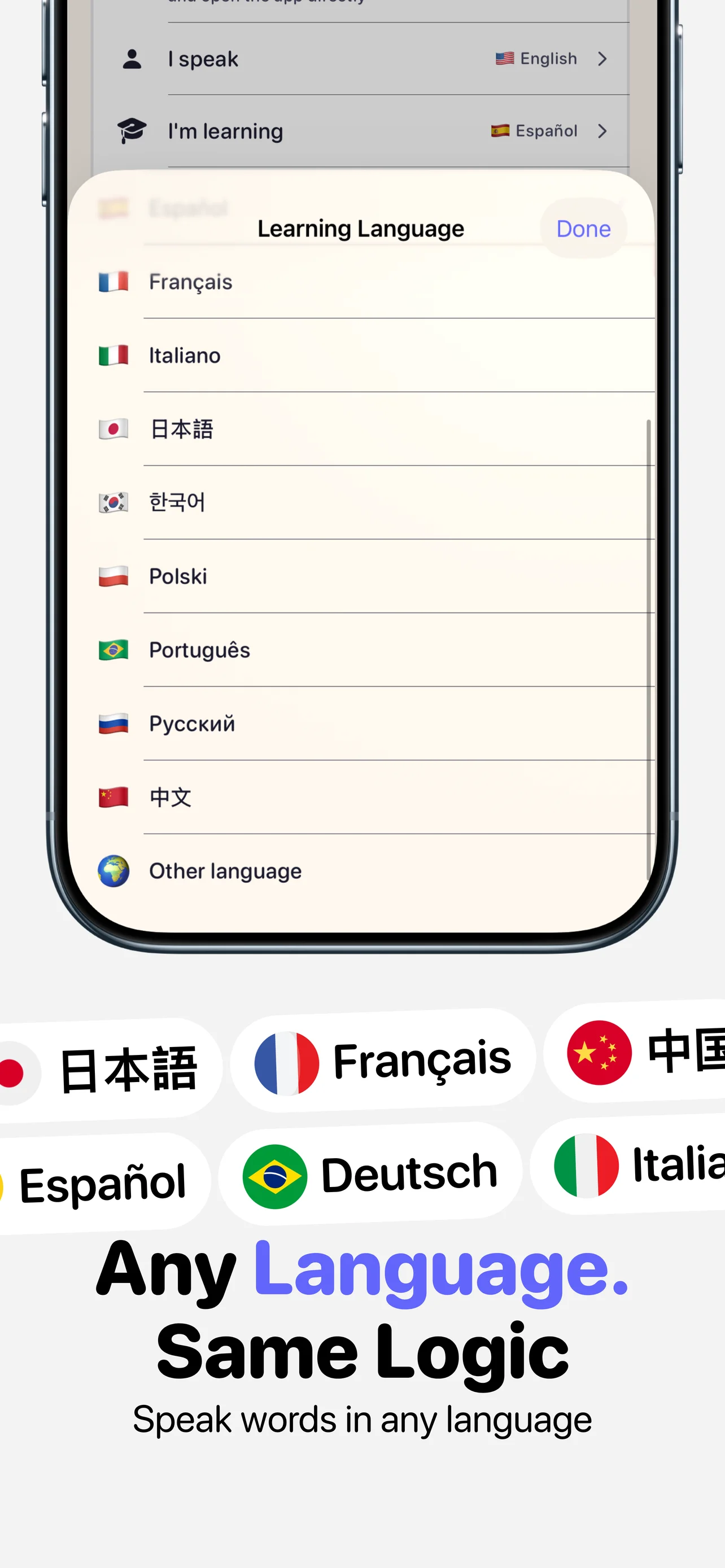
- 1,080+ curated words across 18 topics in 11 languages — English, German, Spanish, French, Italian, Japanese, Korean, Polish, Brazilian Portuguese, Russian and Mandarin Chinese.
- Your own words too — add any word with translation, transcription and an example sentence, and it enters the same rotation.
- Works offline. Cards and shields run with no network once installed; iCloud backup is opportunistic and uses your own private database.
- No account. No signup, no email, no password — nothing between installing and the first encounter.
Related reading
- How many words to speak a language — how many of these words you actually need: ~2,000–3,000 families for conversation.
- How many words a day should you learn? — what these encounter counts add up to as a daily review load.
- Does passive learning actually work? — what the incidental-learning studies found: ~22% of unknown words from a whole book.
- Passive learning — how vocabulary practice can run without a decision to study.
- Microlearning — why seconds-long bursts beat one long session for retention.
- Anki alternative — spaced repetition without building or opening a deck.
- Should you learn words in context or alone? — what those encounters should look like, not just how many.
- Active vs passive vocabulary — why encounters in one direction don't buy you the other.
- Lock-screen language learning — where the encounter actually appears on iPhone.
- Productive screen time — turning the 186 daily pickups into something that compounds.
- Why do you forget vocabulary you have learned? — what happens to a word between those encounters, and why the gap decides it.
- How do you stay consistent? — why the plan is rarely what fails, and what a routine needs to survive.
Repetition FAQ
Sources
- Uchihara, T., Webb, S., & Yanagisawa, A. (2019). The Effects of Repetition on Incidental Vocabulary Learning: A Meta-Analysis of Correlational Studies. Language Learning, 69(3), 559–599. Record
- Cepeda, N. J., Pashler, H., Vul, E., Wixted, J. T., & Rohrer, D. (2006). Distributed practice in verbal recall tasks: A review and quantitative synthesis. Psychological Bulletin, 132(3), 354–380. Record
- Roediger, H. L., & Karpicke, J. D. (2006). Test-enhanced learning: Taking memory tests improves long-term retention. Psychological Science, 17(3), 249–255. Record
- Ebbinghaus, H. (1885). Memory: A Contribution to Experimental Psychology. Full text
- Nation, P., & Wang, K. (1999). Graded readers and vocabulary. Reading in a Foreign Language, 12(2), 355–380.
- Pigada, M., & Schmitt, N. (2006). Vocabulary acquisition from extensive reading: A case study. Reading in a Foreign Language, 18(1), 1–28.
- Reviews.org (2026). Cell Phone Usage Stats: Americans Check Their Phones 186 Times a Day. Survey of ~1,000 US adults, fielded Q4 2025. Report
Last reviewed 27 July 2026.
Start collecting
encounter number one
No account. Works offline. The next time you reach for a shielded app, that’s one repetition down.
Download for iOS