How many words a day
should you learn?
There is no research-backed magic number, but the arithmetic pins the range down. A word needs roughly 8–12 spaced encounters before it stays (Nation & Wang, 1999; Pigada & Schmitt, 2006), so every new word you add today becomes about nine future reviews. Ten a day settles into a steady state of ~90 recall attempts a day — around 9 minutes at 6 seconds a card — and reaches the 3,000 word families that cover everyday conversation in roughly 10 months. The right pace is the largest one whose review load you will still be doing in week twelve.
Every figure below is sourced at the end of the page
What each daily pace actually costs
Picking a daily number is really picking a daily review load. If a word takes about nine encounters to stick and you add W new words a day, then once the pipeline fills you are doing roughly W × 9 recall attempts every day — forever, until you stop adding. That steady state, not the intake, is what people actually quit.
The table below uses nine encounters per word (the midpoint of the 8–12 range) and six seconds per card, which is about what a two-sided recognition card takes when you know the answer or know that you don't.
| New words/day | To 3,000 families | Reviews/day at steady state | Minutes/day |
|---|---|---|---|
| 3 | ~2 years 9 months | ~27 | ~3 min |
| 5 | ~1 year 8 months | ~45 | ~4–5 min |
| 10 | ~10 months | ~90 | ~9 min |
| 15 | ~7 months | ~135 | ~14 min |
| 30 | ~3 ½ months | ~270 | ~27 min |
Time-to-target assumes every word sticks on schedule; budget 20–30% more for words that fall back through the queue. The review column is the steady state reached after the first few weeks, not day one — which is exactly why fast paces feel easy at the start.
Why the ceiling is review load, not new words
You can meet fifty new words in a single morning. What you cannot do is meet the 450 recall attempts they generate over the following weeks. Vocabulary paces fail on the second number, and they fail late enough that the first number feels like it worked.
- Intake is cheap, retention is expensive. Reading a word once costs seconds; carrying it to the eighth or twelfth encounter is where nearly all the time goes, and it is the part a daily goal usually forgets to count.
- The load arrives late. Today's ten words schedule reviews across the next several weeks, so week one is light and week four is where a pace is actually tested. Judging a daily number by how the first week felt is how people overcommit.
- A missed day is not free. The reviews do not vanish, they queue — and forgetting keeps running while they wait, so a skipped day costs more than the reviews you skipped.
Where the 8–12 figure comes from, and how recall attempts change it: how many times you need to see a word to remember it.
How long each vocabulary target takes at ten words a day
Vocabulary targets are usually quoted in word families, and the useful ones are tied to lexical coverage — the share of the words in ordinary speech or text you already know. Nation (2006) puts the first 1,000 families at roughly 80% of everyday speech, with each following thousand adding less.
| Target (word families) | What it buys you | At 10 words/day |
|---|---|---|
| 500 | Signs, menus, survival phrases | ~2 months |
| 1,000 | ~80% coverage of everyday speech | ~3 months |
| 2,000–3,000 | ~95% coverage — you can hold a conversation | ~7–10 months |
| 5,000 | Most of a news broadcast without stopping | ~1 year 5 months |
| 6,000–7,000 | ~98% coverage of speech — comfortable listening | ~1 year 8 months to 2 years |
| 8,000–9,000 | Novels and newspapers unassisted | ~2¼ to 2½ years |
Coverage figures from Nation (2006) and Adolphs & Schmitt (2003). What each band means in practice, with the CEFR mapping: how many words you need to speak a language.
Does a bigger daily number make you faster?
Only up to the point where the reviews still happen. Cepeda and colleagues (2006) synthesised 254 studies of distributed practice and found the same total study time produces substantially better retention when it is spread out rather than massed — so a large daily block is not simply a small one scaled up. Doubling the intake doubles the review debt, and review debt is paid in days you may not have.
Forgetting is what sets the deadline. Ebbinghaus's 1885 curve — replicated with modern controls by Murre and Dros (2015) — shows the steepest loss in the first day after learning. That is why a word met once on Monday and not seen again until Sunday is, for most learners, a word met once. The daily number only counts encounters that land before the memory decays.
The long view is even less flattering to cramming. Bahrick and Phelps (1987) tested people on Spanish vocabulary eight years after they learned it and found retention tracked how widely the original sessions had been spaced, not how hard any single session had been. The pace that wins is not the ambitious one; it is the one still running in month three.
The same 90 encounters, four different shapes
Suppose you have committed to ten new words a day and the resulting ninety-odd recall attempts. How you distribute them across the day changes both what you retain and how likely you are to do it at all.
Nothing below changes the total. All four rows are the same amount of work.
| Shape of the day | What the research predicts | What it needs from you |
|---|---|---|
| One 9-minute block | Massed within the session; weakest long-term retention of the four (Cepeda et al., 2006) | Nine protected minutes you have to defend every day |
| Two 4–5 minute blocks | Clearly better than one — the gap between sessions is doing the work | Two slots that survive a busy day |
| Bursts spread through the day | Most spacing per encounter, and each one is a recall attempt rather than a re-reading (Roediger & Karpicke, 2006) | A trigger that fires without you deciding |
| Skipped — the busy-day default | Zero encounters, and the queue rolls into tomorrow while forgetting continues | Nothing, which is precisely the problem |
The fourth row is the one that decides most outcomes. A schedule that depends on remembering to study competes with everything else in the day; a schedule attached to something you already do does not.
Where the encounters come from if you never sit down
The third row above needs a trigger that fires on its own, many times a day, without a decision. Most people already have one in their pocket.
The trigger already fires
Americans check their phones about 186 times a day — roughly 11.6 times an hour of waking time (Reviews.org, 2026). A daily vocabulary pace does not need a new slot in your schedule; it needs to attach to a slot that already repeats.
Turn the reach into a recall attempt
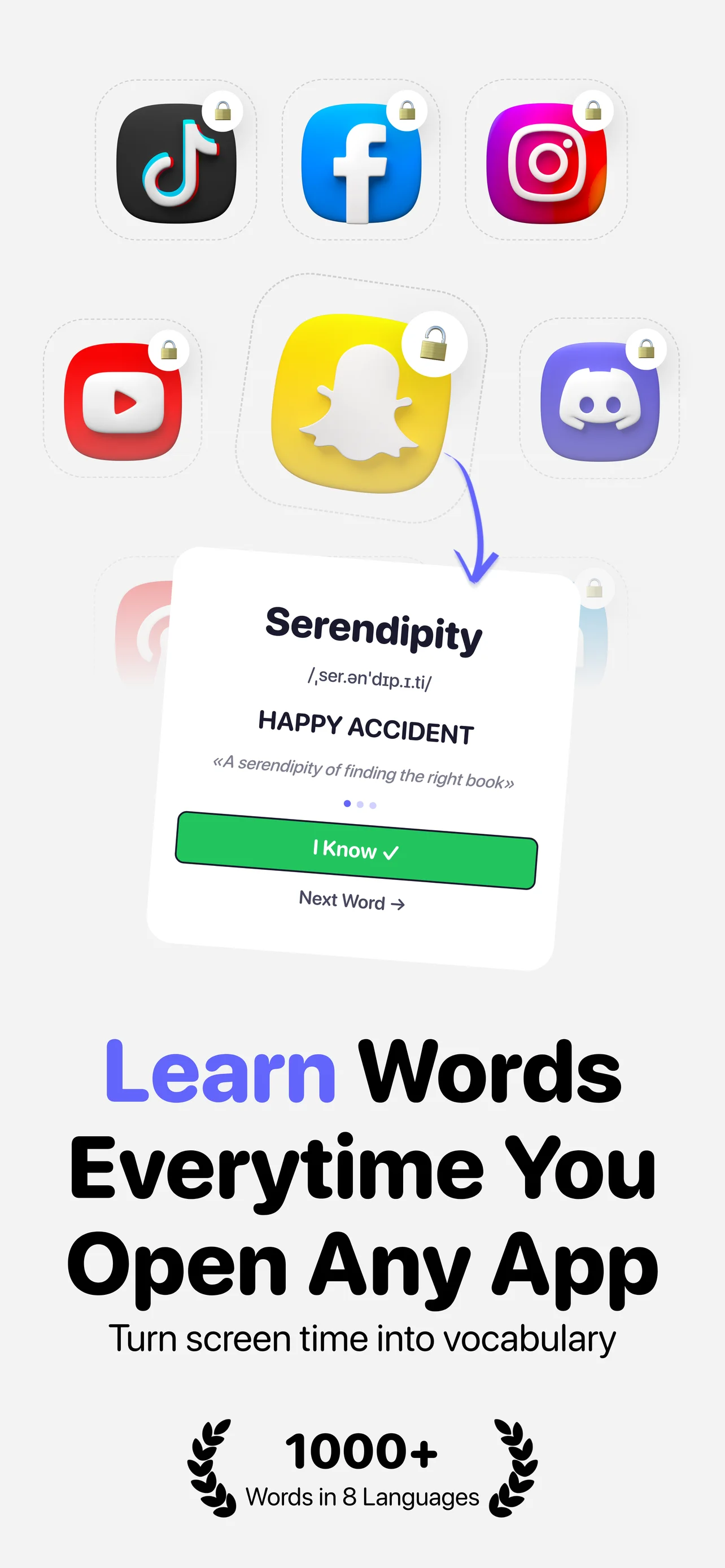
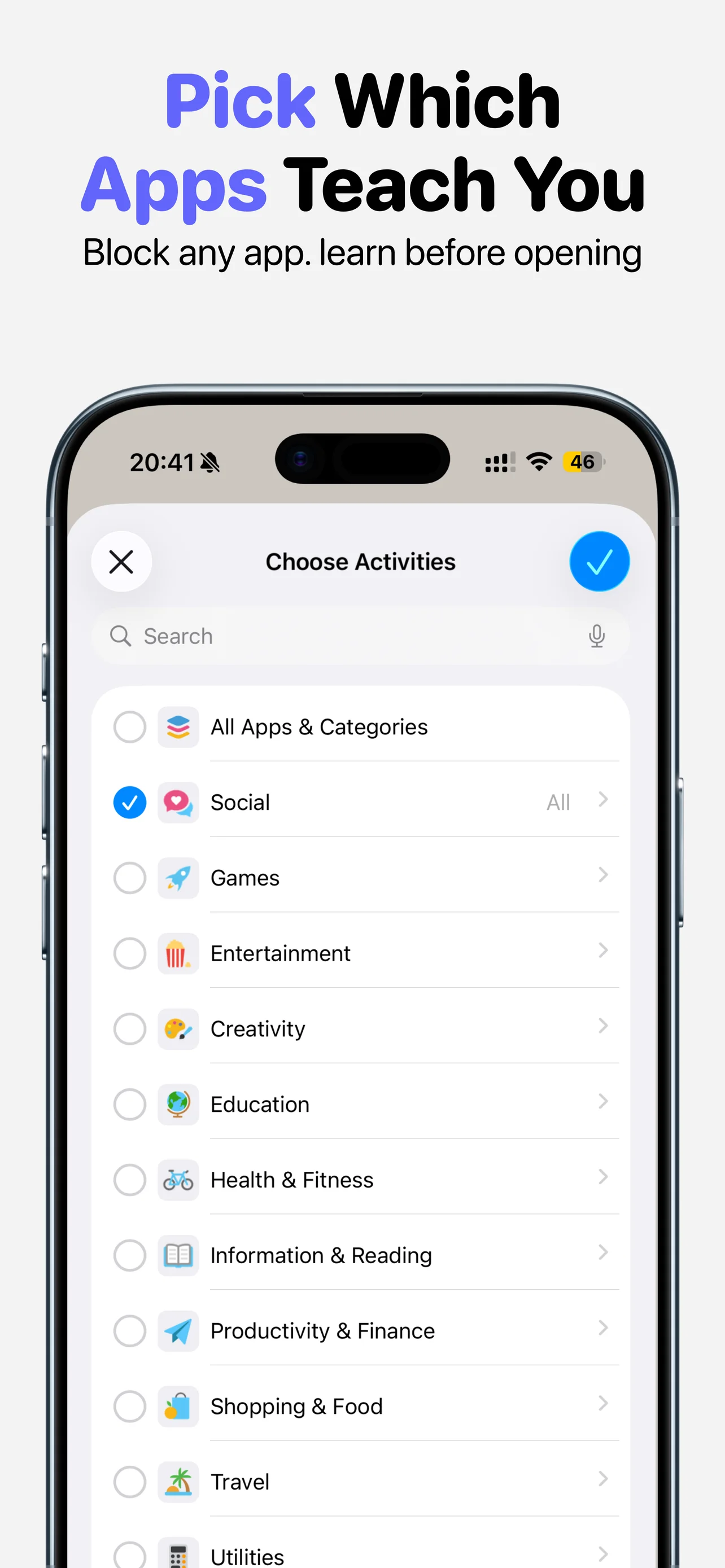
LearnScreen uses Apple's Screen Time API to shield the apps you choose. Opening one shows a vocabulary card instead of the feed; answer it and the app unlocks for a set window. The encounter is a retrieval attempt, which is the kind that counts (Roediger & Karpicke, 2006).
Let the queue decide the spacing
A Leitner schedule picks which word appears: one you just missed returns quickly, one you knew backs off geometrically. You never choose what to review, so the 8–12 encounters land spread out instead of stacked into one sitting.
- You set the daily load directly. Words per session is adjustable from 3 to 20, and so is the number of times a day the shield returns. The default of five sessions of five words is about 25 recall attempts a day, which sustains roughly a three-new-words-a-day pace; turning both up moves you toward the ten-a-day row of the table above.
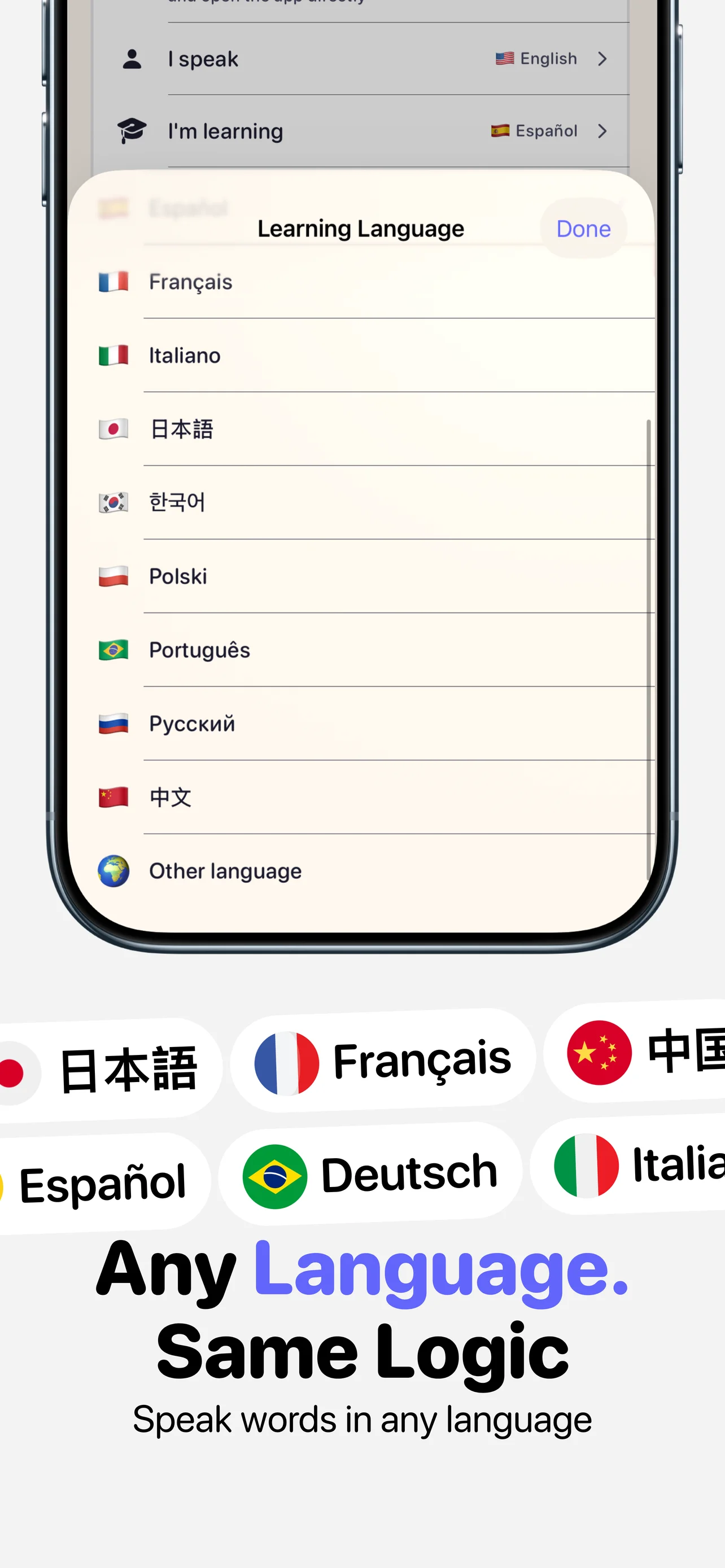
- 1,080+ curated words across 18 topics. Eleven languages are supported as learning targets, and you can add unlimited custom words with translation, transcription and an example sentence.
- It works offline. Cards and shields run with no network once installed; iCloud backup is opportunistic and writes to your own private database rather than our servers.
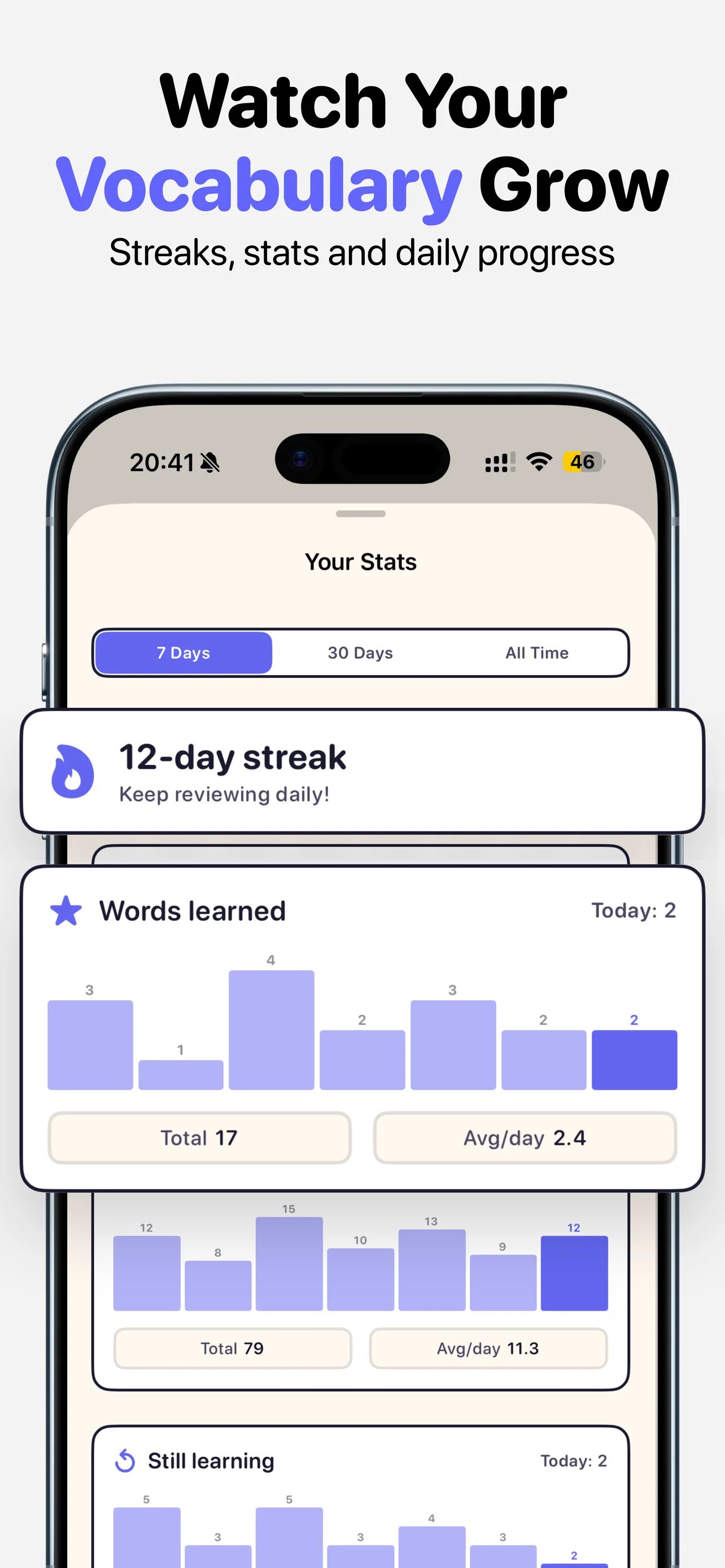
- No account and no streak to break. Nothing to sign up for, and no chain that punishes a light day — the queue simply carries the word forward to the next time you reach for a blocked app.
Related reading
- Which words should you learn first? — what to put in the queue once the daily pace is set; selection moves the result more than speed does.
- How many words do you need to speak a language? — the size of the target, by coverage and CEFR band.
- How many minutes a day to learn a language? — the same question measured in time rather than words.
- How many times do you need to see a word? — where the 8–12 encounters figure comes from.
- Microlearning for languages — why seconds-long bursts beat scheduled sessions.
- Does passive learning actually work? — the evidence on what exposure alone returns, and the four conditions.
- Passive language learning — accumulating vocabulary without a study block.
- A passive Anki alternative — spaced repetition that comes to you.
- Why do you forget vocabulary you have learned? — the decay that turns yesterday’s new words into today’s review load.
Frequently asked questions
Sources
- Nation, I. S. P., & Wang, K. (1999). Graded readers and vocabulary. Reading in a Foreign Language, 12(2), 355–380.
- Pigada, M., & Schmitt, N. (2006). Vocabulary acquisition from extensive reading: A case study. Reading in a Foreign Language, 18(1), 1–28.
- Cepeda, N. J., Pashler, H., Vul, E., Wixted, J. T., & Rohrer, D. (2006). Distributed practice in verbal recall tasks: A review and quantitative synthesis. Psychological Bulletin, 132(3), 354–380.
- Roediger, H. L., & Karpicke, J. D. (2006). Test-enhanced learning: Taking memory tests improves long-term retention. Psychological Science, 17(3), 249–255.
- Bahrick, H. P., & Phelps, E. (1987). Retention of Spanish vocabulary over 8 years. Journal of Experimental Psychology: Learning, Memory, and Cognition, 13(2), 344–349.
- Murre, J. M. J., & Dros, J. (2015). Replication and analysis of Ebbinghaus' forgetting curve. PLOS ONE, 10(7), e0120644.
- Nation, I. S. P. (2006). How large a vocabulary is needed for reading and listening? Canadian Modern Language Review, 63(1), 59–82.
- Adolphs, S., & Schmitt, N. (2003). Lexical coverage of spoken discourse. Applied Linguistics, 24(4), 425–438.
- Reviews.org (2026). Cell Phone Usage Stats. Survey of ~1,000 US adults, fielded Q4 2025. Report
Encounter counts, coverage percentages and CEFR bands come from the published research above. The arithmetic in the tables is ours: encounters per word held at nine, six seconds per card, and no allowance for lapses.
Pick a pace you will still be doing in week twelve
LearnScreen puts the encounters inside phone use you already have, so the daily number does not depend on finding a study slot.
Download on the App Store