Does passive learning
actually work?
Partly, and slowly. Reading an entire book in a foreign language teaches you the meanings of about 22% of the unknown words in it (Horst, Cobb & Meara, 1998), and a word generally needs 8–12 spaced encounters before it stays (Nation & Wang, 1999). So pure exposure works only at enormous volume. What makes effortless learning actually work is not removing the effort but relocating it: keep the delivery passive — no session to schedule, no decision to make — and make the moment itself active. Repeated retrieval beats repeated exposure so decisively that dropping it cut week-later recall from ~80% to ~35% in Karpicke and Roediger's (2008) experiment, with total study time held constant.
Every figure below is sourced at the end of the page
How much does passive exposure actually teach?
This question has a research literature attached to it, under the name incidental vocabulary acquisition: what learners pick up from meaning-focused input when nobody told them to learn any words. The studies are small, and they measure receptive knowledge rather than the ability to produce a word in conversation — but they point the same way, and the direction is consistent enough to plan around.
The headline is that passive exposure genuinely works and is genuinely inefficient. Every study below found real gains from reading alone. None of them found gains fast enough to carry a learner to conversational coverage in a reasonable time.
| Study | What learners did | What stuck |
|---|---|---|
| Horst, Cobb & Meara (1998) | Read a simplified novel of about 21,000 words | Meanings of roughly 22% of the unknown words tested — about one word in five |
| Waring & Takaki (2003) | Read one graded reader; tested immediately, then again three months later | Recognition faded sharply over the three months; words met fewer than about eight times rarely survived |
| Pigada & Schmitt (2006) | One learner read about 30,000 words of French over a month | Some measurable gain on about 65% of 133 tracked words — mostly spelling; full meaning far rarer |
| Webb (2007) | Met target words 1, 3, 7 or 10 times in context | Knowledge rose with every additional encounter; ten was still short of full knowledge |
| Nation & Wang (1999) | Modelled how often words recur across graded-reader schedules | Learners need roughly one reader a week for words to repeat often enough to be learned |
These are small studies — Pigada and Schmitt followed a single learner — and they measure recognition, the easiest form of word knowledge, not production. Read them as an order of magnitude rather than a constant: exposure returns something like one word in five from a whole book, and the words that survive are the ones that happened to repeat.
Why “just absorb it” underperforms
The gap between how good immersion sounds and how little it returns per hour is not mysterious. Three specific things go wrong, and each of them is a property of exposure itself rather than of the learner's discipline.
- Recognising is not recalling. Exposure builds the weakest form of word knowledge first — you know you have seen it. Producing it on demand is a different skill, and it is trained by trying to produce it. Roediger and Karpicke (2006) found being tested on material beat re-reading it, even when re-reading took longer.
- Word frequency collapses fast. The first 1,000 word families cover about 80% of everyday speech (Nation, 2006), so they repeat constantly and are easy to absorb. Past that, the words you still need appear so rarely in ordinary input that the 8–12 encounters each one requires can take months of reading to accumulate.
- Exposure has no schedule. Forgetting runs on its own clock, steepest in the first day (Murre & Dros, 2015). Input arrives whenever it happens to arrive, so it almost never returns a word at the moment you are about to lose it — which is precisely the moment a review is worth most (Cepeda et al., 2008).
Where the 8–12 figure comes from, and what changes it: how many times do you need to see a word.
Which “passive” method does what?
“Passive” gets used for two completely different things: input you do not have to work at, and delivery you do not have to arrange. Only the second one is reliably a good idea. The column that predicts whether a method builds durable vocabulary is not how relaxing it is — it is whether anything in it asks you to retrieve.
| Method | Effort to start | Recall attempt? | Genuinely good at |
|---|---|---|---|
| Background audio you are not following | None | No | Sound patterns and rhythm; very little vocabulary |
| TV or film with subtitles | Low | No | Listening comprehension, high-frequency words, staying motivated |
| Extensive reading (graded readers) | Medium | No | The strongest incidental gains measured — at about a book a week |
| Songs on repeat | None | No | A small set of phrases, memorised very durably |
| A flashcard app you have to open | High — a daily decision | Yes | Everything, on the days it actually gets opened |
| A recall prompt that comes to you | None after setup | Yes | Spaced retrieval without a session to schedule or skip |
The two rows that build vocabulary fastest are the two with a recall attempt in them. The difference between them is not learning science, it is adherence: one depends on a decision you make every day, the other on a trigger that fires whether or not you decided anything.
So was Krashen wrong about input?
Not wrong — incomplete for this particular job. Krashen's (1985) input hypothesis holds that language is acquired by understanding messages slightly beyond your current level, and the case for comprehensible input as the engine of grammatical competence is strong. Nothing in the retrieval literature contradicts it. What the vocabulary numbers show is narrower: input is an excellent way to meet words and an inefficient way to keep them.
Karpicke and Roediger (2008) made the size of that gap hard to ignore. Learners studied foreign-language word pairs, and the experimenters manipulated whether items kept being restudied or kept being tested. Dropping repeated retrieval cut recall a week later from roughly 80% to roughly 35% — while dropping repeated study barely mattered. Total exposure was held constant. The retrieval attempt was doing nearly all of the work.
This is the uncomfortable part of the evidence, and it is worth stating plainly rather than selling around: the effort in learning is not waste to be engineered away. Bjork and Bjork (2011) call these conditions desirable difficulties — the moments that feel harder and less productive are frequently the ones that produce durable memory. What can honestly be automated is everything around the difficulty: when it happens, which word it uses, and whether you had to remember to start. Those are exactly the parts learners fail at, and exactly the parts a schedule can own.
The four conditions effortless learning has to meet
Strip the debate down and there are four requirements a word has to pass through before it is yours. Pure exposure satisfies one and a half of them. Any method that satisfies all four will work, whatever it is called.
The last column is the practical test: can this be handed to a system, or does it need you? Three of the four can be automated entirely. The fourth cannot, and any product claiming otherwise is selling recognition and calling it recall.
| Condition | What the research shows | Can it be automated? |
|---|---|---|
| Enough encounters | Roughly 8–12 for a word met in reading; knowledge still rising at ten exposures (Webb, 2007) | Yes — a queue can guarantee the count that reading leaves to chance |
| Spaced, not massed | 254 studies favour distributed practice (Cepeda et al., 2006); optimal gap is about 10–20% of the retention interval (Cepeda et al., 2008) | Yes — this is what a spaced-repetition schedule is |
| Retrieval, not review | Dropping repeated retrieval cut week-later recall from ~80% to ~35% (Karpicke & Roediger, 2008) | No — the recall attempt is the irreducible part; it costs you seconds |
| It has to keep happening | Forgetting is steepest in the first 24 hours (Murre & Dros, 2015), so gaps in the habit are not neutral | Yes — if the trigger is something you already do rather than something you remember to do |
Three automated conditions and one that costs about twenty seconds is the honest version of “learning without effort”. It is a much smaller claim than immersion makes, and unlike immersion it holds up against the numbers in the table above.
Passive delivery, active moment
This is the shape the evidence points at, and it is the shape LearnScreen is built in: the schedule does the three conditions that can be automated, and asks you for the one that cannot.
The trigger is already in your day
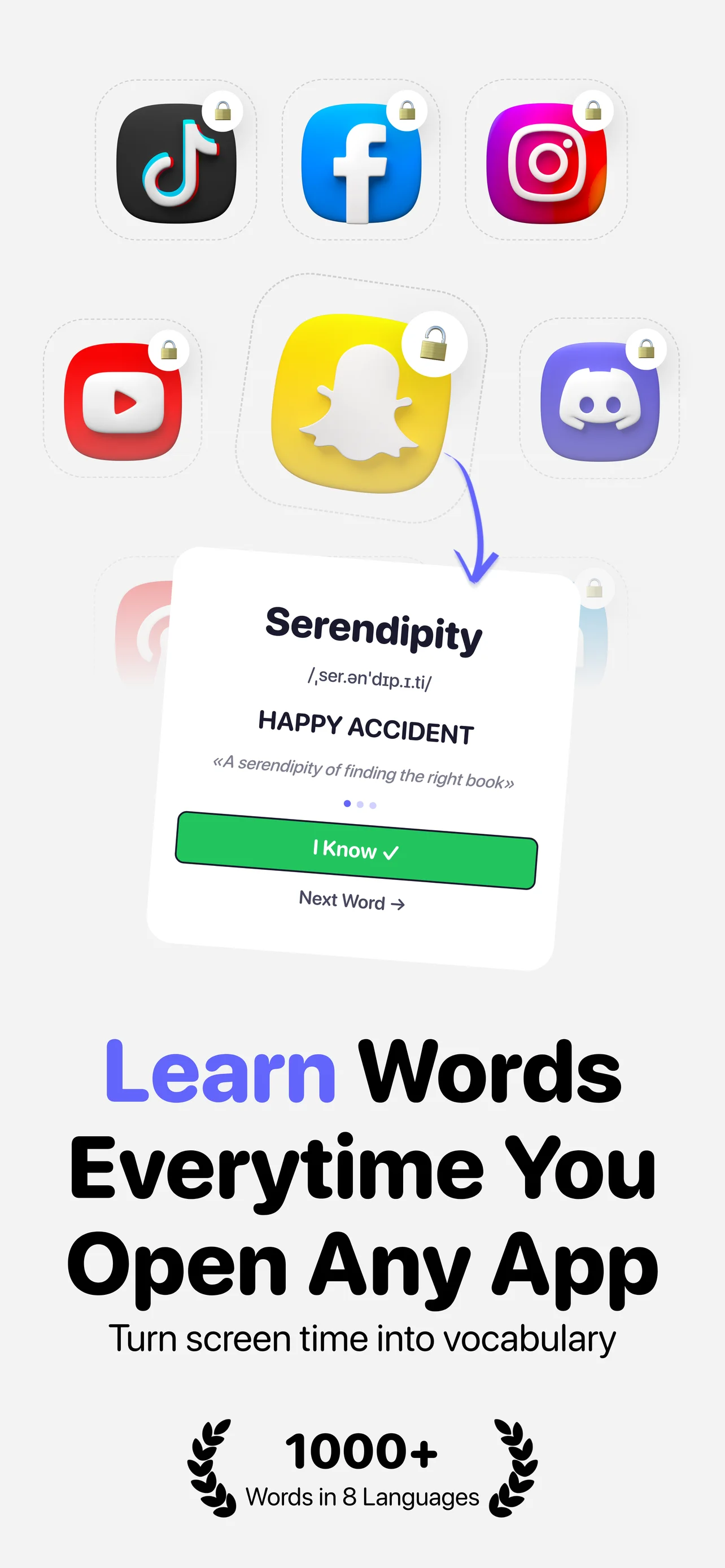
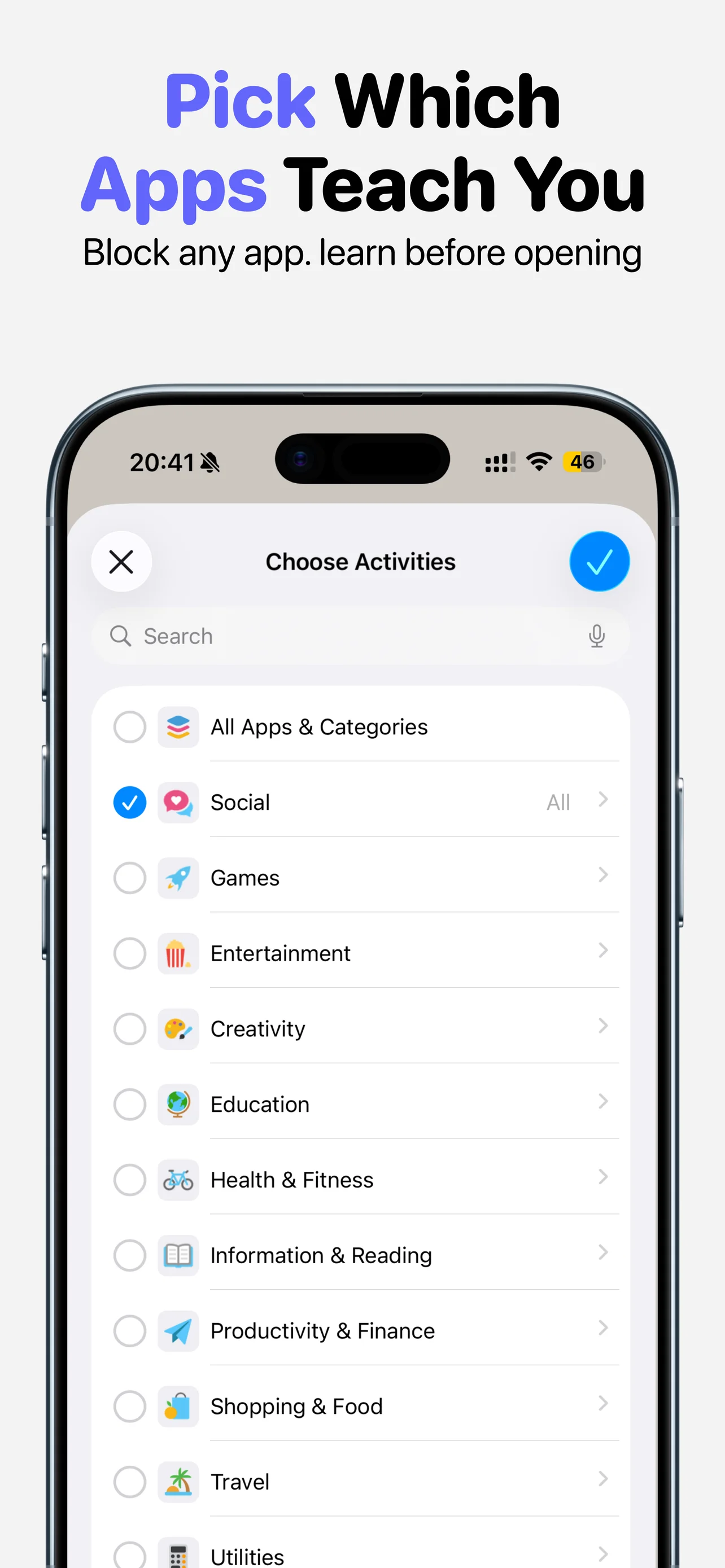
Phones get checked about 186 times a day, roughly 11.6 times per waking hour (Reviews.org, 2026). LearnScreen uses Apple's Screen Time API to shield the apps you choose, so the prompt arrives on a reach you were making anyway — no session to remember, which is the condition most learners fail.
Twenty seconds of actual recall
Opening a shielded app shows a vocabulary card instead of the feed. You try to remember the word before revealing the answer, then mark it known or unknown. That attempt — not the glance — is what Roediger and Karpicke (2006) found beats re-reading, and it is the part no schedule can do for you.
The spacing is not your job
A Leitner schedule decides which word appears: one you just missed returns quickly, one you knew backs off geometrically. You never choose what to review, so the gaps land closer to the 10–20% ridgeline Cepeda et al. (2008) describe than any reading schedule could.
- You set the dose. Words per session adjust from 3 to 20, as does how often the shield returns — the defaults come to roughly 25 recall attempts a day, about two and a half minutes spread across it.
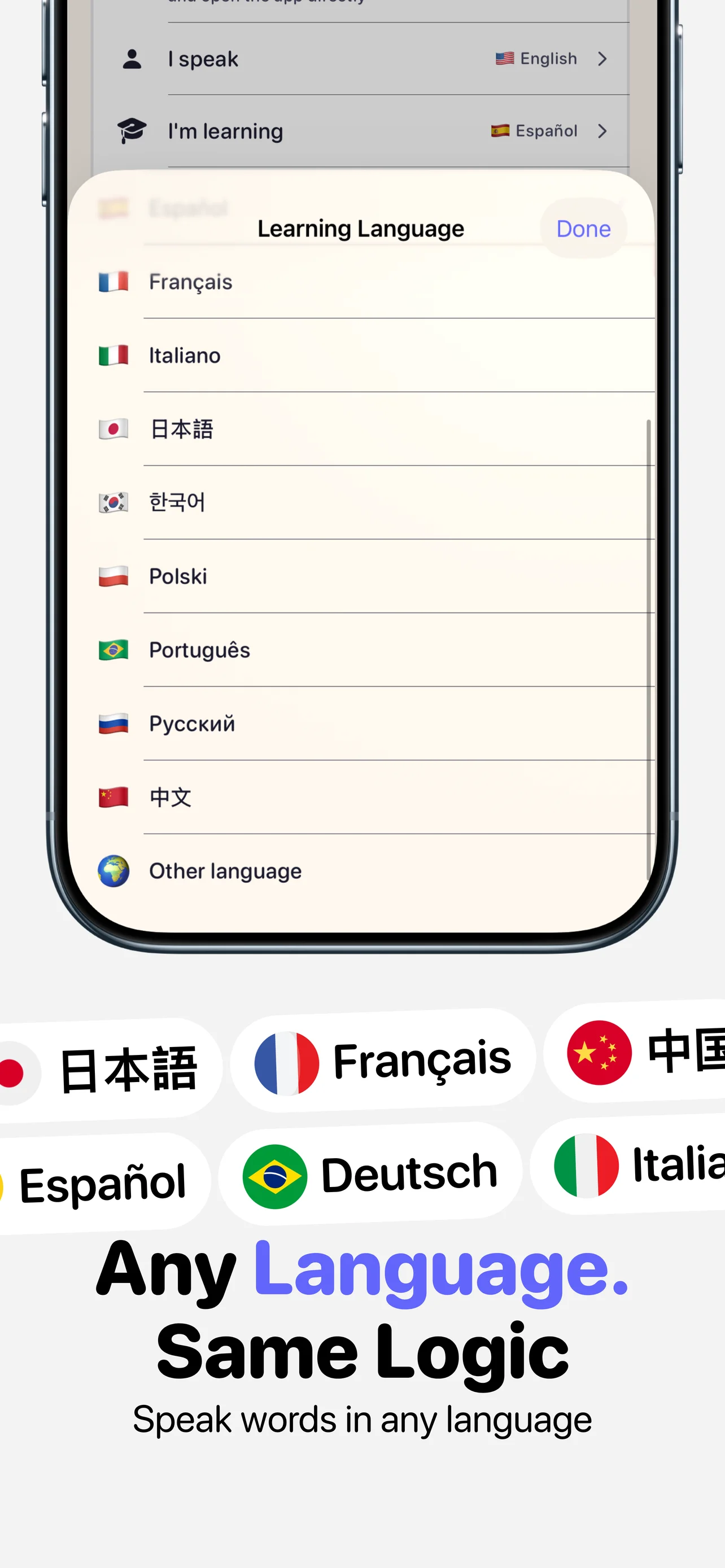
- 1,080+ curated words across 18 topics. Eleven languages are supported as learning targets, and you can add unlimited custom words with translation, transcription and an example sentence.
- It works offline. Cards and shields run with no network once installed; iCloud backup is opportunistic and writes to your own private database rather than our servers.
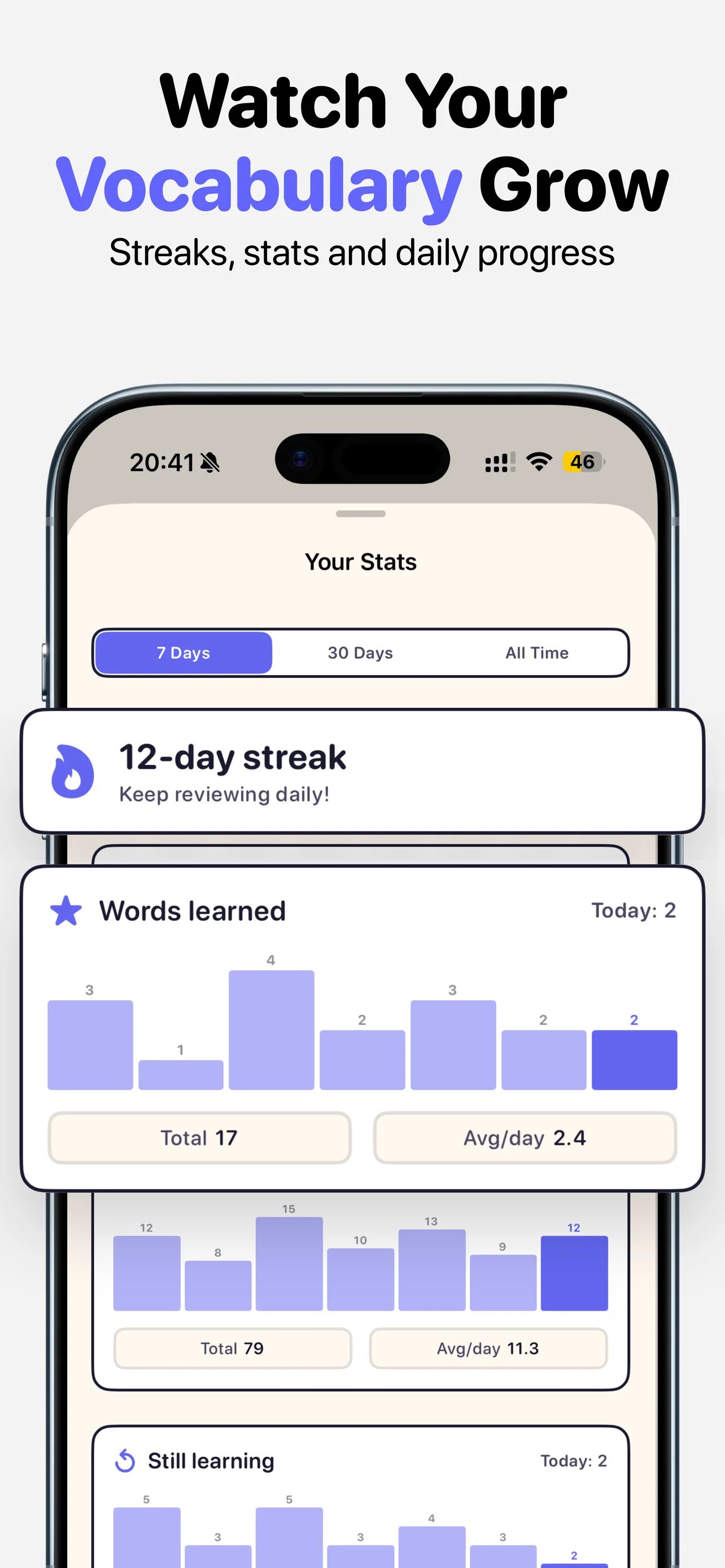
- No account and no streak to break. Nothing to sign up for, and no chain that punishes a light day — the queue simply carries the word forward to the next time you reach for a shielded app.
Related reading
- Passive language learning — what it is and how a passive setup is put together, once you accept the evidence above.
- How many times do you need to see a word? — where the 8–12 encounters figure comes from.
- Microlearning for languages — why seconds-long bursts beat scheduled sessions.
- How many minutes a day to learn a language? — the time arithmetic, and where the minutes already are.
- A passive Anki alternative — spaced repetition that does not wait for you to open it.
- Active vs passive vocabulary — why exposure leaves you understanding words you still can't say.
- Should you learn words in context or alone? — what a pair teaches, what a sentence teaches, and why reading is slow.
- Can you learn while doing something else? — which moments of your day can carry a review, and which cannot.
- Does listening help you learn a language? — exposure through the ear alone: what it buys cheaply and what it never buys.
- Why do you forget vocabulary you have learned? — what happens to a word that exposure alone never comes back for.
- How do you stay consistent? — why the plan is rarely what fails, and what a routine needs to survive.
- Should you study vocabulary before bed? — the one stretch of the day where retention improves at genuinely zero effort.
Frequently asked questions
Sources
- Horst, M., Cobb, T., & Meara, P. (1998). Beyond A Clockwork Orange: Acquiring second language vocabulary through reading. Reading in a Foreign Language, 11(2), 207–223.
- Waring, R., & Takaki, M. (2003). At what rate do learners learn and retain new vocabulary from reading a graded reader? Reading in a Foreign Language, 15(2), 130–163.
- Pigada, M., & Schmitt, N. (2006). Vocabulary acquisition from extensive reading: A case study. Reading in a Foreign Language, 18(1), 1–28.
- Webb, S. (2007). The effects of repetition on vocabulary knowledge. Applied Linguistics, 28(1), 46–65.
- Nation, I. S. P., & Wang, K. (1999). Graded readers and vocabulary. Reading in a Foreign Language, 12(2), 355–380.
- Roediger, H. L., & Karpicke, J. D. (2006). Test-enhanced learning: Taking memory tests improves long-term retention. Psychological Science, 17(3), 249–255.
- Karpicke, J. D., & Roediger, H. L. (2008). The critical importance of retrieval for learning. Science, 319(5865), 966–968.
- Cepeda, N. J., Pashler, H., Vul, E., Wixted, J. T., & Rohrer, D. (2006). Distributed practice in verbal recall tasks: A review and quantitative synthesis. Psychological Bulletin, 132(3), 354–380.
- Cepeda, N. J., Vul, E., Rohrer, D., Wixted, J. T., & Pashler, H. (2008). Spacing effects in learning: A temporal ridgeline of optimal retention. Psychological Science, 19(11), 1095–1102.
- Murre, J. M. J., & Dros, J. (2015). Replication and analysis of Ebbinghaus' forgetting curve. PLOS ONE, 10(7), e0120644.
- Krashen, S. D. (1985). The Input Hypothesis: Issues and Implications. Longman.
- Bjork, E. L., & Bjork, R. A. (2011). Making things hard on yourself, but in a good way: Creating desirable difficulties to enhance learning. In Psychology and the Real World, 56–64.
- Nation, I. S. P. (2006). How large a vocabulary is needed for reading and listening? Canadian Modern Language Review, 63(1), 59–82.
- Reviews.org (2026). Cell Phone Usage Stats. Survey of ~1,000 US adults, fielded Q4 2025. Report
Acquisition rates, retrieval effects and coverage percentages come from the published sources above. Where a study reported several measures we cite the one named in the row; the studies are small and measure receptive knowledge, so the percentages are orders of magnitude rather than constants.
Automate the three, keep the one
LearnScreen handles the repetition, the spacing and the trigger. All it asks of you is the twenty seconds that actually build the memory.
Download on the App Store