Can you learn a language while doing something else?
Yes for reviewing, no for meeting a word the first time — and the variable that decides it is language, not busyness. Craik and colleagues (1996) found that dividing attention while material is being encoded sharply reduces later recall, while dividing it during retrieval leaves memory largely intact. Fernandes and Moscovitch (2000) found the exception: when the competing task is itself made of words, even retrieval suffers. So a walk, a queue or a sink of dishes can carry vocabulary review. A podcast, a phone call or a meeting cannot carry anything.
Every figure below is sourced at the end of the page
Which half of learning survives a divided attention
“Can you learn while doing something else” is usually argued as one question with one answer. It is two. Memory has an input side — encoding, the moment a word first goes in — and an output side, retrieval, every later moment you pull it back out. Craik, Govoni, Naveh-Benjamin and Anderson (1996) tested both directly: participants learned and later recalled word lists while a secondary task ran alongside, and the researchers moved the distraction between the two phases.
The result is an asymmetry, and it is the single most useful thing to know before you plan a day around learning: distraction during encoding cost a great deal of later recall; the same distraction during retrieval cost very little. Retrieving a memory is far more robust to competition than forming one. Fernandes and Moscovitch (2000) then found where that robustness ends — when the competing task is built out of words, retrieval is disrupted too, and by a lot.
| What you are doing with the word | Memory phase | What the research finds | What it means for your day |
|---|---|---|---|
| Meeting it for the first time | Encoding | Large, reliable loss of later recall under divided attention (Craik et al., 1996) | First exposure needs a clear moment. This is the part you cannot smuggle into a busy one |
| Recalling one you already met | Retrieval | Little effect on what is remembered, with a non-verbal competing task (Craik et al., 1996) | Review is the half that travels. Almost every waiting moment can carry it |
| Either, against a task made of words | Both | Substantial interference at retrieval as well as encoding (Fernandes & Moscovitch, 2000) | Podcasts, calls and meetings are the expensive company — not the busy hands |
| Either, against a task made of digits or shapes | Both | Measurably smaller cost than the word-based version (Fernandes & Moscovitch, 2000) | Walking, tidying and queueing are cheap neighbours |
| Nothing else at all — a gap | Both | Full attention, for as long as the gap lasts | The gaps between your tasks are worth more than the tasks. Most days have hundreds |
Read the table as a rule about overlap rather than about effort. Neither study measured language learning specifically; both measured memory for verbal material, which is what vocabulary is. The direction — encoding fragile, retrieval sturdy until the distraction becomes verbal — has held across three decades of replication.
Why the same activity can be free or ruinous
Two tasks do not compete for one general pool of attention. They compete for the specific machinery they share, which is why an activity that feels demanding can be a fine companion and one that feels effortless can be fatal.
- Interference tracks overlap, not difficulty. Wickens (2008) formalises dual-task cost as competition for shared resources — the same modality, the same code, the same processing stage. Climbing stairs is hard and shares almost nothing with vocabulary. Skim-reading an email is easy and shares everything.
- Speech is the worst possible neighbour. Salámé and Baddeley (1982) found that speech you are not even listening to disrupts verbal short-term memory, while non-speech noise at the same level largely does not. Background chatter, a podcast, lyrics: all of them occupy the channel you are trying to learn in.
- Load is a property of the material, not of your willpower. Sweller's (1988) cognitive load account is that working memory has a hard, small ceiling and that learning fails when material plus task exceed it. Wanting it more does not raise the ceiling. Choosing a quieter companion task does.
What exposure alone can and cannot teach, separately from the attention question: does passive learning actually work?
Your day, activity by activity
The practical version of the research is one question you can ask of any moment: is anything already using my words? Hands, feet and eyes are mostly irrelevant. The column that decides each row below is the third one.
| While you are… | Already occupied | Language channel | What it can carry |
|---|---|---|---|
| Walking, or standing on a train | Eyes, legs | Free | Review, comfortably. The best slot most days already contain |
| Washing up, tidying, folding laundry | Hands, eyes | Free | Review by ear or by glance; not reading, and not first exposure |
| Queueing, waiting rooms, lifts | Nothing much | Free | Review, and the occasional new word — this is closest to a real study moment |
| Listening to a podcast, or music with lyrics | Language, continuously | Occupied | Nothing reliably. Unattended speech disrupts verbal memory (Salámé & Baddeley, 1982) |
| In a meeting, on a call, writing email | Language at full load | Occupied | Nothing. This is where “I'll learn while I work” quietly dies |
| Driving | Eyes, hands, and language the moment you speak | Do not | Nothing — and the attempt is unsafe, not merely wasteful (Strayer & Johnston, 2001) |
“Free” here means the language channel, not your whole attention: a review during a walk is still a worse encoding moment than a quiet desk. The claim is narrower and more useful than “multitasking works” — it is that the retrieval half of learning is cheap enough to survive a walk, and that no arrangement of free hands rescues the rows where words are already in use.
The hands-free illusion
There is one experiment worth knowing in full, because most people take exactly the wrong lesson from it. Strayer and Johnston (2001) put participants in a simulated driving task and had them converse on a phone. Missed traffic signals roughly doubled — and a hands-free handset was no safer than a handheld one. The cost was not in the hands. It was in the conversation.
The same study included a control that is even more instructive for learners: listening to the radio did not produce the impairment. Passive listening was cheap because passive listening does almost nothing. That is the whole trade-off in one experiment — the language activity that was cheap enough to survive driving was also the one demanding nothing of memory, and the activity that engaged language properly was the one that broke the driving.
So the popular advice to “learn hands-free while you drive” asks for both halves of a trade-off that does not have both halves. If the audio is engaging enough to teach you, it is competing with the road; if it is passive enough to be safe, it contains no retrieval — and withholding repeated retrieval cut week-later recall from roughly 80% to roughly 35% in Karpicke and Roediger (2008). What makes a moment usable is never free hands. It is a free language channel.
The gaps, not the tasks
If most tasks are poor hosts for learning, the obvious conclusion is that there is no time. The arithmetic says otherwise, because the supply was never in the tasks. It is in the seams between them — the unlock, the queue, the kettle, the thirty seconds before a meeting starts — and those are moments when nothing at all is using language.
There are far more of them than anyone estimates. Phones are checked around 186 times a day, roughly 11.6 times per waking hour (Reviews.org, 2026). A single review is one recall attempt on one word: try to produce the meaning, check, move on. Six seconds is generous. At that size, the seams are not a scarce resource.
| The gap | How often | Typical length | Reviews it can carry |
|---|---|---|---|
| Reaching for the phone | ~186× a day | A few seconds | 1–3 cards, with no ceremony and nothing to open |
| Kettle, microwave, bus stop | Several times a day | 1–3 minutes | 3–5 cards without hurrying |
| Queue, lift, waiting room | A few times a day | 2–10 minutes | 5–10 cards, and the rare new word |
| Between meetings | 2–5× a workday | 1–5 minutes | 5–10 cards, once the last conversation has stopped echoing |
Card counts are arithmetic from a six-second recall attempt, not measured app data. Roughly 25 attempts a day — about two and a half minutes, spread out — is enough to keep a hundred words in rotation at the 8–12 spaced encounters per word that Nation and Wang (1999) report, and spreading practice out this way is what produced 47% recall against 37% for the same time crammed (Cepeda et al., 2006). Spreading is not a compromise forced by a busy day. It is the better schedule anyway.
Learning that waits for a free channel
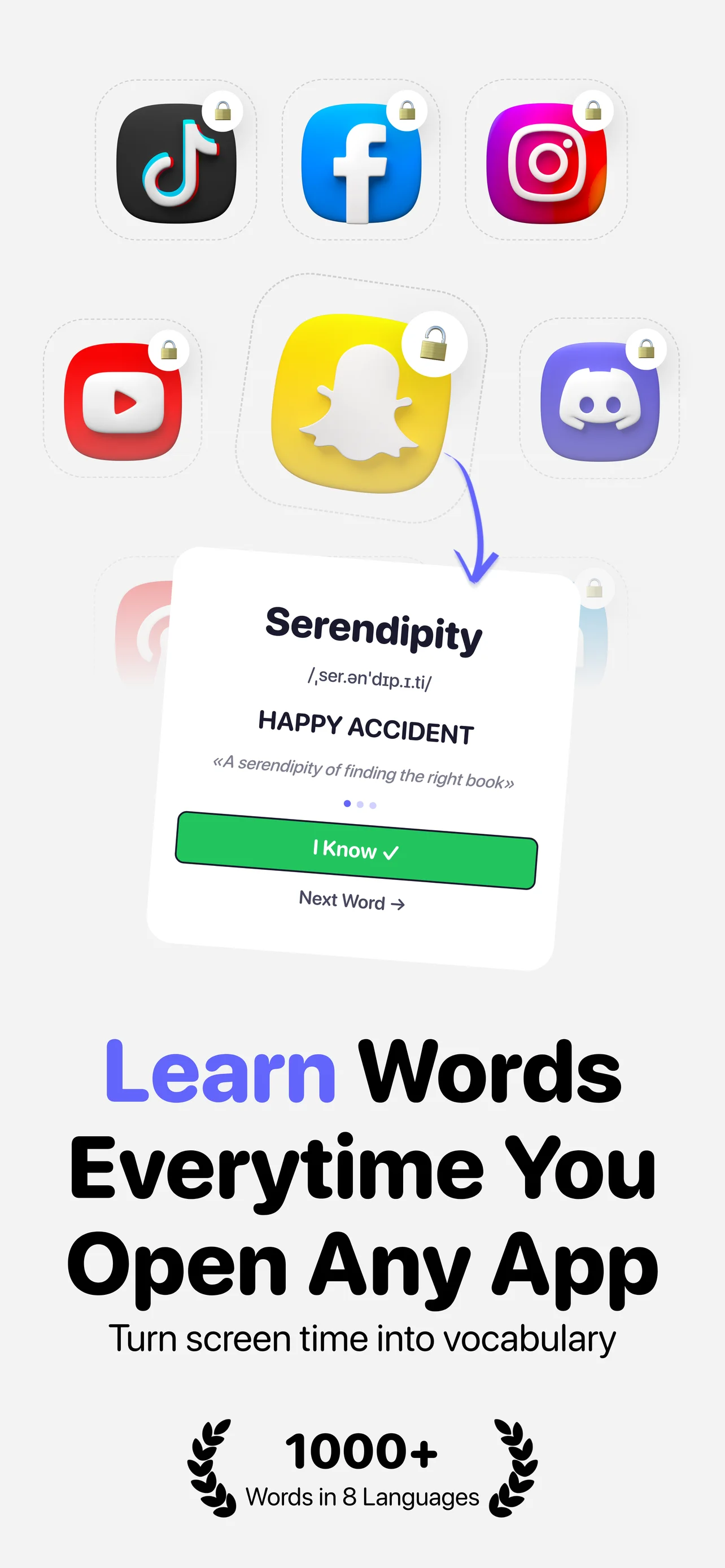
Everything above points at one design: aim at the retrieval half, fire in a gap rather than during a task, and keep each event short enough that no competing activity has time to start. That is the shape LearnScreen is built around — not learning while you do something else, but learning in the moments between the things you do.
It arrives in the seam, not the task
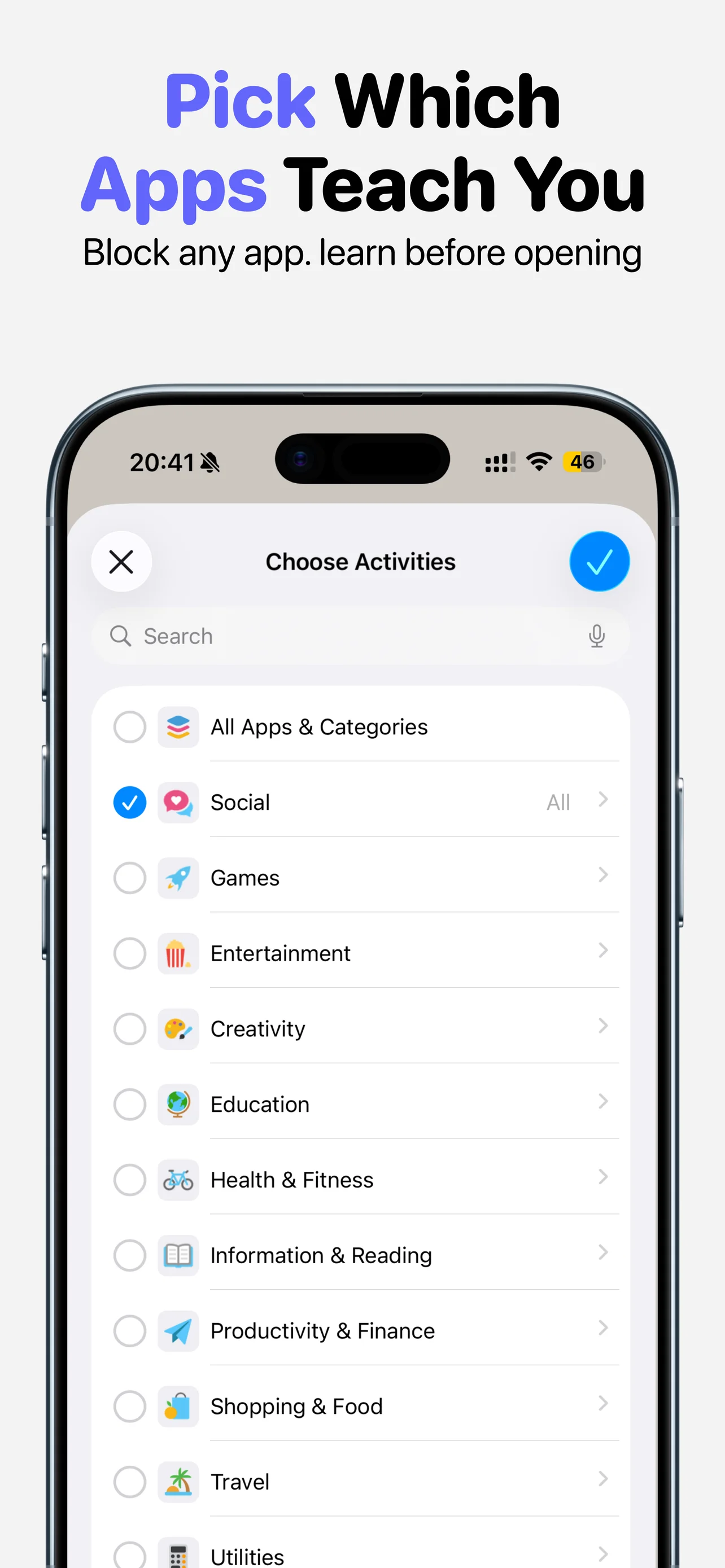
Using Apple's Screen Time API, LearnScreen shields the apps you choose, so the card appears at the moment you reach for the phone — a gap you were already having, when nothing else is using language. There is nothing to launch and nothing to remember, which is the failure point every schedule shares.
It asks for recall, not attention
The card asks for the meaning before it shows it. That makes each event a retrieval — the half that Craik et al. (1996) found survives a divided attention — rather than a lesson, which is the half that does not. It is also the part that does the actual work: retrieval beat rereading outright in Karpicke and Roediger (2008).
Six seconds, then out of the way
3 to 20 words per session, and the interval between shields is yours to set. Short events are what keep the language channel from ever being contested: the card is finished before a conversation, a podcast or a meeting could start competing with it.
- You choose which apps host the gap. Shield the feed you open without deciding to, and leave maps, messages and music alone — the point is to sit in a moment that was already dead, not to add friction to a useful one.
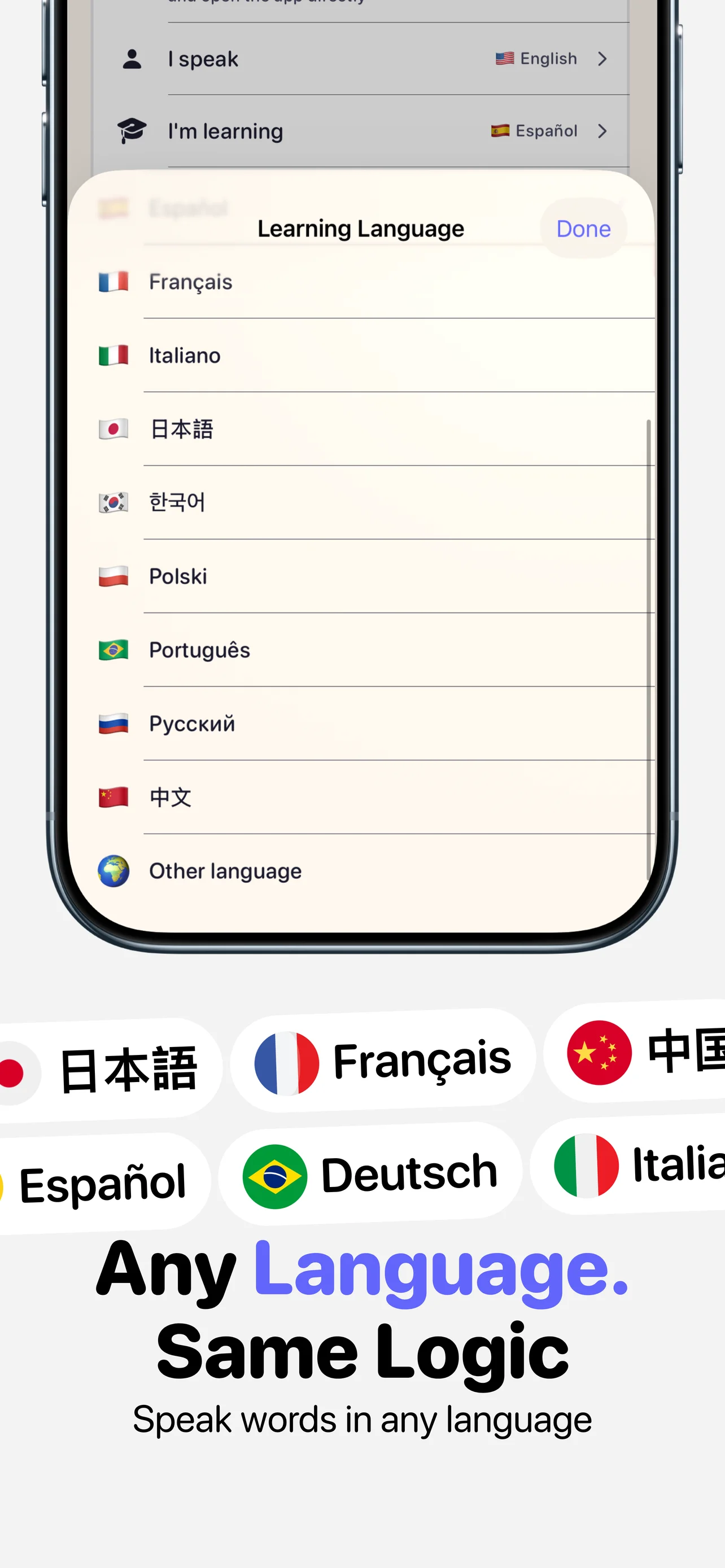
- 1,080+ curated words across 18 topics. Eleven languages to learn, plus unlimited custom words with translation, transcription and an example sentence for the first-exposure moments that do deserve your full attention.
- Works offline. Cards and shields run with no network once installed, so a tunnel, a plane or a dead zone is still a usable gap. iCloud backup writes to your own private database, not to our servers.
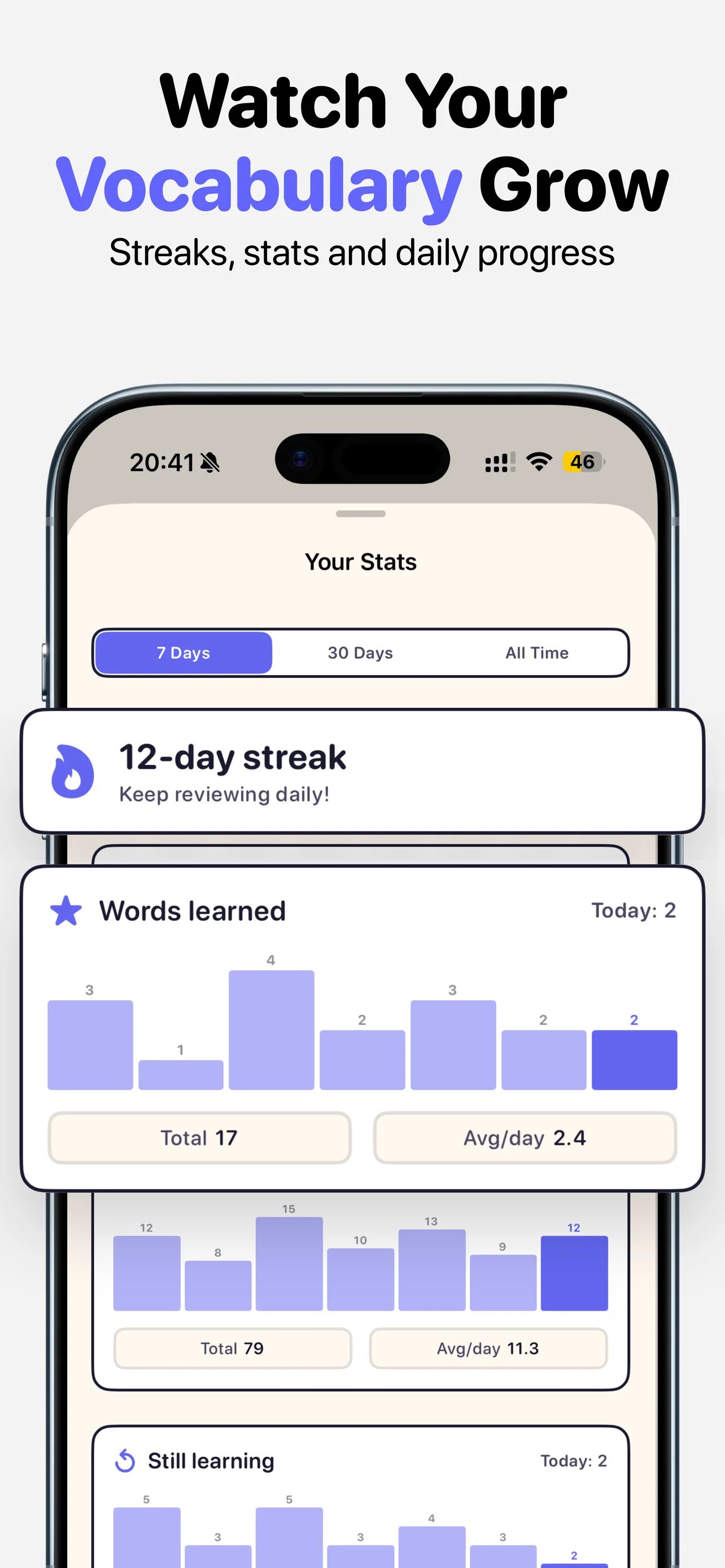
- No account, and no streak to break. Nothing to sign up for, and no chain that punishes a bad day — a missed word simply comes back the next time you reach for a shielded app.
Keep reading
- Does passive learning actually work? — what exposure alone produces, and the point at which it stops.
- How many minutes a day to learn a language? — the time arithmetic these gaps have to satisfy.
- How often should you review vocabulary? — when the reviews the gaps are carrying should actually fall.
- How many times do you need to see a word? — how many of those six-second events one word costs.
- How many words a day should you learn? — why review load, not intake, sets the ceiling.
- What is microlearning? — the wider case for very short, very frequent sessions.
- Why do you forget vocabulary you have learned? — why a review that never lands costs more than a divided one that does.
- How do you stay consistent? — why the plan is rarely what fails, and what a routine needs to survive.
- Should you study vocabulary before bed? — what happens to a word during the hours you are not doing anything at all.
Frequently asked questions
Sources
- Craik, F. I. M., Govoni, R., Naveh-Benjamin, M., & Anderson, N. D. (1996). The effects of divided attention on encoding and retrieval processes in human memory. Journal of Experimental Psychology: General, 125(2), 159–180.
- Fernandes, M. A., & Moscovitch, M. (2000). Divided attention and memory: Evidence of substantial interference effects at retrieval and encoding. Journal of Experimental Psychology: General, 129(2), 155–176.
- Strayer, D. L., & Johnston, W. A. (2001). Driven to distraction: Dual-task studies of simulated driving and conversing on a cellular telephone. Psychological Science, 12(6), 462–466.
- Salámé, P., & Baddeley, A. (1982). Disruption of short-term memory by unattended speech: Implications for the structure of working memory. Journal of Verbal Learning and Verbal Behavior, 21(2), 150–164.
- Wickens, C. D. (2008). Multiple resources and mental workload. Human Factors, 50(3), 449–455.
- Sweller, J. (1988). Cognitive load during problem solving: Effects on learning. Cognitive Science, 12(2), 257–285.
- Craik, F. I. M., & Lockhart, R. S. (1972). Levels of processing: A framework for memory research. Journal of Verbal Learning and Verbal Behavior, 11(6), 671–684.
- Karpicke, J. D., & Roediger, H. L. (2008). The critical importance of retrieval for learning. Science, 319(5865), 966–968.
- Cepeda, N. J., Pashler, H., Vul, E., Wixted, J. T., & Rohrer, D. (2006). Distributed practice in verbal recall tasks: A review and quantitative synthesis. Psychological Bulletin, 132(3), 354–380.
- Nation, I. S. P., & Wang, K. (1999). Graded readers and vocabulary. Reading in a Foreign Language, 12(2), 355–380.
- Simon, C. W., & Emmons, W. H. (1956). Responses to material presented during various levels of sleep. Journal of Experimental Psychology, 51(2), 89–97.
- Rudoy, J. D., Voss, J. L., Westerberg, C. E., & Paller, K. A. (2009). Strengthening individual memories by reactivating them during sleep. Science, 326(5956), 1079.
- Reviews.org (2026). Cell Phone Usage Stats. Survey of ~1,000 US adults, fielded Q4 2025. Report
The divided-attention studies cited here measured memory for verbal material such as word lists, not classroom language learning, and the encoding/retrieval asymmetry is reported as a direction and rough magnitude rather than a single number, because the size of the effect varies with the secondary task. Card counts and daily totals are arithmetic from a six-second recall attempt and the encounter counts in the vocabulary literature — an order of magnitude, not measured app data.
Use the gaps, not the tasks
LearnScreen keeps the queue, picks the word, and waits for a moment when nothing else is using your words. All it asks for is the six seconds that actually build the memory.
Download on the App Store