How do you stay consistent
with language learning?
Not by deciding to. Experiments that successfully changed people's intentions moved their actual behaviour by about half as much (Webb & Sheeran, 2006) — the plan is rarely the part that fails. What survives is a small action attached to a cue that already fires in your day: specifying when and where produced a medium-to-large effect across 94 independent tests (Gollwitzer & Sheeran, 2006), and repetition in a stable context is what makes it automatic, over a median of 66 days (Lally et al., 2010). Pick the cue, then shrink the action until a bad day can't break it.
Every figure below is sourced at the end of the page
Where consistency actually breaks
The folk explanation is that people who keep going want it more. The research does not support that, and the reason is oddly specific: wanting it more is measurable, and it does not move behaviour much. What moves behaviour is whether the action has somewhere to attach.
Each row below is a study that measured the thing people assume is the problem. Read the third column as a set of findings about design, not about character.
| Study | What it measured | What it found |
|---|---|---|
| Webb & Sheeran (2006) | Experiments that successfully strengthened people's intentions, then followed the behaviour | A medium-to-large gain in intention produced only a small-to-medium gain in behaviour — roughly half the effect, in the studies where the persuasion worked |
| Jordan (2015) | Completion of open online courses, where quitting costs nothing at all | Median completion around 12.6%: the enrolment was never the hard part, and dropping out is the normal outcome rather than the exceptional one |
| Lally et al. (2010) | 96 people adopting one new daily behaviour, self-rated for automaticity every day | Automaticity plateaued after a median of 66 days, ranging from 18 to 254 — and one missed day did not measurably set the curve back |
| Wood, Quinn & Kashy (2002) | Hour-by-hour diaries of what people actually did all day | About 43% of daily behaviour was repeated almost every day in the same setting, and performed with little deliberation |
| Ji & Wood (2007) | Whether intention or habit strength better predicted what people did next | Where the habit was strong, intention stopped predicting behaviour; deciding mattered mainly when the usual cue was missing |
These are different fields with different measures, and none of them is about language learning specifically. What they converge on is a claim that transfers cleanly: the gap between intending and doing is large, ordinary and well-documented, and it narrows when the behaviour is attached to a stable context rather than to a decision. That is why the last row is the encouraging one — the same mechanism currently protecting the habits you did not choose is available for one you did.
Three different failures get called “no discipline”
Lumping them together is what makes the advice useless, because each one has a different fix and only one of them has anything to do with effort. Almost every abandoned study plan is one of these three.
- The plan that was never cued. “I'll study in the evenings” names an intention and no trigger, so the behaviour has to be remembered and chosen every single day. This is the failure implementation intentions were designed for, and the effect is large: specifying the when and the where produced a medium-to-large improvement in goal attainment across 94 tests (Gollwitzer & Sheeran, 2006).
- The plan too big for a bad day. A thirty-minute session survives an ordinary Tuesday and dies on a bad one, and bad ones are frequent enough to break the chain. Lally et al. (2010) found simpler actions reached automaticity faster than complex ones, so the small version is not the compromise — it is the version that builds itself.
- The plan whose payoff arrives in six months. Rothman (2000) separates starting from continuing: starting runs on the outcomes you expect, but continuing runs on satisfaction with the outcomes you actually receive. Vocabulary pays out slowly and invisibly, so a routine that offers nothing in the moment is competing with things that pay immediately, and losing.
The related question of how much time a day is actually required: how many minutes a day to learn a language.
What a routine needs to survive
Habit research is unusually practical, because the ingredients are things you can change on purpose in an afternoon. Each row is one requirement, what the evidence says about it, and what it looks like when it is actually in place rather than merely intended.
| What it needs | What the evidence says | What that looks like |
|---|---|---|
| A cue that already fires | Wood & Neal (2007): habits are triggered by context, not re-chosen by intention each time | “When I do X, I review” — anchored to something that already happens, not to a time you hope to be free |
| The same context each time | Lally et al. (2010); Judah et al. (2013) on flossing, where cue timing predicted whether the habit formed | The same moment in the same setting, even if the clock time moves — stability beats punctuality |
| An action small enough for a bad day | Lally et al. (2010): simple behaviours reached automaticity faster than complex ones | Two minutes that happens on 26 days beats thirty minutes that happens on four |
| Less friction than the alternative | Duckworth et al. (2016): situational strategies act earlier and cost less than resisting an impulse in the moment | Change what the moment offers, rather than out-arguing yourself at the moment of temptation |
| Something you get now | Rothman (2000) on maintenance; Milkman et al. (2014) raised gym attendance ~29% by bundling it with something wanted | Attach the review to a thing you already want, so the payoff is not six months away |
| No penalty for the day you miss | Lally et al. (2010): a single missed day did not measurably damage the automaticity curve | A counter that resets adds a reason to quit to a day the evidence says was harmless |
Only the third and sixth rows are about doing less. The other four are about placement — when the action happens, what it sits next to, and what it costs to start. That is the practical content of the habit literature: consistency is mostly a question of where you put the thing, and only marginally a question of how much you want it.
Willpower is the expensive lever
Duckworth, Gendler and Gross (2016) draw a distinction that reframes the whole problem. Response-focused self-control is what most people mean by discipline: the impulse arrives, and you refuse it. Situational self-control acts earlier, by changing what you are exposed to and when, so that the impulse either does not arrive or arrives against something else. Their argument is that the situational strategies are the more effective family, because they do their work before the moment of maximum temptation rather than during it. Applied here, that is the difference between resolving to study instead of scrolling, and arranging things so that the reach for the feed is what produces the word.
This also explains why the people who look disciplined are usually not doing what they appear to be doing. Wood, Quinn and Kashy (2002) had participants record their behaviour hour by hour and found that roughly 43% of it was repeated almost daily, in a consistent setting, with very little conscious thought. Ji and Wood (2007) then showed the consequence directly: once a habit is strong, intention stops predicting behaviour, and deliberate choice re-enters only when the usual cue is absent. Reliable behaviour is mostly cue-driven behaviour. That is not a discouraging finding, because cues can be designed.
The most useful applied result is Milkman, Minson and Volpp (2014), who gave people access to audiobooks they wanted only at the gym. Attendance rose by about 29% over the study, and the participants who had experienced the arrangement were willing to pay to keep it. The mechanism is not motivation but adjacency: an activity with a distant payoff was fastened to one with an immediate one. A vocabulary review has exactly the distant-payoff problem, and the phone in your pocket is the thing with the immediate pull — which makes the pairing available rather than hypothetical.
What the missing days actually cost
Consistency gets moralised, which makes it easy to dismiss. It is worth being precise instead: the days you skip have specific, measured costs, and they are larger than the difference between any two study methods you could be agonising over.
Three of these rows are losses. The fourth is the reason a gap is not a reason to start over — and it is the best-evidenced row in the table.
| What goes missing | The evidence | How big it is |
|---|---|---|
| The spacing advantage | Cepeda et al. (2006), across 254 studies | About 47% recalled spaced against 37% massed — same material, same total minutes, different distribution |
| The words that were half-learned | Murre & Dros (2015), replicating Ebbinghaus | Loss is steepest in the first days, so a gap costs most on exactly the words you met most recently |
| The encounters a word still needs | Nation & Wang (1999); Webb (2007) | Roughly 8–12 spaced encounters, which a stopped routine simply never delivers |
| Not everything — relearning stays cheap | Bahrick (1984), tracking school Spanish across fifty years | A large core survived decades unused, and what fades is recovered far faster than it was first learned |
The last row is the part worth keeping. A month off does not return you to zero, and the standard response to a broken streak — abandoning the language and starting a different one in January — throws away the cheapest material you own. What decay does between encounters, in more detail: why you forget vocabulary you've learned.
Borrowing a cue you already have
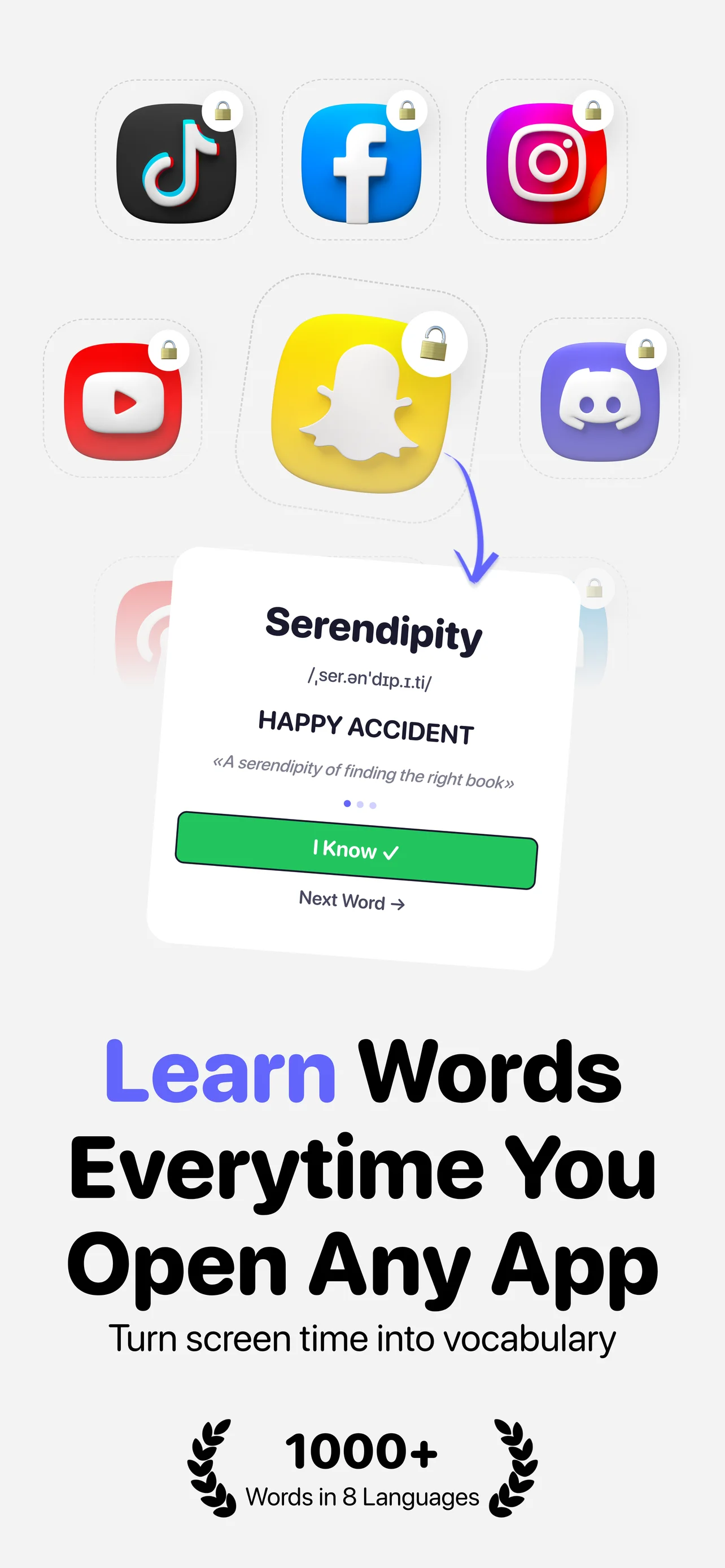
The habit literature says to attach the action to something that already fires, keep it small, and stop punishing the day you miss. LearnScreen is that arrangement built into the phone — it does not ask you to be more consistent, it removes the step where consistency was required.
The cue is already firing
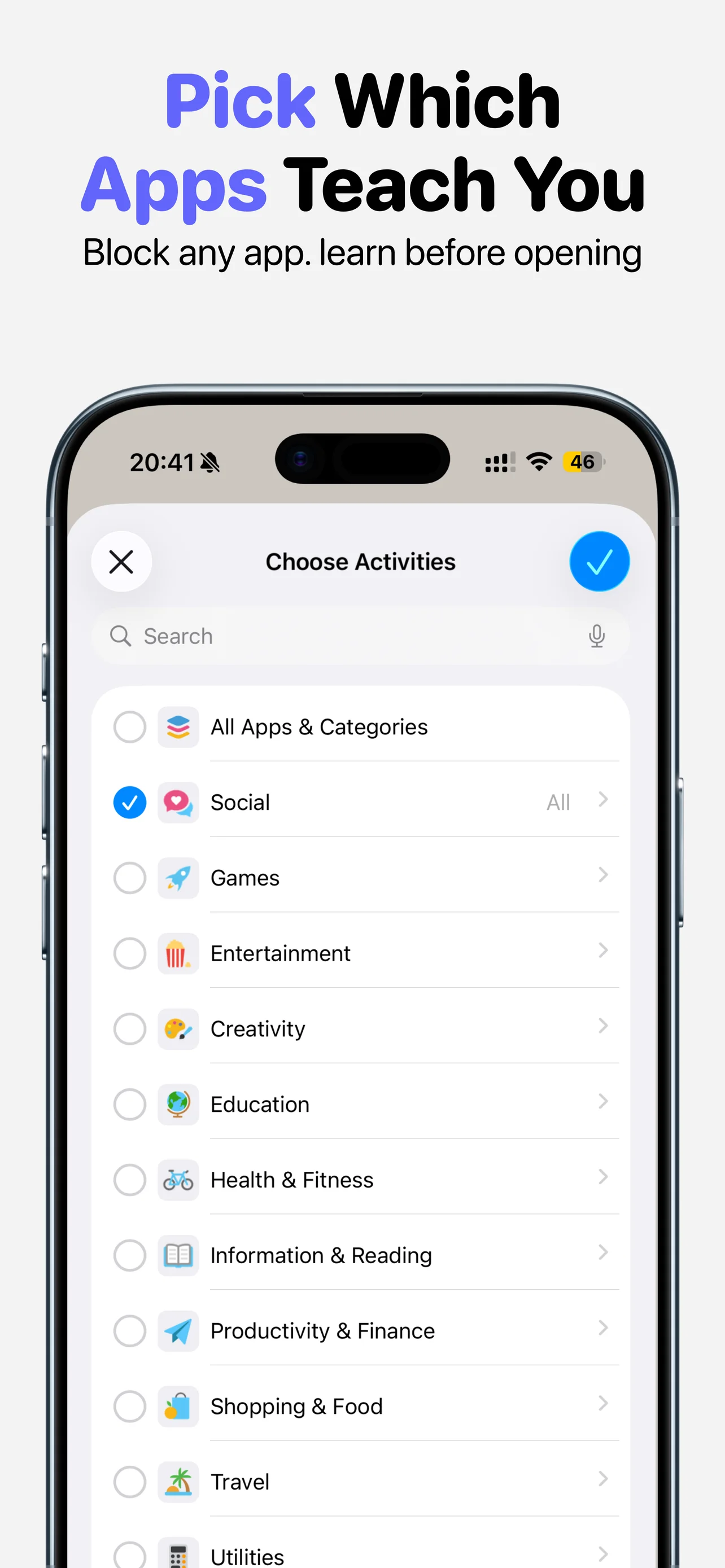
Phones get checked about 186 times a day, roughly 11.6 times per waking hour (Reviews.org, 2026). Using Apple's Screen Time API, LearnScreen shields the apps you pick and puts a word where the feed would have been — the reach is the trigger, so nothing has to be remembered or scheduled.
It is small by construction
One card is a few seconds, and the answer stays hidden until you tap, so each encounter is a recall attempt rather than a reading. There is no session to find time for, which is the requirement that kills most plans on a bad day.
Nothing resets when you stop
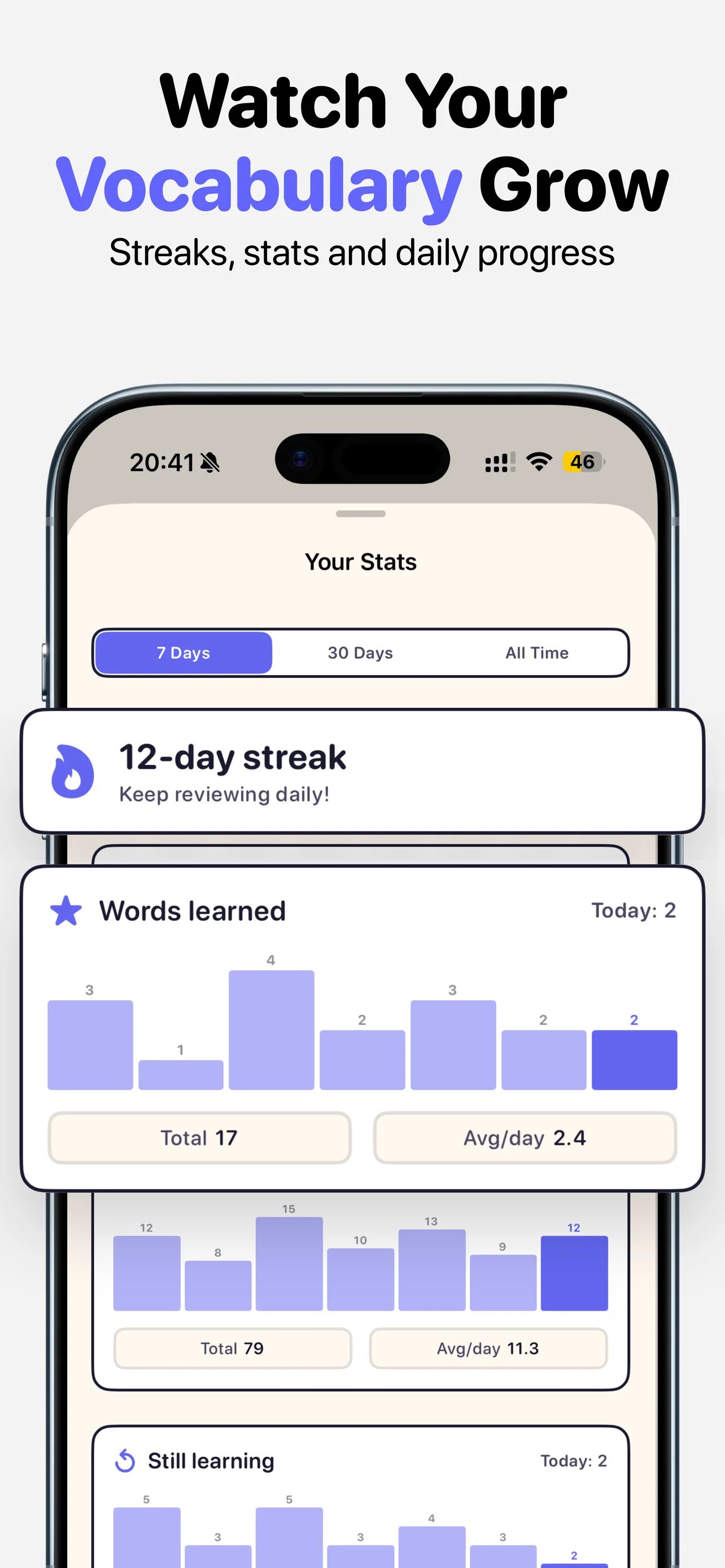
There is no streak counter and no penalty for a quiet week. A Leitner schedule keeps the queue and brings back what you missed, so a gap costs you the spacing and nothing else — and the day you come back does not start from zero.
- You set the dose. Words per session adjust from 3 to 20, as does how often the shield returns — the defaults come to roughly 25 recall attempts a day, about two and a half minutes spread across it.
- The thing you want is the thing that carries it. This is the temptation-bundling arrangement Milkman et al. (2014) tested, in the one place it is already installed: the app you were opening anyway is what delivers the card.
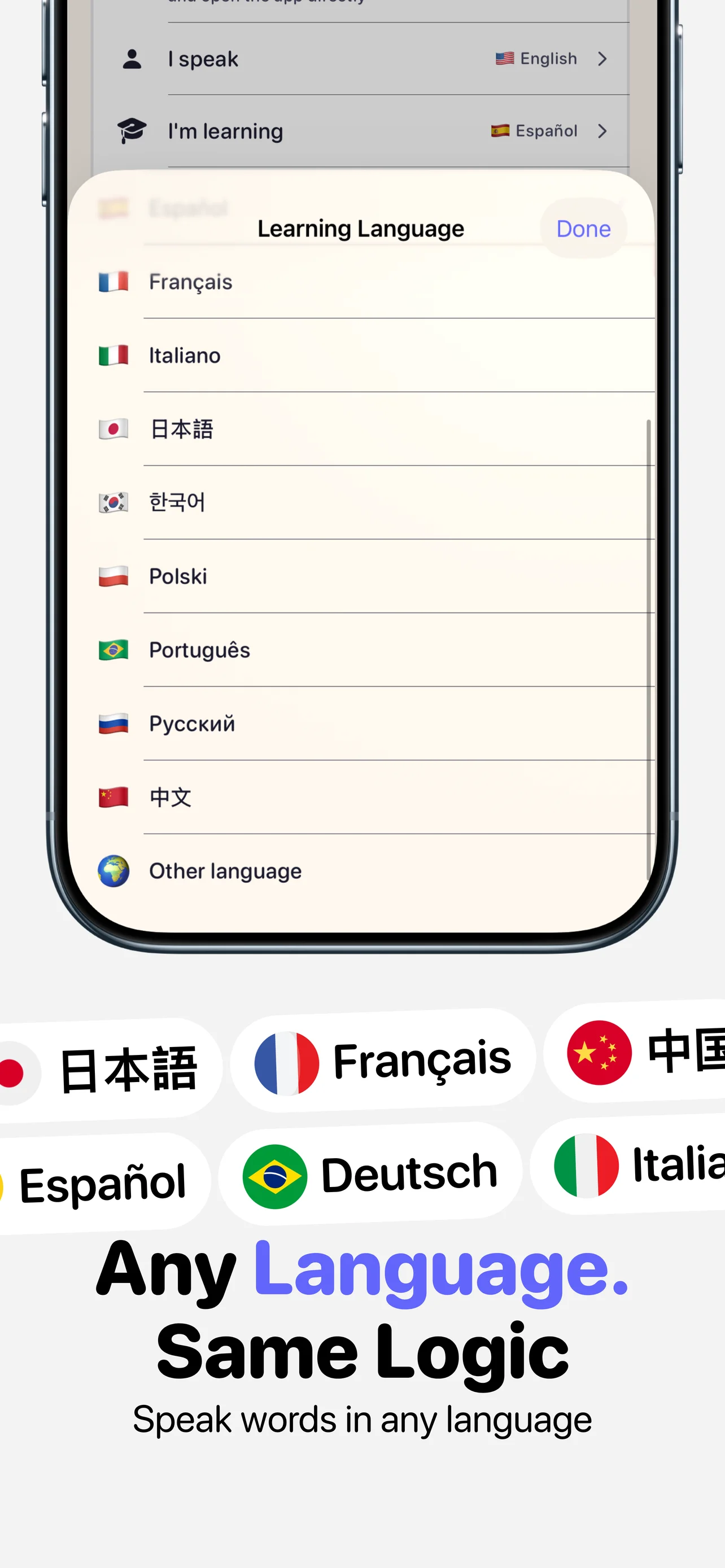
- 1,080+ curated words across 18 topics. Eleven languages are supported as learning targets, and unlimited custom words can be added with their own translation, transcription and example sentence.
- It works offline, with no account. Cards and shields run without a network once installed; iCloud backup writes to your own private database rather than our servers, and there is nothing to sign up for.
Related reading
- How many minutes a day does it take? — the budget the routine has to fit inside.
- Can you learn while doing other things? — which moments can host a review and which cannot.
- Why do I forget vocabulary I've learned? — what a gap between encounters actually costs.
- How often should you review vocabulary? — the intervals that catch a word before it slips.
- Should you study vocabulary before bed? — the review that benefits most is the last one before sleep, which is also the easiest to place.
- Does passive learning actually work? — what exposure alone produces, and the conditions it needs.
- A passive Anki alternative — spaced repetition that does not wait for you to open it.
Frequently asked questions
Sources
- Webb, T. L., & Sheeran, P. (2006). Does changing behavioral intentions engender behavior change? A meta-analysis of the experimental evidence. Psychological Bulletin, 132(2), 249–268.
- Sheeran, P., & Webb, T. L. (2016). The intention–behavior gap. Social and Personality Psychology Compass, 10(9), 503–518.
- Gollwitzer, P. M., & Sheeran, P. (2006). Implementation intentions and goal achievement: A meta-analysis of effects and processes. Advances in Experimental Social Psychology, 38, 69–119.
- Lally, P., van Jaarsveld, C. H. M., Potts, H. W. W., & Wardle, J. (2010). How are habits formed: Modelling habit formation in the real world. European Journal of Social Psychology, 40(6), 998–1009.
- Wood, W., & Neal, D. T. (2007). A new look at habits and the habit–goal interface. Psychological Review, 114(4), 843–863.
- Wood, W., Quinn, J. M., & Kashy, D. A. (2002). Habits in everyday life: Thought, emotion, and action. Journal of Personality and Social Psychology, 83(6), 1281–1297.
- Ji, M. F., & Wood, W. (2007). Purchase and consumption habits: Not necessarily what you intend. Journal of Consumer Psychology, 17(4), 261–276.
- Duckworth, A. L., Gendler, T. S., & Gross, J. J. (2016). Situational strategies for self-control. Perspectives on Psychological Science, 11(1), 35–55.
- Milkman, K. L., Minson, J. A., & Volpp, K. G. M. (2014). Holding the Hunger Games hostage at the gym: An evaluation of temptation bundling. Management Science, 60(2), 283–299.
- Rothman, A. J. (2000). Toward a theory-based analysis of behavioral maintenance. Health Psychology, 19(1S), 64–69.
- Judah, G., Gardner, B., & Aunger, R. (2013). Forming a flossing habit: An exploratory study of the psychological determinants of habit formation. British Journal of Health Psychology, 18(2), 338–353.
- Kaushal, N., & Rhodes, R. E. (2015). Exercise habit formation in new gym members: A longitudinal study. Journal of Behavioral Medicine, 38(4), 652–663.
- Jordan, K. (2015). Massive open online course completion rates revisited: Assessment, length and attrition. International Review of Research in Open and Distributed Learning, 16(3), 341–358.
- Cepeda, N. J., Pashler, H., Vul, E., Wixted, J. T., & Rohrer, D. (2006). Distributed practice in verbal recall tasks: A review and quantitative synthesis. Psychological Bulletin, 132(3), 354–380.
- Murre, J. M. J., & Dros, J. (2015). Replication and analysis of Ebbinghaus’ forgetting curve. PLOS ONE, 10(7), e0120644.
- Bahrick, H. P. (1984). Semantic memory content in permastore: Fifty years of memory for Spanish learned in school. Journal of Experimental Psychology: General, 113(1), 1–29.
- Nation, I. S. P., & Wang, K. (1999). Graded readers and vocabulary. Reading in a Foreign Language, 12(2), 355–380.
- Webb, S. (2007). The effects of repetition on vocabulary knowledge. Applied Linguistics, 28(1), 46–65.
- Reviews.org (2026). Cell Phone Usage Stats. Survey of ~1,000 US adults, fielded Q4 2025. Report
The habit and self-control findings come from health, consumer and education research rather than from language learning, and transfer by mechanism rather than by direct replication; the effect sizes are group averages with wide individual variation, as the 18-to-254-day range in Lally et al. makes plain. The 12.6% completion figure describes open online courses, which are free to abandon, and is an upper bound on how much a paid commitment would drift. Card counts and daily totals are arithmetic from a roughly twenty-second recall attempt, not measured app data.
Stop needing to be consistent
LearnScreen attaches the review to the one thing you already do a hundred times a day, keeps it to a few seconds, and takes nothing away on the days you skip. It asks for no new routine, because it is not adding one.
Download on the App Store