Is it too late to learn
a language as an adult?
No. Age limits one thing clearly: sounding exactly like a native speaker. In a study of 669,498 people, grammar-learning ability held steady until about 17.4 years and then declined gradually, with no cliff at 30 or 40 (Hartshorne, Tenenbaum & Pinker, 2018). Teenagers and adults made the fastest progress in the first months of learning Dutch, while 3–5-year-olds scored lowest (Snow & Hoefnagel-Höhle, 1978), and native speakers keep adding words for decades: about 6,000 more between ages 20 and 60 (Brysbaert et al., 2016).
Every figure on this page is referenced at the bottom


What age limits, and what it leaves alone
“Children are sponges” and “the window closes at puberty” both come from real research, but the studies measured something narrower than the slogan. They measured whether a learner ends up indistinguishable from a native speaker: accent judged by native listeners, or grammar tested on subtle sentences. Measured that way, age matters a great deal. Measured as speed, vocabulary, or being able to work and live in the language, it matters much less.
The table separates the layers. Each row is a different question, and the age effect is strong in the first three and weak or reversed in the last two.
| What was measured | What the study found | What it means for you |
|---|---|---|
| Grammar, at the finest level | Hartshorne, Tenenbaum & Pinker (2018), 669,498 English speakers: grammar-learning ability held until about 17.4 years, then declined; reaching native-level grammar required starting by about 10–12 | Native-identical grammar is unlikely if you start as an adult. The decline after 17 is gradual, so a 35-year-old is not meaningfully worse off than a 25-year-old |
| Accent | Flege, Munro & MacKay (1995), 240 Italian immigrants in Canada: very few who started English after 15 were rated within the native range; age of learning explained 59% of accent variance, language use another 15% | An accent is the most age-sensitive layer. It affects how you sound, not whether you are understood, and how much you use the language still moves it |
| Passing as a native under scrutiny | Abrahamsson & Hyltenstam (2009), 195 Spanish–Swedish bilinguals: a small minority of those who started after 12 passed as native with listeners; under detailed testing none of the late starters matched natives on every measure | This is the ceiling the research is about. It is set very high: only a few of the early starters matched natives on every measure either |
| Speed in the first year | Snow & Hoefnagel-Höhle (1978), English speakers learning Dutch in the Netherlands: 12–15-year-olds and adults progressed fastest in the first months; 3–5-year-olds scored lowest on every test | Adults are faster learners at the start. They bring reading, strategies and a first language to map onto |
| Vocabulary | Brysbaert et al. (2016): native speakers add about 6,000 words between ages 20 and 60; Hartshorne & Germine (2015): web vocabulary scores peaked at about 65 | Word learning is the layer age limits least. It is also the layer most of comprehension depends on |
Read the first three rows as one finding about a very high bar, and the last two as a separate finding about everything below it. The vocabulary side has its own page with the numbers for each level: how many words do you need to speak a language?
Three versions of “it’s too late”
The claim gets repeated in three forms, and they are not equally true. Only the first holds up against the studies above.
- Partly true: you will probably keep an accent. Flege, Munro and MacKay (1995) found that listeners could hear an accent even in some people who started English as children; listener estimates of where accent begins ranged from 3.1 to 11.6 years of age. If your goal is to pass as a native speaker, age is a real constraint. If your goal is to be understood, an accent is not the obstacle.
- Oversimplified: children learn faster. They reach a higher final level when they grow up in the language, but they are not faster. In Snow and Hoefnagel-Höhle’s (1978) year-long study, adults and 12–15-year-olds led during the first months, and 3–5-year-olds scored lowest on every test. Children win the long race through years of immersion, which most adults never get either way.
- False: there is a cut-off at 25, 30 or 40. No study finds one. Johnson and Newport (1989) tested 46 Chinese and Korean speakers who had arrived in the US between ages 3 and 39: among those who arrived after puberty, scores varied widely and were unrelated to age of arrival. In that sample, arriving at 39 predicted no lower score than arriving at 17.
Most adult learners stall on vocabulary, not grammar or accent. Which words to learn first is answered here: which words should you learn first?
What the evidence says at 18, 25, 30, 40, 50 and 60+
People search for one age at a time. The research uses age ranges, so this table puts the findings for each starting age in one place, including where the evidence is thin.
| Starting age | What the evidence says | A realistic goal |
|---|---|---|
| 18 | Just past the 17.4-year point where grammar-learning ability begins to decline (Hartshorne et al., 2018). The decline is gradual, not a drop | Full professional use. Near-native grammar is possible with heavy use; a perfect accent is unlikely |
| 25 | Johnson & Newport (1989): after puberty, attainment was unrelated to age of arrival; the differences came from the learners, not their birthdays | The same as at 18. What decides the outcome is hours of use, not three more years of age |
| 30 | Hartshorne et al. (2018): immersion learners who started in their late 20s eventually outscored the youngest native speakers in the sample | Fluent, working-level use. Expect a long tail: learners in that study needed decades of immersion to level off |
| 40 | Hartshorne & Germine (2015): working memory peaked around 30, while vocabulary scores were still rising | Shorter, more frequent sessions. Work memory less and spacing more; a word reviewed at the right gaps does not need a young memory |
| 50 | Brysbaert et al. (2016): native vocabulary keeps growing, by about one new word every two days between 20 and 60 | Large reading and listening vocabulary. Comprehension is the strongest goal at this age |
| 60+ | Few studies start learners this late. Hartshorne & Germine (2015) found vocabulary peaked around 65 in their web sample, while processing speed peaked in the late teens | Reading, travel and conversation at your own pace. Treat any promise of a fixed timeline with care: the data are thin |
The rows are not a ladder of declining odds. The biggest step in the evidence is between childhood and the late teens; across adult ages, hours of use and the kind of practice explain more than the year you were born. The daily-time side of that is on how many minutes a day it takes.
Age changes how you learn, not whether you can
Adults lose some things and keep others. What declines is implicit learning: absorbing grammar and sound patterns without noticing, which is how a child who grows up in a language ends up with native grammar and accent. What adults keep, and often gain, is explicit learning: reading, comparing with a first language, noticing a pattern once it is pointed out. That is why adults lead in the first months (Snow & Hoefnagel-Höhle, 1978) and why the US Foreign Service Institute can plan adult courses to professional proficiency in fixed numbers of weeks.
The real disadvantage for most adults is time, not the brain. A child in immersion hears the language for most of every waking day. An adult with a job gets what fits around it. Hartshorne and colleagues (2018) estimated that even immersion learners needed around 30 years to reach their final level, which says less about adult brains than about how slowly anyone, native or not, finishes learning a language.
So the useful question at 30, 40 or 60 is where your limited hours go. Vocabulary is the best place for many of them. It is the layer age limits least, it decides how much of a text or a conversation you can follow, and it responds to spaced review rather than to youth: spaced practice beat massed practice in 254 studies, about 47% recall against 37% (Cepeda et al., 2006). Short reviews also fit adult days well. The average American picks up a phone about 186 times a day (Reviews.org, 2026), and each of those is a moment that needs no scheduling.
How long it takes an adult, by language
The best public numbers on adult learning come from the US Foreign Service Institute, which trains adult employees to professional working proficiency (level 3 on the ILR scale) in full-time courses. Its official figures are below, translated into years at 30 minutes of class-equivalent time a day.
The arithmetic is simple: class hours × 2 days per hour, divided by 365. It counts class hours only; FSI students also do about 17 hours of self-study a week.
| Languages (FSI category) | FSI time to professional level | At 30 minutes a day |
|---|---|---|
| Italian, Portuguese (I) | 24 weeks, about 552 class hours | About 3.0 years |
| Spanish, French (I) | 30 weeks, about 690 class hours | About 3.8 years |
| German (II); Polish, Russian (III) | German about 36 weeks (828 hours); Polish and Russian about 44 weeks (1,012 hours) | About 4.5 years; about 5.5 years |
| Japanese, Korean, Mandarin (IV) | 88 weeks, about 2,200 class hours | About 12 years |
Two cautions. These hours are for English speakers aiming at professional level, which is far above holiday conversation, so useful ability arrives years earlier. And many articles still quote 600–750 hours for the easiest languages; the State Department page now gives 552–690 class hours, based on 23 class hours a week.
Where LearnScreen fits
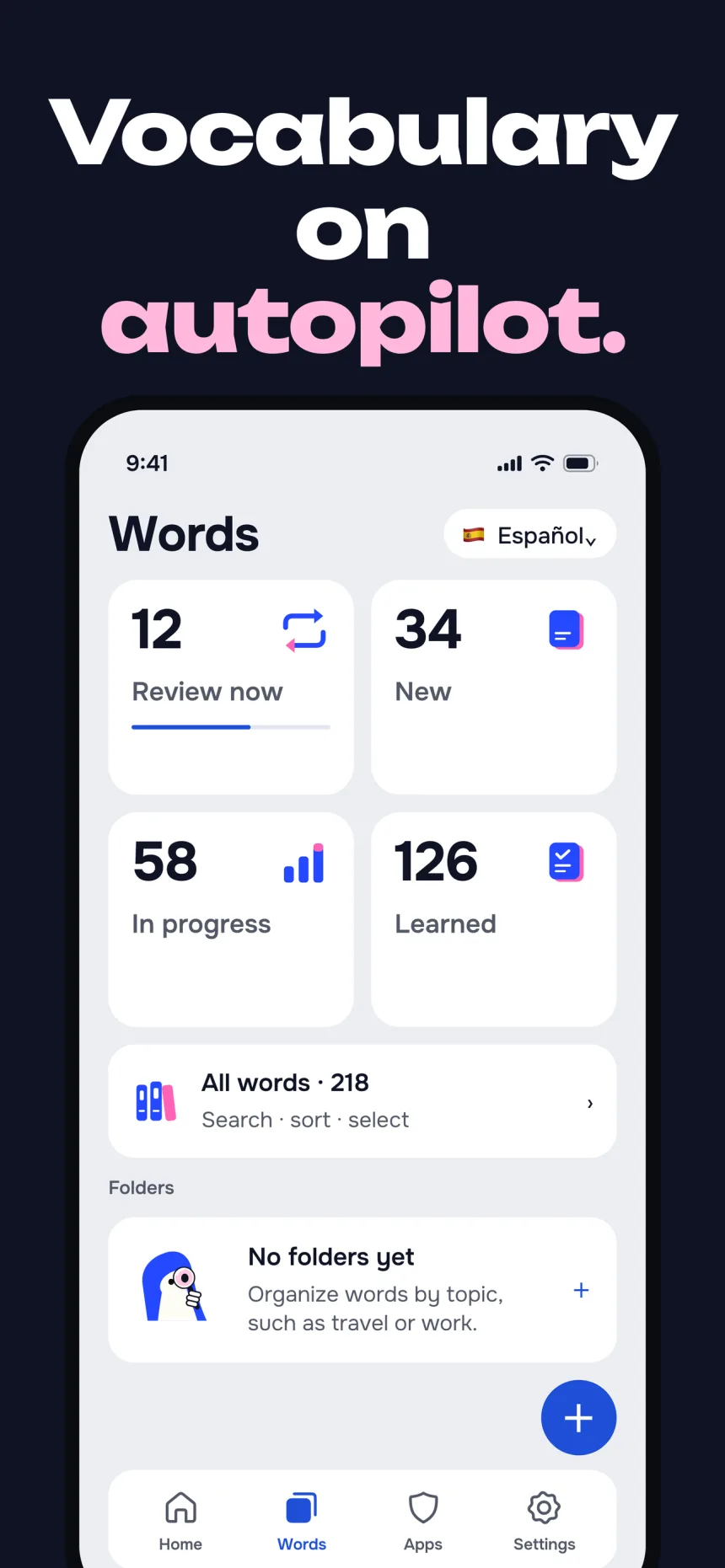
LearnScreen works on the layer age limits least: vocabulary, reviewed in short spaced moments. It does not teach accent or pronunciation, and it has no audio.
A word card instead of the feed
Through Apple’s Screen Time API, LearnScreen blocks the apps you choose. Opening one shows a vocabulary card first; answer it and the app unlocks for a while, from 15 minutes up to a few hours depending on your settings, then locks again by itself.
Spaced by SM-2
Reviews follow the SM-2 spaced-repetition schedule: first after 1, 3 and 9 days, then at intervals multiplied by an ease factor. A word counts as learned once its interval reaches 21 days. The schedule follows your answers, not your age.
Curated words, plus your own
Each of the 11 languages comes with 1,080 curated words in 18 topic directories, and you can add your own words without limit, such as the ones from your course or your job.
- Eleven languages. English, German, Spanish, French, Italian, Japanese, Korean, Polish, Brazilian Portuguese, Russian and Chinese.
- No extra study slot. Reviews happen when you open an app you blocked, so they do not depend on finding free time in a busy week.
- Offline, no account. Cards and blocking work without a connection; the optional backup goes to your own iCloud.
- 7-day free trial. After the trial, LearnScreen is a monthly or annual subscription; the App Store shows the price in your currency.



Related reading
- How many words do you need to speak a language? — the vocabulary sizes behind each level.
- How many minutes a day does it take to learn a language? — the daily-time side of the hours above.
- Which words should you learn first? — where an adult’s limited hours go furthest.
- How to be consistent learning a language — what keeps practice going in an adult schedule.
- Why do I forget vocabulary I’ve already learned? — forgetting is about spacing, not age.
- Do language learning apps actually work? — what an app can and cannot cover.
Frequently asked questions
Sources
- Hartshorne, J. K., Tenenbaum, J. B., & Pinker, S. (2018). A critical period for second language acquisition: Evidence from 2/3 million English speakers. Cognition, 177, 263–277.
- Johnson, J. S., & Newport, E. L. (1989). Critical period effects in second language learning: The influence of maturational state on the acquisition of English as a second language. Cognitive Psychology, 21(1), 60–99.
- Snow, C. E., & Hoefnagel-Höhle, M. (1978). The critical period for language acquisition: Evidence from second language learning. Child Development, 49(4), 1114–1128.
- Flege, J. E., Munro, M. J., & MacKay, I. R. A. (1995). Factors affecting strength of perceived foreign accent in a second language. Journal of the Acoustical Society of America, 97(5), 3125–3134.
- Abrahamsson, N., & Hyltenstam, K. (2009). Age of onset and nativelikeness in a second language: Listener perception versus linguistic scrutiny. Language Learning, 59(2), 249–306.
- Brysbaert, M., Stevens, M., Mandera, P., & Keuleers, E. (2016). How many words do we know? Practical estimates of vocabulary size dependent on word definition, the degree of language input and the participant’s age. Frontiers in Psychology, 7, 1116.
- Hartshorne, J. K., & Germine, L. T. (2015). When does cognitive functioning peak? The asynchronous rise and fall of different cognitive abilities across the life span. Psychological Science, 26(4), 433–443.
- U.S. Department of State, Foreign Service Institute. Foreign Language Training: NFATC’s experience with language learning. Accessed 2026-10-28. Page
- Cepeda, N. J., Pashler, H., Vul, E., Wixted, J. T., & Rohrer, D. (2006). Distributed practice in verbal recall tasks: A review and quantitative synthesis. Psychological Bulletin, 132(3), 354–380.
- Reviews.org (2026). Cell Phone Usage Stats. Survey of ~1,000 US adults, fielded Q4 2025. Report
Four limits apply to these numbers. Hartshorne and colleagues measured English grammar with an online quiz, not speaking or vocabulary. Johnson and Newport tested 46 people, so their post-puberty result is a pattern, not a precise curve. The FSI figures are for full-time courses aimed at professional level, not for casual learners. And the vocabulary growth figures describe native speakers’ first language; they show that word learning continues with age, not how fast a second language grows. Where this page applies a finding to your situation, that is an inference.
It isn’t too late. Start with the words.
Vocabulary is the part age limits least. LearnScreen reviews it on the screens you already open.
Download on the App Store