Should you change your phone’s
language to learn a language?
Yes for the interface, no for the vocabulary you actually want. A phone UI is a closed set of a few hundred fixed strings, and habituation reliably drains attention from a repeated, unchanging stimulus (Rankin et al., 2009) — within a week you navigate by shape, not by reading. What is left is form recognition, the weakest link in the vocabulary hierarchy (Laufer & Goldstein, 2004). The instinct is right about the surface: the phone gets checked about 186 times a day (Reviews.org, 2026). It is wrong about the material.
Every figure on this page is referenced at the end
What switching your phone’s language actually teaches
Almost everyone learning a language tries this, and the reasoning behind it is sound: the phone is the object you touch most, so translating it should put the language everywhere. The honest way to evaluate it is to stop asking whether it “works” and ask what kind of exposure each part of a translated phone produces — because vocabulary research is unusually specific about which kinds of exposure produce which kinds of knowledge.
One caveat first, and it belongs at the top rather than in a footnote: no study has measured device-language switching for vocabulary gain. Every row below applies published findings about the type of exposure the switch creates. That is weaker than a trial and considerably stronger than a hunch.
| What changes | What kind of exposure it is | What that produces |
|---|---|---|
| Menus, buttons, settings labels | High frequency, fixed position, and a closed set of a few hundred strings that never grows | Fast recognition of those exact words in that exact place, and almost no ability to produce them anywhere else |
| System notifications and alerts | Formulaic phrases, read at a glance, under mild time pressure | Whole-phrase recognition — 3 nouveaux messages registers as one unit and is rarely broken into its parts |
| The keyboard, autocorrect, dictation | Output support: the system offers the word and you accept it | Genuine help with spelling and accents, and no retrieval practice, because the form arrives before you have to produce it |
| What is inside your apps | Unchanged. The OS language setting does not translate feeds, messages or articles | Nothing — and this is the part where the actual language would have been |
| Error and confirmation dialogs | Rare, high stakes, read once and acted on immediately | Two or three verbs learned properly through consequence, plus a real chance of tapping the wrong one |
The set is small, and more importantly it is closed. Nation’s (2006) coverage figures describe word families in running text; a phone interface is not running text. It is a fixed lexicon of labels, and a well-designed one is something you learn to navigate by position long before you read it by word.
Three claims travel under “just change your phone language”
They rest on completely different evidence, which is why the advice sounds obviously true and slightly suspicious at the same time. Only the first is well supported.
- The supported one: you will learn the interface. This genuinely happens, and quickly. A few dozen to a few hundred word types — system nouns, imperative verbs, a handful of set phrases — become automatic within days, because you meet each of them many times a day in the same place. It is a real gain in a narrow band, and useful mostly if you ever have to give someone tech support in that language.
- The overstated one: this is immersion. Immersion in the research sense means comprehensible input at volume. Horst, Cobb and Meara (1998) measured incidental vocabulary gains from reading an entire graded novel, and even at that volume the pickup was partial rather than wholesale. A phone interface offers no narrative, no new words after the first week, and no context beyond the button you are about to press. It changes the wrapper on your day, not the amount of language in it.
- The false one: you will absorb the language without studying. What decides whether an encounter is remembered is the orienting task, not the exposure. Hyde and Jenkins (1973) had people process the same word lists for meaning or for surface features and found far better recall after semantic processing. Hunting for a button is a surface task by definition: you are processing position and shape, and the word is what you skip past on the way.
What exposure on its own can and cannot buy has a page of its own: does passive learning actually work?
What the switch costs after the first week
The first three days are genuinely instructive, which is why the advice keeps getting passed on — everybody who tries it has evidence it works. Then six mechanisms quietly switch the setting off in your head while leaving it on in your phone. None of them is about effort, which is the part worth noticing.
| The limit | What the evidence says | What it looks like |
|---|---|---|
| Habituation | Rankin et al. (2009): responding to a repeated, unchanging stimulus declines reliably — one of the most conserved behaviours in biology | Day one you read Ajustes. Day ten you tap a grey gear in the third row and read nothing at all |
| Fixed-position blindness | Benway (1998): people miss information placed in predictable screen positions even while actively searching for it | An interface is the most position-stable content you own, which makes it the easiest to stop seeing |
| A surface-level orienting task | Hyde & Jenkins (1973): recall was far better after processing words for meaning than after processing the same words for form | Your task is get to the camera. It is never what does this word mean |
| A closed vocabulary set | Nation (2006): covering everyday spoken language takes thousands of word families, not hundreds of labels | You cannot add a word to your phone’s interface, so the curve flattens in about a week |
| No retrieval attempt | Roediger & Karpicke (2006): being tested on material beat restudying it for long-term retention | Every label is an answer shown to you, and never once a question asked of you |
| No control over spacing | Cepeda et al. (2006), across 254 studies: roughly 47% recall for spaced practice against 37% for massed | What you see is decided by which screen you needed, so the words you keep forgetting never come back on purpose |
Notice what is absent from that list: difficulty. Nothing here fails because it is too hard. It fails because it becomes too easy to stop noticing — which is precisely what you want from a phone interface, and precisely wrong for a teaching surface.
The frequency is right. The material is wrong.
The instinct behind the switch deserves to be kept, because it identifies something no study designer would have handed you. Americans check their phones about 186 times a day, roughly 11.6 times per waking hour (Reviews.org, 2026). Nothing else in an ordinary day — no class, no commute, no book — recurs at that rate. Set that against what a word costs: Nation and Wang (1999) put the encounters needed to pick a word up from context somewhere in the range of five to twenty, and Webb (2007) showed word knowledge growing gradually across repetitions rather than arriving at one. That is a frequency budget the phone can settle in a day and a classroom cannot settle in a month. The switch spots the right surface.
What it cannot do is change what it shows. That is the whole failure, and it is worth stating plainly because it is not a failure of the phone: it is a failure of the setting. A teaching surface has to be able to put a different word in front of you tomorrow, and a system language toggle has exactly one lexicon, chosen by an engineering team for clarity rather than for coverage. Three hundred labels, met two hundred times a day, is not two hundred learning events. After the first week it is one learning event repeated until it disappears — and the words you actually need for a conversation were never in the set.
The second missing piece is direction. Laufer and Goldstein (2004) tested vocabulary knowledge as a hierarchy of strengths, with recognising a written form at the weak end and producing the word from its meaning at the strong end. A translated label always hands you the form first — that is what a label is. So even at 186 encounters a day you are rehearsing the weakest link, on the smallest possible set of words, with no attempt at recall to convert any of it. Whatever is never retrieved decays on the ordinary curve (Murre & Dros, 2015), and this is the reason so many people report a phone in Spanish for two years and no Spanish: active versus passive vocabulary, at 186 repetitions a day, still on the passive side.
Keep the surface. Replace the material.
If the frequency is the good idea and the fixed lexicon is the bad one, the fix follows: keep everything the phone already supplies for free, and replace the one part a setting cannot change. Four properties are worth naming, because the first three are what make the phone attractive in the first place and the fourth is why nobody loses anything by trying.
Only the first row survives a device-language switch, and only barely.
| What the phone already gives you | Why it matters | What it still needs |
|---|---|---|
| Frequency — about 186 pickups a day | Nation & Wang (1999); Webb (2007): a word needs repeated, spaced meetings before it stays | Material that can change, so the encounters land on the words you are actually learning |
| Zero decision cost | The step self-study loses people at is deciding to start, not the studying itself | A review that arrives, rather than an app that waits to be opened |
| A moment of attention already spent | The unlock is an interruption you have already made, so nothing new has to be interrupted | A question rather than a label — the answer withheld until you commit to one |
| Reversibility | You can undo a phone setting in ten seconds, which is why it is such a low-risk thing to try | A schedule that decides what returns, so retention stops depending on you remembering (Cepeda et al., 2006) |
None of this argues for more effort. Every row is about moving work off the learner: the phone supplies the frequency and the moment, and the schedule supplies the judgement about what to show. The only thing asked of you is the six seconds in which you try to remember a word.
The same surface, with material that can change
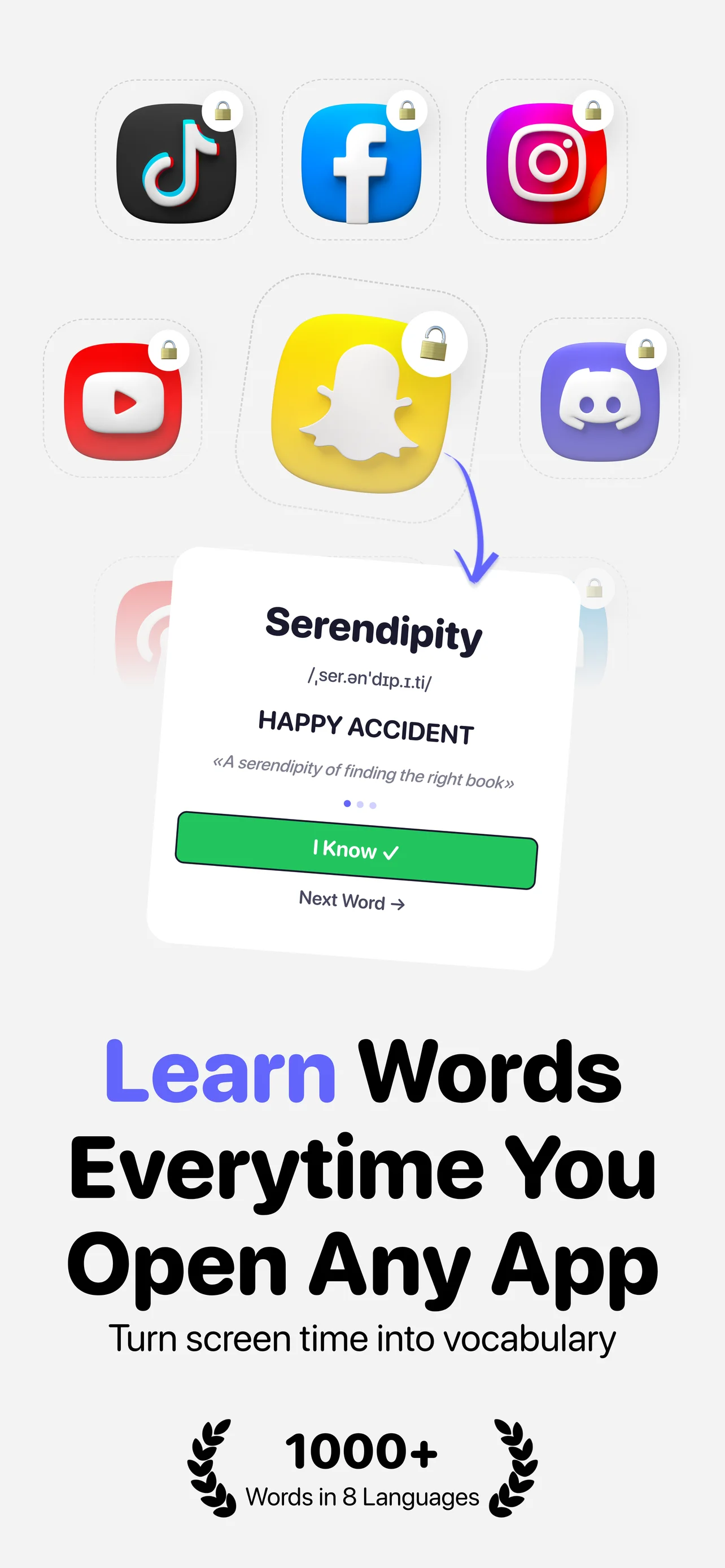
That is the gap LearnScreen was built for. Your phone keeps whatever language you can actually navigate; the learning happens on the surface you were already looking at, with words that move.
The trigger is a pickup you already made
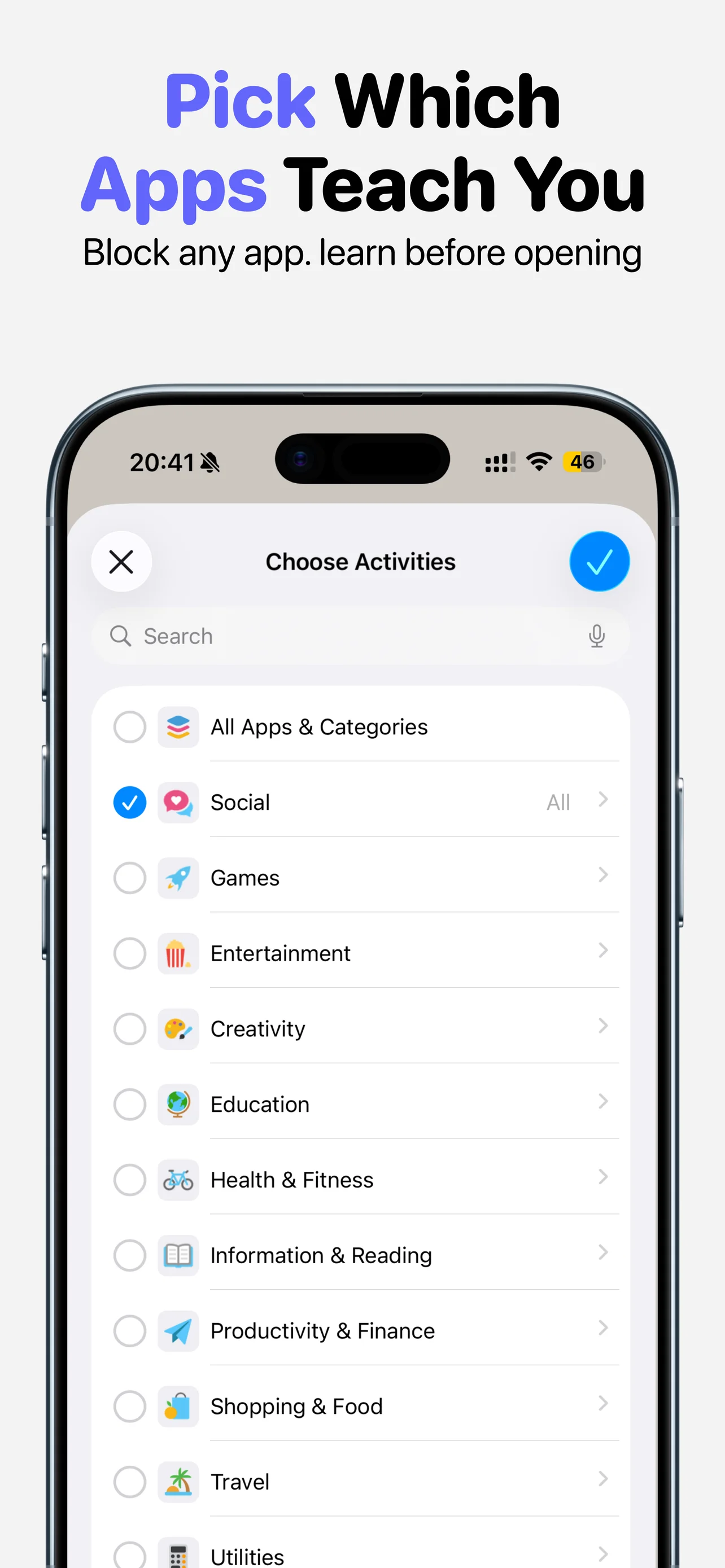
Using Apple’s Screen Time API, LearnScreen shields the apps you choose and puts a vocabulary card where the feed would have been. No session gets scheduled, because the moment was already happening — the same insight that makes people translate their menus, pointed at content that can be different tomorrow.
Every card is a question, not a label
The answer stays hidden until you tap, so each encounter is a retrieval attempt rather than a reading. That is the direction Laufer and Goldstein (2004) rank strongest, and the one Roediger and Karpicke (2006) found beat restudying — the single thing a translated interface can never do.
A Leitner schedule decides what returns
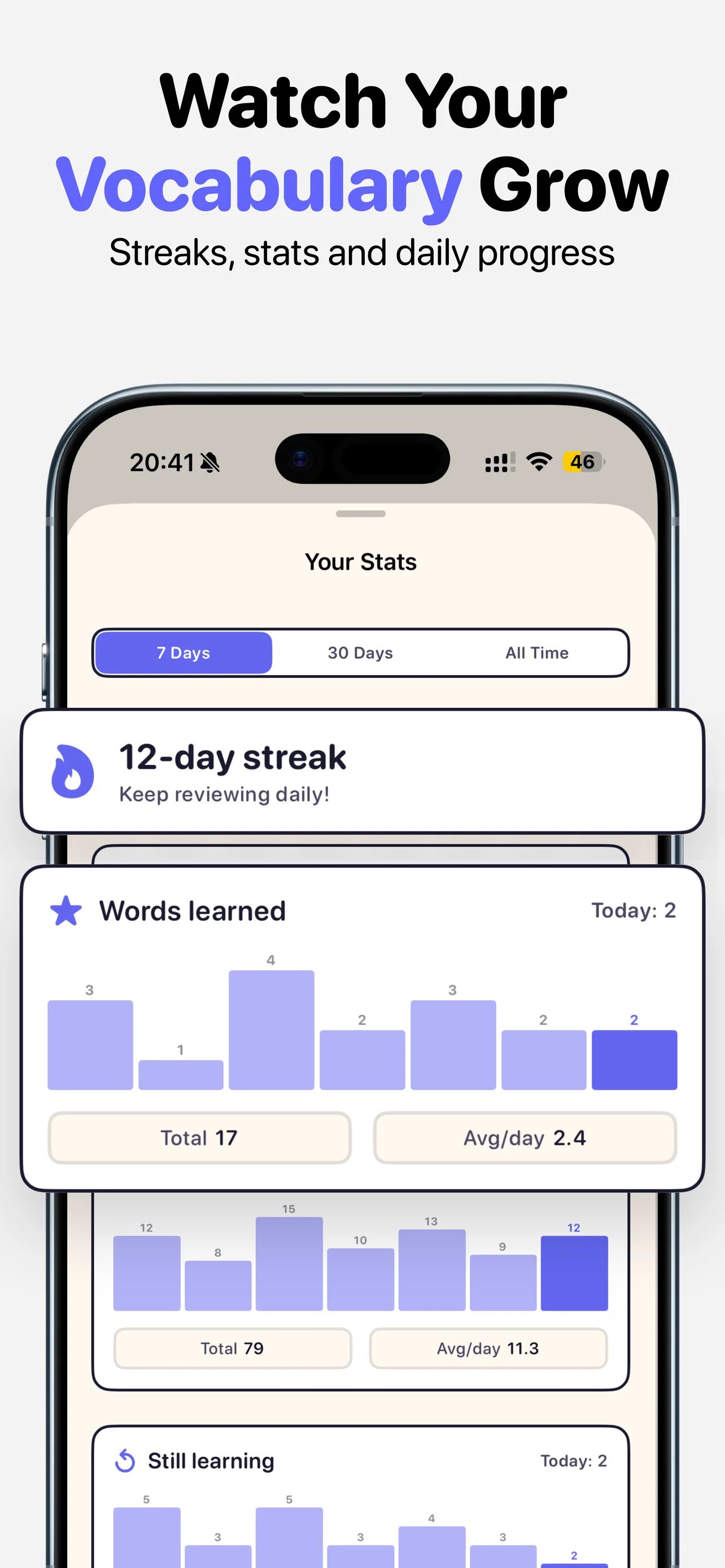
Words you miss come back sooner, words you get right back off geometrically. What appears is chosen by how well you know it rather than by which settings screen you happened to open, which is the part the spacing research (Cepeda et al., 2006) says does the work.
- You set the dose. Words per session adjust from 3 to 20, as does how often the shield returns. The defaults come to roughly 25 recall attempts a day — about two and a half minutes spread across it, small enough that nothing else in the day has to be cancelled.
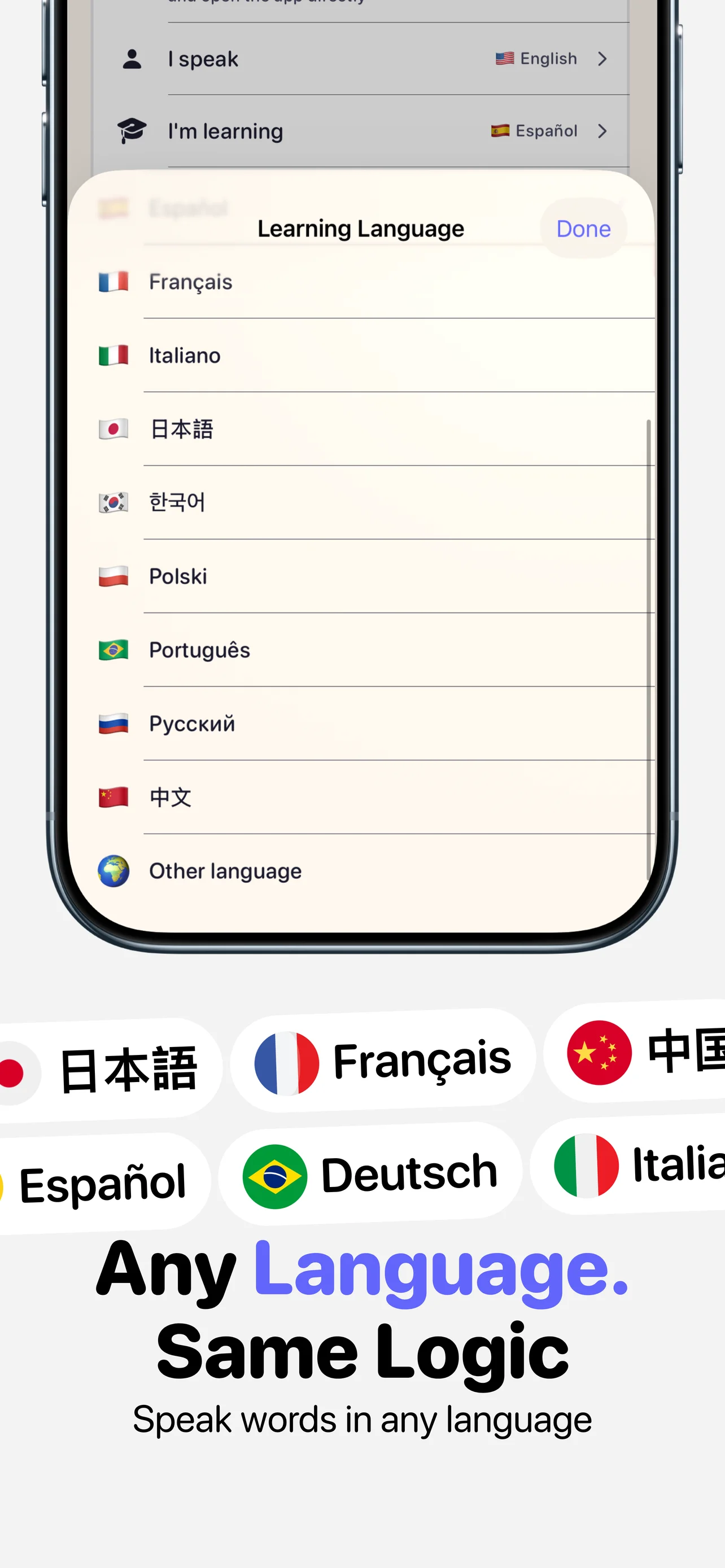
- Your phone’s own language stays yours. Nothing here asks you to navigate a settings menu you cannot read. The learning surface is separate from the operating system, which also means it is reversible without hunting for a language picker in a script you do not know.
- Frequency-ordered lists, or your own words. 1,080+ curated words across 18 topics in 11 languages, starting where coverage is cheapest (Nation, 2006), and anything you add or paste in bulk joins the same queue — which words to learn first.
- It works offline, with no account. Cards and shields run without a network once installed; iCloud backup writes to your own private database rather than our servers, and there is nothing to sign up for.
Related reading
- Does passive learning actually work? — what exposure alone delivers, measured, and where it stops.
- Can you learn while doing something else? — which half of learning survives a divided attention.
- Active vs passive vocabulary — why recognising a label is the weakest thing you can do with a word.
- Why do I forget vocabulary I’ve already learned? — what happens to a word between encounters.
- How often should you review vocabulary? — the intervals a fixed interface can never supply.
- Do language learning apps actually work? — the efficacy evidence for the whole category.
Frequently asked questions
Sources
- Laufer, B., & Goldstein, Z. (2004). Testing vocabulary knowledge: Size, strength, and computer adaptiveness. Language Learning, 54(3), 399–436.
- Hyde, T. S., & Jenkins, J. J. (1973). Recall for words as a function of semantic, graphic, and syntactic orienting tasks. Journal of Verbal Learning and Verbal Behavior, 12(5), 471–480.
- Rankin, C. H., Abrams, T., Barry, R. J., Bhatnagar, S., Clayton, D. F., Colombo, J., et al. (2009). Habituation revisited: An updated and revised description of the behavioral characteristics of habituation. Neurobiology of Learning and Memory, 92(2), 135–138.
- Benway, J. A. (1998). Banner blindness: The irony of attention grabbing on the World Wide Web. Proceedings of the Human Factors and Ergonomics Society Annual Meeting, 42(5), 463–467.
- Roediger, H. L., & Karpicke, J. D. (2006). Test-enhanced learning: Taking memory tests improves long-term retention. Psychological Science, 17(3), 249–255.
- Cepeda, N. J., Pashler, H., Vul, E., Wixted, J. T., & Rohrer, D. (2006). Distributed practice in verbal recall tasks: A review and quantitative synthesis. Psychological Bulletin, 132(3), 354–380.
- Nation, I. S. P., & Wang, K. (1999). Graded readers and vocabulary. Reading in a Foreign Language, 12(2), 355–380.
- Webb, S. (2007). The effects of repetition on vocabulary knowledge. Applied Linguistics, 28(1), 46–65.
- Horst, M., Cobb, T., & Meara, P. (1998). Beyond A Clockwork Orange: Acquiring second language vocabulary through reading. Reading in a Foreign Language, 11(2), 207–223.
- Nation, I. S. P. (2006). How large a vocabulary is needed for reading and listening? Canadian Modern Language Review, 63(1), 59–82.
- Nation, I. S. P. (2007). The four strands. Innovation in Language Learning and Teaching, 1(1), 2–13.
- Murre, J. M. J., & Dros, J. (2015). Replication and analysis of Ebbinghaus’ forgetting curve. PLOS ONE, 10(7), e0120644.
- Reviews.org (2026). Cell Phone Usage Stats. Survey of ~1,000 US adults, fielded Q4 2025. Report
The honest limit of this page is stated where it matters most: no published study has measured device-language switching as a vocabulary intervention. Everything above reasons from research on the kind of exposure it produces — habituation, orienting tasks, retrieval practice, spacing and incidental pickup from reading — all of which were measured on other materials. The effect sizes in that literature are moderate and the studies are mostly short. Treat the conclusion as well-grounded reasoning rather than a trial result, and treat any claim that a settings toggle teaches you a language as having no evidence behind it at all.
Keep the frequency. Change what it shows.
You were right that the phone is the place. LearnScreen puts a word you are actually learning on the screen you were already unlocking, hides the answer until you try, and lets you keep your menus in a language you can read.
Download on the App Store