Do flashcards work for
language learning?
Yes, as long as each card makes you recall the answer and keeps coming back at growing gaps. Across 22 studies of word-focused activities such as flashcards and word lists, learners recalled the meaning of 60% of target words right after study and 39% on delayed tests (Webb, Yanagisawa & Uchihara, 2020); words met only while reading or listening were picked up at 6–17% (Webb, Uchihara & Yanagisawa, 2023). How the cards are used decides the rest: students who stopped testing themselves on pairs they already knew recalled about a third of them a week later, against 80% for those who kept testing (Karpicke & Roediger, 2008).
Every number is sourced at the bottom of the page

What the flashcard studies actually measured
The question has been tested directly, mostly with word pairs: a foreign word on one side, its meaning on the other. The six studies below either pooled dozens of experiments or changed one thing about how the cards were used and measured recall days later.
Read the first two rows together. They are the closest thing the research has to a head-to-head: deliberate study of chosen words against picking words up from input.
| What was tested | Study and sample | Measured result |
|---|---|---|
| Deliberate word study: flashcards, word lists, writing, fill-in-the-blank | Webb, Yanagisawa & Uchihara (2020): meta-analysis, 22 studies, 100 effect sizes | Meaning recall 60.1% right after, 39.4% on delayed tests; producing the word: 58.5% then 25.1% |
| Picking up new words from reading, listening or viewing | Webb, Uchihara & Yanagisawa (2023): meta-analysis, 24 studies, 2,771 participants | 9–18% of target words right after, 6–17% on delayed tests; viewing alone 7% |
| Testing pairs again after the first correct recall, or dropping them from testing | Karpicke & Roediger (2008): 40 Swahili–English word pairs, final test after one week | About 80% recalled with repeated testing; 36% and 33% when pairs were dropped from testing, even with restudy |
| One large stack against four small stacks, and against cramming | Kornell (2009): three experiments, GRE-type English word pairs | Spacing beat massing for 90% of participants; after the first session, 72% believed massing had worked better |
| Spaced against massed practice in second-language learning | Kim & Webb (2022): meta-analysis, 48 experiments, 3,411 learners | Medium-to-large benefit of spacing; longer gaps beat shorter ones on delayed tests; equal and expanding gaps did equally well |
| Letting learners set aside cards they think they know | Kornell & Bjork (2008): four flashcard experiments | Dropping cards had small but consistently negative effects on learning |
The first two rows are not a like-for-like race. Deliberate-study experiments test a small set of target words shortly after study; incidental studies count words picked up from a text that was not built around them. The gap is wide enough to show which way the evidence points, but treat it as a direction, not a precise ratio.
Three things people believe about flashcards
Most arguments about flashcards are about one of three claims. One is wrong, one is oversimplified, and one is right but leaves out the part that decides what kind of word knowledge you end up with.
- Wrong: “flashcards are rote memorisation that does not stick.” On delayed tests learners still recalled the meaning of 39.4% of deliberately studied words, several times the 6–17% picked up from input in the incidental meta-analysis. What a card cannot teach is how a word behaves in a sentence: collocations, register, grammar. That comes from reading and listening, so cards and input do different jobs rather than competing for the same one.
- Oversimplified: “any flashcard habit works.” Across activities, immediate gains ranged from 18.4% to 77.0% (Webb, Yanagisawa & Uchihara, 2020), and recall of the word form fell from 58.5% to 25.1% by the delayed test. Dropping pairs from testing once they had been recalled cut week-later recall from about 80% to 33–36% (Karpicke & Roediger, 2008). The method is fine; most habits around it are not.
- Right but incomplete: “spaced repetition makes cards work.” Spacing has a medium-to-large effect on second-language learning (Kim & Webb, 2022). But spacing does not choose the direction of the card. Japanese learners of English who practised producing the English word gained more across orthography, syntax and meaning than those who only recognised it; recognition practice won only on recognising the meaning (Webb, 2009).
For what a card cannot teach and a sentence can, see should you learn words in context or as a list?
Five flashcard mistakes, and what the studies found
Each row below is a habit the research has measured. In most of them the learner felt the habit was working while it was lowering week-later recall.
| Habit | What the study found | What to do instead |
|---|---|---|
| Retiring a card after the first correct answer | Dropping pairs from testing: about a third recalled a week later, against 80% with repeated testing (Karpicke & Roediger, 2008); letting learners drop cards they felt they knew hurt learning slightly but consistently across four experiments (Kornell & Bjork, 2008) | Keep the card in rotation and let the gap grow each time you get it right |
| Reviewing a small stack over and over in one sitting | Four small stacks lost to one large stack for 90% of learners (Kornell, 2009); with spacing held equal, stack size itself made little difference (Nakata & Webb, 2016) | Watch the gap between two views of the same card, not the size of the pile |
| Cramming the night before | Spacing beat last-day cramming in Kornell (2009); longer gaps beat shorter ones on delayed tests in 48 experiments (Kim & Webb, 2022) | Spread the same number of reviews over the days you have |
| Flipping the card before trying to answer | Recall attempts, not re-reading, produced the 80% (Karpicke & Roediger, 2008); practice testing is one of two techniques of ten rated high utility (Dunlosky et al., 2013) | Say or type the answer first, then turn the card |
| Only ever going from the foreign word to its meaning | Producing the word gave larger gains across more kinds of word knowledge than recognising it (Webb, 2009); producing the form fell to 25.1% on delayed tests (Webb, Yanagisawa & Uchihara, 2020) | Add the reverse direction for words you want to say or write, ideally typed |
What sets the gaps between reviews, and how long they should grow: how often should you review vocabulary?
Why flashcards work, and why they feel like they do not
A flashcard works because answering it is itself a learning event. In Karpicke and Roediger’s (2008) experiment every group reached near-perfect scores during study, so the learning curves looked identical. The difference appeared a week later and tracked one variable: whether a pair kept being retrieved after it was first recalled. Restudying the answer did not make up for it.
The catch is that learners cannot feel this. Students in all four conditions predicted they would remember about half the pairs, whatever they had done. In Kornell (2009) 72% judged massing more effective after the first session, though spacing won for 90% of them. A survey of 374 undergraduates found that students understood the value of practising until they were right, but neither used nor understood longer gaps between reviews (Wissman, Rawson & Pyc, 2012). The habit that feels productive, a small stack until every card is easy, is the one that tests worst.
That is why reviews of learning techniques rate the method highly when it is used properly. Dunlosky and colleagues (2013) assessed ten study techniques and gave a high utility rating to two, practice testing and distributed practice. A flashcard answered before it is turned, and brought back at growing gaps, is both of them at once.
How to set up your cards for what you want to do
The right card depends on what the word is for. Understanding a film and saying the word in conversation are different skills, and the research shows that cards mostly train the direction you practise.
If you only have time for one change, add a recall step before every flip. It costs a second per card and it is the variable behind the 80%.
| Goal | Card format | Why |
|---|---|---|
| Understand words when reading and listening | Foreign word first; recall the meaning before turning | Recognition practice gave the largest gain in recognising meaning (Webb, 2009) |
| Say and write the words yourself | Meaning first; produce the foreign word, typed if possible | Producing the word lifted more kinds of knowledge (Webb, 2009); the form is what fades fastest (25.1% delayed) |
| A test in two weeks | All cards in one deck, reviewed a little every day rather than all on the last day | Spacing beat cramming for 90% of learners (Kornell, 2009) |
| A vocabulary that lasts for months | Keep known cards in rotation with gaps that keep growing | Longer gaps win on delayed tests (Kim & Webb, 2022); dropping known pairs cost more than half the week-later recall (Karpicke & Roediger, 2008) |
These are applications of the studies above, not a tested programme: most of the experiments used university students and short lists of word pairs. The direction of each effect has replicated; the exact sizes will differ for your words.
Where LearnScreen fits
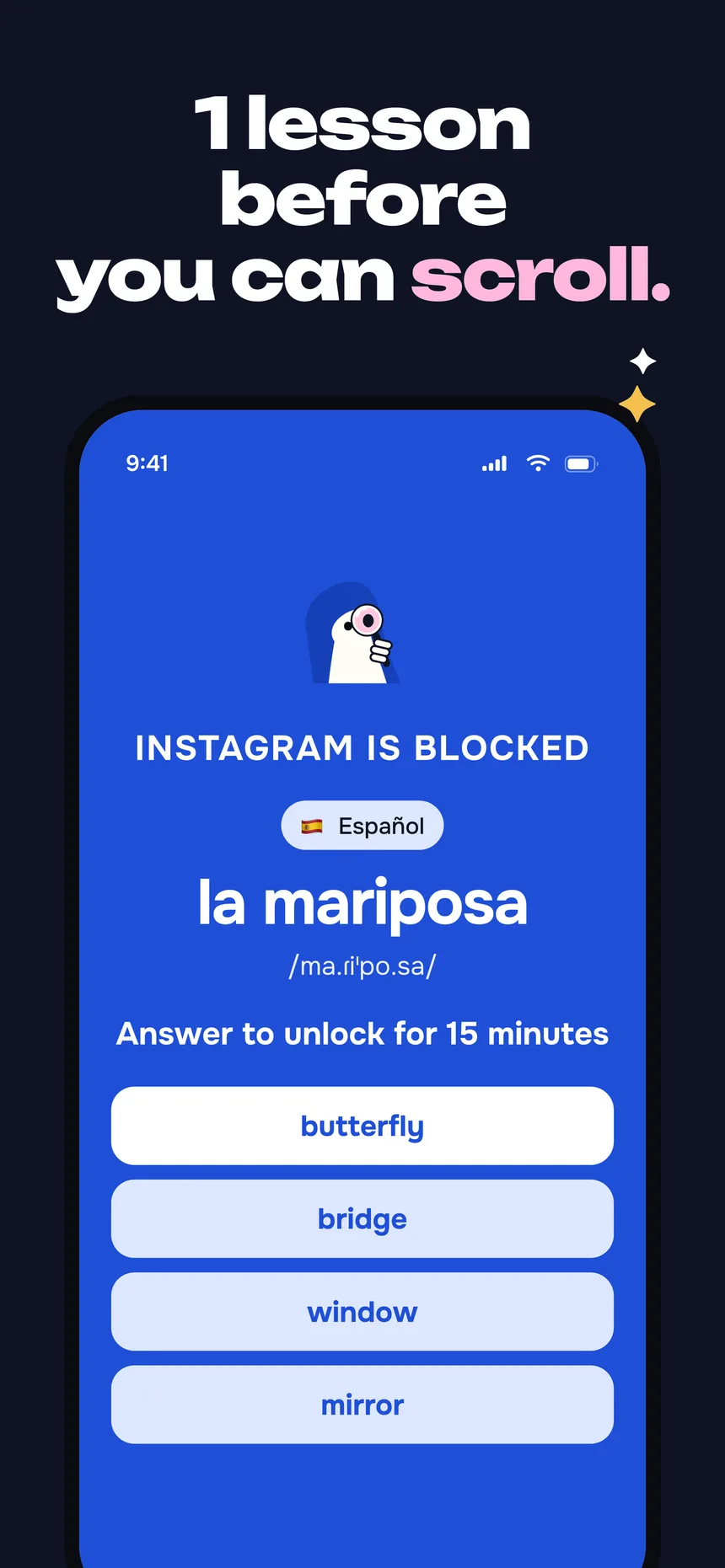
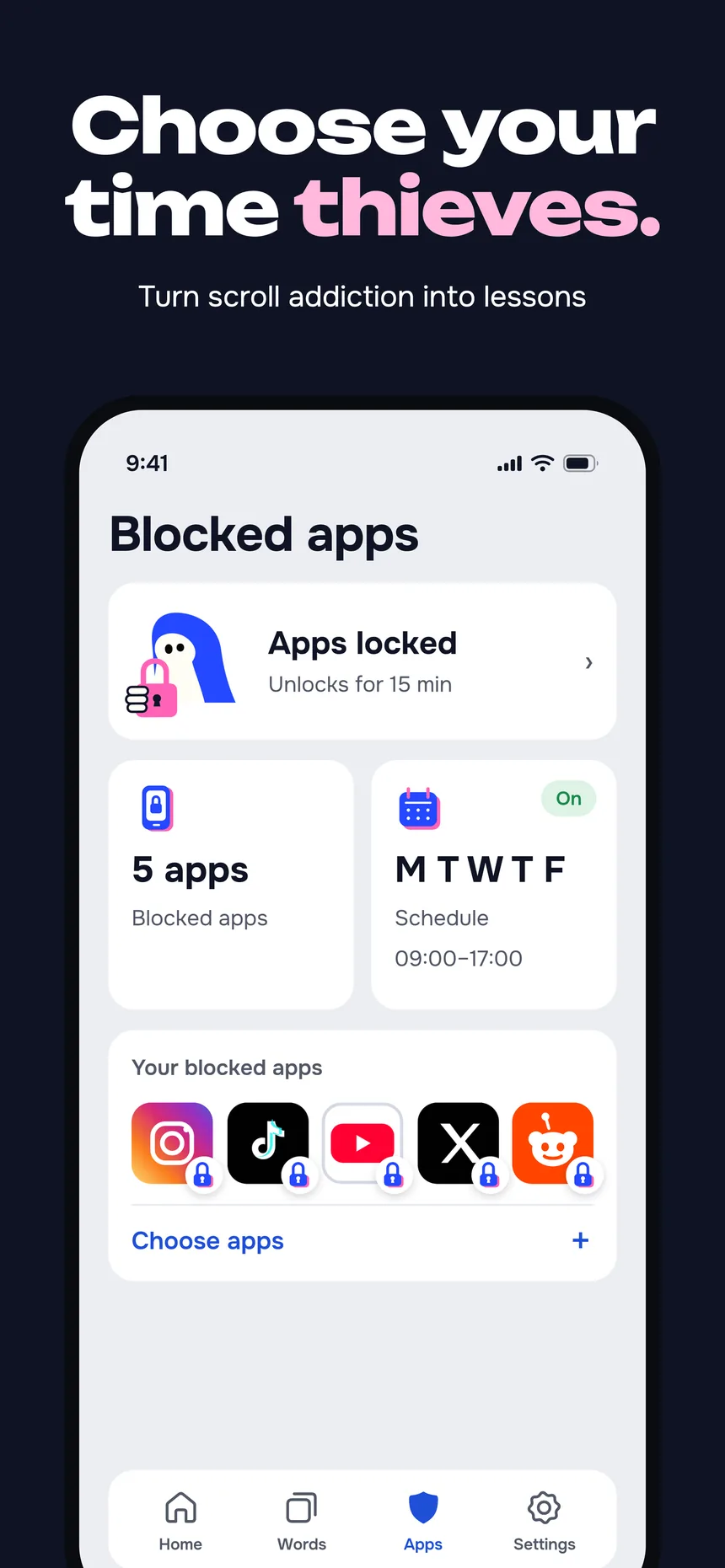
LearnScreen is a flashcard app with an unusual trigger: the card appears when you open an app you chose to block. It does what the table above recommends for retrieval and spacing; reading and listening still have to come from elsewhere.
A card at the pickup
LearnScreen blocks the apps you choose with Apple’s Screen Time API. Opening one shows a vocabulary card with the translation hidden: recall it, tap Show translation, then mark I know or I don’t know. A second mode asks you to pick the right translation from two options. Answer, and the app unlocks for 15 minutes to a few hours, then locks again.
Known words come back later, not never
Scheduling is SM-2 spaced repetition: a word returns after 1, 3 and 9 days, then the gap grows by an ease factor. A word you get right is not retired; it comes back at a longer gap, and counts as learned at a 21-day interval.
Both directions, typed or chosen
In the app’s own review you choose the answer format (pick an answer, type it, or a mix) and the direction (the foreign word first, your language first, or mixed), so the cards can train producing a word, not only recognising it.
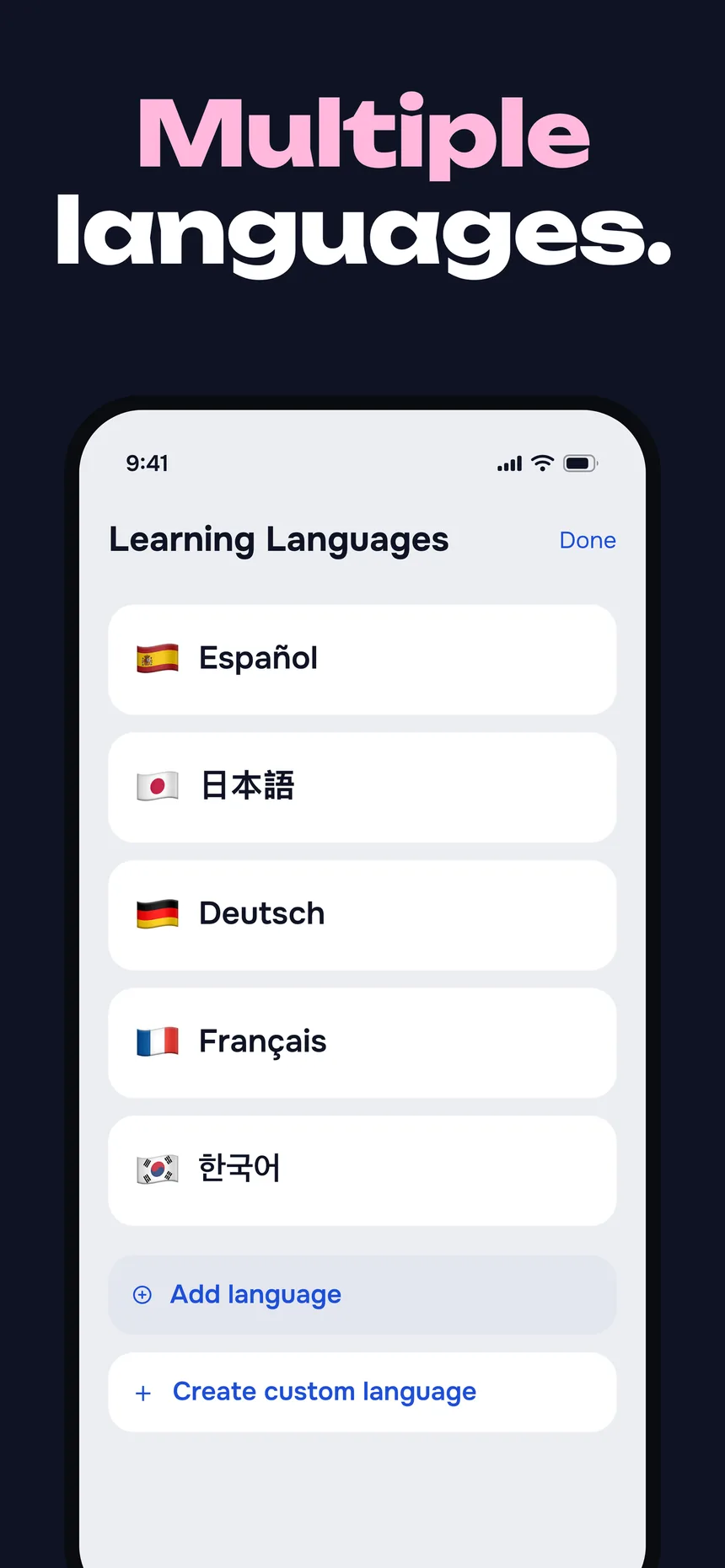
- Eleven languages. English, German, Spanish, French, Italian, Japanese, Korean, Polish, Brazilian Portuguese, Russian and Chinese.
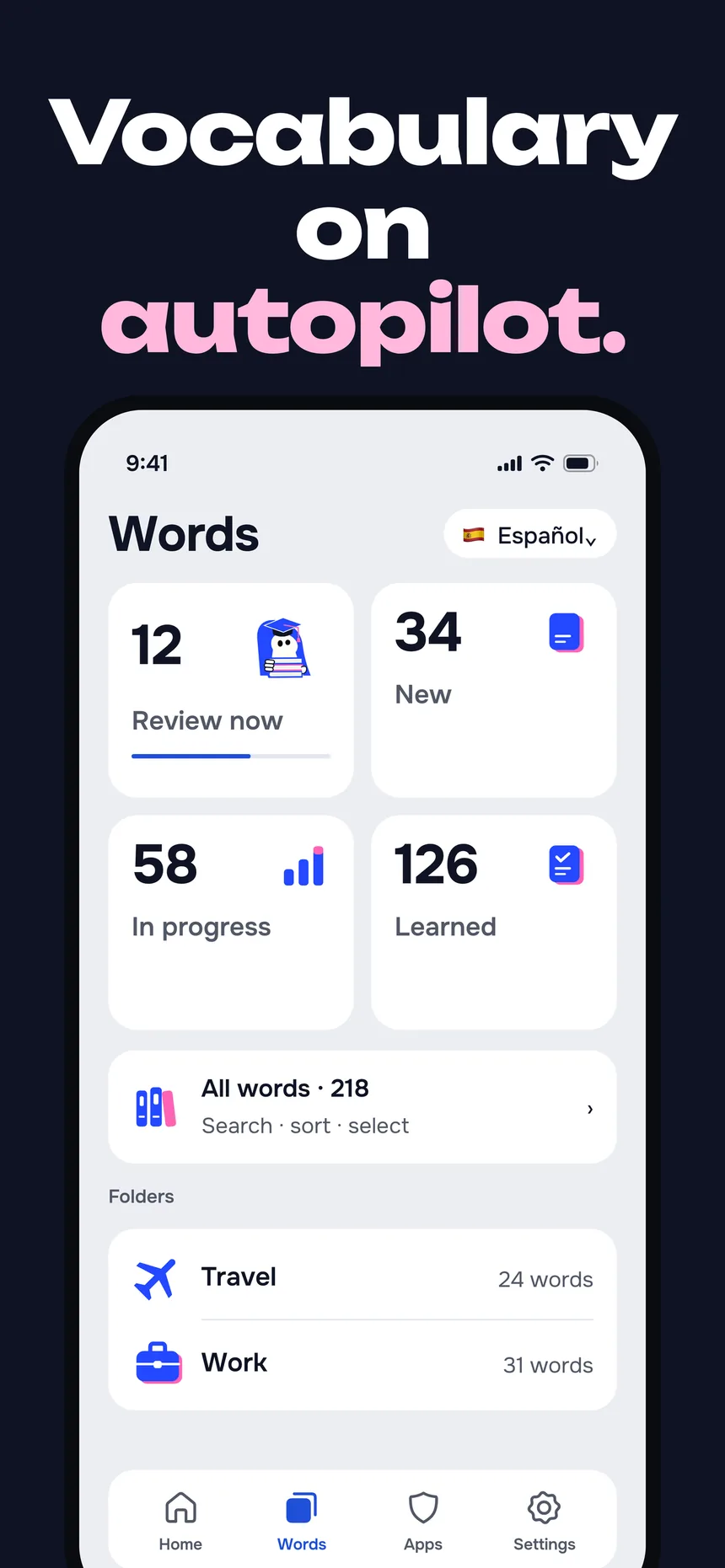
- 1,080 words per language. Curated in 18 topic decks, plus as many words of your own as you want to add.
- Offline, no account. Cards and blocking work without internet; an optional backup goes to your own iCloud.
- 7-day free trial. After that LearnScreen is a monthly or annual subscription; the App Store shows the price in your currency.
Keep reading
- Should you learn words in context? — what a word pair teaches and what only a sentence can.
- How often should you review vocabulary? — the review gaps behind spaced repetition.
- Active vs passive vocabulary — why you understand words you cannot say.
- Why do I forget vocabulary? — the forgetting curve and what slows it.
- How many times to learn a word? — the number of encounters a word needs.
Frequently asked questions
Sources
- Webb, S., Yanagisawa, A., & Uchihara, T. (2020). How effective are intentional vocabulary-learning activities? A meta-analysis. The Modern Language Journal, 104(4), 715–738. DOI
- Webb, S., Uchihara, T., & Yanagisawa, A. (2023). How effective is second language incidental vocabulary learning? A meta-analysis. Language Teaching, 56(2), 161–180. DOI
- Karpicke, J. D., & Roediger, H. L. (2008). The critical importance of retrieval for learning. Science, 319(5865), 966–968. DOI
- Kornell, N. (2009). Optimising learning using flashcards: Spacing is more effective than cramming. Applied Cognitive Psychology, 23(9), 1297–1317. DOI
- Kornell, N., & Bjork, R. A. (2008). Optimising self-regulated study: The benefits—and costs—of dropping flashcards. Memory, 16(2), 125–136. DOI
- Kim, S. K., & Webb, S. (2022). The effects of spaced practice on second language learning: A meta-analysis. Language Learning, 72(1), 269–319. DOI
- Nakata, T., & Webb, S. (2016). Does studying vocabulary in smaller sets increase learning? The effects of part and whole learning on second language vocabulary acquisition. Studies in Second Language Acquisition, 38(3), 523–552. DOI
- Webb, S. (2009). The effects of receptive and productive learning of word pairs on vocabulary knowledge. RELC Journal, 40(3), 360–376. DOI
- Wissman, K. T., Rawson, K. A., & Pyc, M. A. (2012). How and when do students use flashcards? Memory, 20(6), 568–579. DOI
- Dunlosky, J., Rawson, K. A., Marsh, E. J., Nathan, M. J., & Willingham, D. T. (2013). Improving students’ learning with effective learning techniques. Psychological Science in the Public Interest, 14(1), 4–58. DOI
- Sage, K., Rausch, J., Quirk, A., & Halladay, L. (2016). Pacing, pixels, and paper: Flexibility in learning words from flashcards. Journal of Information Technology Education: Research, 15, 431–456. DOI
Three limits on these numbers. Most experiments used university students and short lists of word pairs, tested within days or weeks, not years. The deliberate and incidental meta-analyses measure different things, so the comparison between them shows a direction, not a ratio. And Kornell (2009) used English GRE vocabulary rather than a foreign language. Where this page turns a result into advice, that is our inference.
Let the cards find you.
LearnScreen puts a vocabulary card in front of the apps you choose, so the reviews spaced repetition asks for happen in moments you already spend on your phone.
Download on the App Store